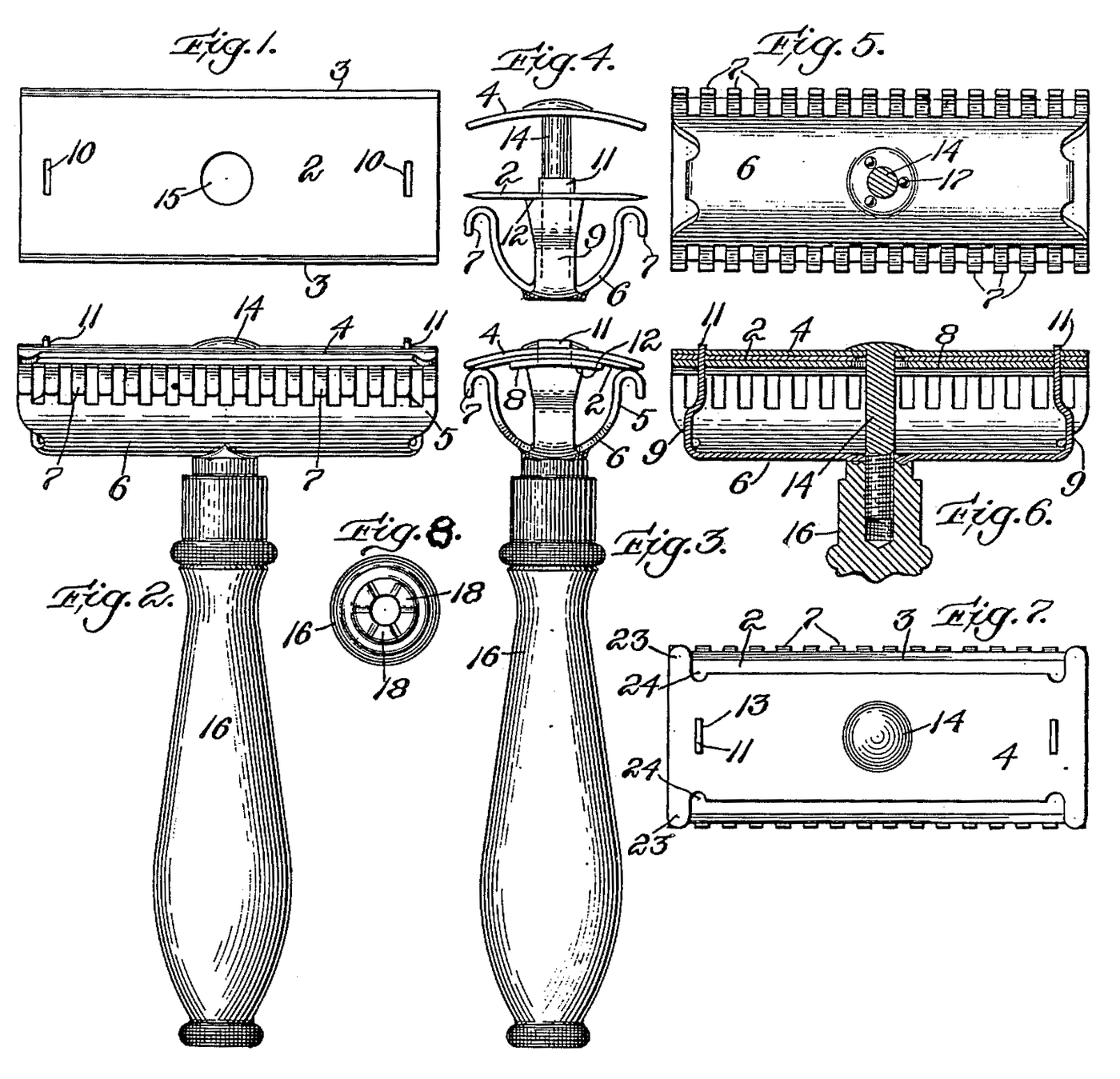


Gillette Safety Razor
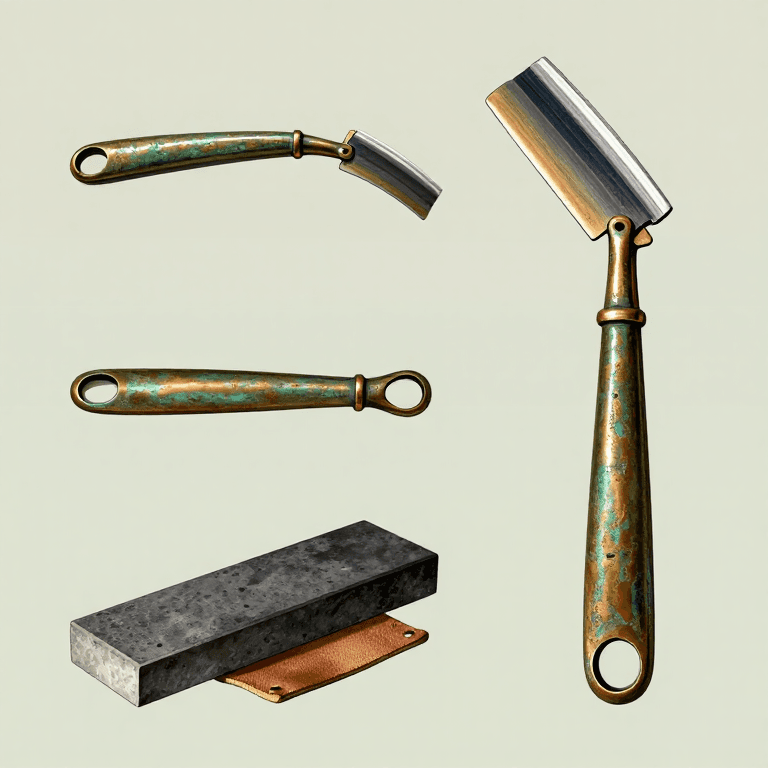
A straight razor is a serious tool. It is honed on a stone, stropped before every use, held at a learned angle, and it will open your face if you get any of that wrong. It also lasts a lifetime.
Gillette's idea was to throw the blade away. Not to make a better edge — to make an edge so cheap that maintaining it was pointless. The razor becomes a holder whose only job is to present a wafer of steel at a fixed angle with a fixed exposure, and the skill that used to live in the user's wrist is moved into the geometry of the head.
US Patent 775,134, filed 3 December 1901 and granted 15 November 1904, claims a "flexible and detachable blade made of sheet-steel" that can be "thrown away when dull". Every part of the design follows from that one sentence — including the business model that came with it.
निर्देश
Handle loose blades as blades, always
Handle loose blades as blades, always
A double-edge blade out of its holder is razor-sharp on both long edges and almost invisible edge-on. Handle only by the short ends, and dispose of used blades in a sealed tin, never loose in a bin.
Read US 775,134 and note what is actually claimed
Read US 775,134 and note what is actually claimed
Gillette claims the combination — a thin flexible blade PLUS a holder that supports and curves it. Neither half is novel alone; the patent is about them working together.
Dismantle a modern double-edge razor
Dismantle a modern double-edge razor
Unscrew the handle and separate cap, blade and base plate. Three parts and one screw — the architecture has barely changed in a hundred and twenty years.
Identify the two numbers that define the head
Identify the two numbers that define the head
Blade exposure is how far the edge stands proud of the line between guard and cap. Blade gap is the space between blade and guard. These two dictate how aggressive the razor is — nothing else does.
आवश्यक उपकरण:
 रूलर
रूलरNotice that the cap is curved, not flat
Notice that the cap is curved, not flat
Tightening the handle bends the flat blade over the cap's curve. That flex is deliberate: it tensions the wafer so it behaves like a rigid edge without being thick.
Cut a base plate and cap from brass
Cut a base plate and cap from brass
Saw two blanks to match the blade's footprint. Brass is right for a first attempt — it files predictably and does not rust while you are still fitting parts.
इस चरण के लिए सामग्री:
 पीतल 260 चादर, 24 गेज1 शीट
आवश्यक उपकरण:
 धातु रेती
File a shallow crown into the cap
File a shallow crown into the cap
Work a gentle convex curve across the cap's underside. A flat cap leaves the blade slack and the razor chatters across the skin.
Cut the safety guard teeth into the base plate
Cut the safety guard teeth into the base plate
File a comb of shallow teeth along the leading edge. The guard is what makes it a SAFETY razor — it holds the skin taut and limits how much can present itself to the edge.
Drill and align the blade locating holes
Drill and align the blade locating holes
Match the holes in a standard double-edge blade so cap, blade and plate stack in register. Misalignment here shows up as one edge shaving and the other not.
आवश्यक उपकरण:
 तारहीन ड्रिल
Turn a handle and cut its thread
Turn a handle and cut its thread
Make the handle long enough to balance the head and thread it to draw the cap down onto the plate. The clamping force is what sets your gap — build the adjustment in.
इस चरण के लिए सामग्री:
 पीतल की गोल छड़1 टुकड़ा
Assemble and measure your actual exposure
Assemble and measure your actual exposure
Lay a straightedge from guard to cap and check where the blade edge sits relative to it. Aim slightly NEGATIVE for a first razor — mild is forgiving, aggressive draws blood.
Test the geometry on a taut balloon, not on skin
Test the geometry on a taut balloon, not on skin
Draw the assembled razor across an inflated balloon at shaving angle. A correctly set head glides; one with too much exposure bursts it immediately.
Understand why the angle is fixed for you
Understand why the angle is fixed for you
With a straight razor the user chooses the angle. Here the cap and guard together define it — you simply rest both on the skin. That transfer of skill from wrist to geometry is the entire product.
Cost out a blade against a hone
Cost out a blade against a hone
Work out the cost per shave of a disposable wafer versus a stone, a strop and the time to learn both. The arithmetic is the reason the straight razor lost.
Compendium — selling the handle to sell the blade
Compendium — selling the handle to sell the blade
The patent. King Camp Gillette filed on 3 December 1901 and was granted US 775,134, "Razor", on 15 November 1904. The specification is unusually blunt about intent: the blade is to be "thrown away when dull" rather than resharpened. Gillette was a travelling salesman for a bottle-cap company, and his employer William Painter had given him the advice that made him rich — invent something people use once and throw away.
The hard part was metallurgy, not design. Gillette had the concept by 1895 and could not make it work for six years, because nobody believed a sheet of steel thin enough to be cheap could be hardened, sharpened and kept flat. Machinists at MIT told him it was impossible. William Nickerson, an MIT-trained engineer, solved the manufacturing — the process for hardening and grinding thin sheet steel at volume — and it is fair to say the razor is Gillette's idea and Nickerson's invention. First-year sales were 51 razors and 168 blades. The next year, 90,884 razors and 123,648 blades.
Exposure and gap are the whole engineering. Blade exposure — how far the edge stands beyond the guard-to-cap plane — controls how much blade meets skin; blade gap controls how much lather and stubble can pass. Increase either and the razor cuts faster and cuts you sooner. The cap's curve tensions the flexible wafer so it resists deflection without being thick. Modern adjustable razors simply let the user vary the gap; the geometry they are varying is Gillette's.
The razor-and-blades business model is misattributed. The famous story is that Gillette gave away handles to sell blades. He did not — during the patent term he sold razors at a high price and kept blade prices high too, because the patent excluded competitors anyway. Cheap handles and expensive blades only appeared AFTER the patent expired in 1921 and rivals flooded in. Economists still call it the "razor and blades" model, which is a good name for a strategy its namesake adopted late and reluctantly. Worth knowing before citing it as the founding example of anything.
सामग्री
2- प्लेसहोल्डर
- 1 टुकड़ाप्लेसहोल्डर
संबंधित ब्लूप्रिंट
ये ब्लूप्रिंट ज्ञान साझा करते हैं — तकनीक, सामग्री या सिद्धांत
CC0 पब्लिक डोमेन
यह ब्लूप्रिंट CC0 के तहत जारी किया गया है। आप बिना अनुमति माँगे इस कार्य को किसी भी उद्देश्य के लिए कॉपी, संशोधित, वितरित और उपयोग करने के लिए स्वतंत्र हैं।
उनके ब्लूप्रिंट के माध्यम से उत्पाद खरीदकर मेकर का समर्थन करें जहाँ वे मेकर कमीशन कमाते हैं जो विक्रेताओं द्वारा निर्धारित होता है, या इस ब्लूप्रिंट का नया संस्करण बनाएँ और राजस्व साझा करने के लिए इसे अपने ब्लूप्रिंट में कनेक्शन के रूप में शामिल करें।