कला
सौंदर्य और कल्याण
हस्तशिल्प
संस्कृति और इतिहास
मनोरंजन
पर्यावरण
खाद्य और पेय
रिवर्स इंजीनियरिंग
विज्ञान
खेल
प्रौद्योगिकी
पहनने योग्य
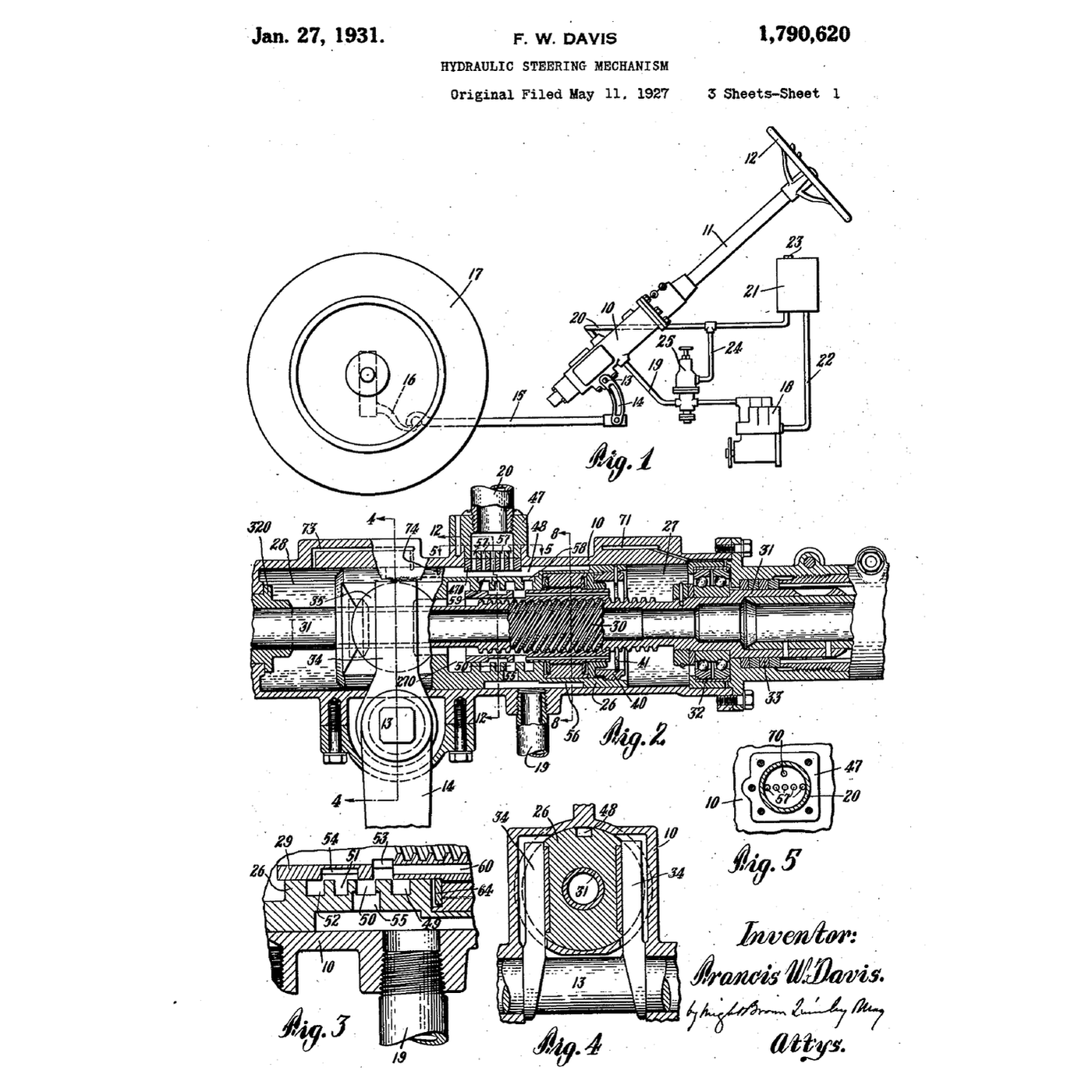


Hydraulic Power Steering: A Piston That Follows the Driver
Balloon tyres made cars ride better and steer worse. Reducing friction in the steering made the wheels shimmy; gearing it lower meant turning the wheel round and round. Francis W. Davis of Waltham, Massachusetts, added a hydraulic piston that does the heavy work while the driver only steers it.
US 1,790,620, *Hydraulic Steering Mechanism*, filed 11 May 1927 as a continuation of his application of 14 April 1926, granted 27 January 1931, works as a follow-up servo. The steering column moves a nut inside the piston; the few thousandths of an inch the nut may slide before it touches the piston are a valve that sends oil to whichever side makes the piston follow. Oil circulates freely when the wheel is still, and if the pump stops the nut simply pushes the piston by hand.
This rung works out why assistance was needed, simulates the follow-up valve, and builds one on the bench.
उन्नत
About 5 hours
निर्देश
1
1
Steering effort, the follow-up valve and the relief limit
Steering effort, the follow-up valve and the relief limit
Jupyter नोटबुक लोड हो रही है…
2
2
Read the power unit from the patent
Read the power unit from the patent
Sheet 1 of US 1,790,620 shows the car's layout: steering wheel 12 turning a post 31 down the column 11 into the power cylinder 10, a pump 18 drawing from tank 21 and delivering through a supply pipe, and the cylinder's piston driving the cross shaft to the steering arm.
Inside the cylinder: the post's thread drives nut 29, which slides inside piston 26. The nut's collar 38 is trapped between shoulder 380 and ring 39, so it can move relative to the piston only "a few thousandths of an inch". Grooves and ports in the nut and piston form the valve. The pump's delivery passes a spring-loaded relief valve 25 set to a predetermined pressure. The patent's liquid is "oil or a glycerine".
3
3
How one steering correction runs
How one steering correction runs
Blockly वर्कस्पेस
Loading Blockly workspace...
4
4
Build a bench follow-up servo
Build a bench follow-up servo
Use a double-acting syringe cylinder and a clear spool valve, built as in this batch's cylinder and spool-valve blueprints. Clamp the cylinder body to a board. Fix the spool valve's **body** to the cylinder's **rod**, so the valve travels with the piston, and pipe its A and B ports to the cylinder's two ends with flexible tube.
Drive the **spool** with a hand lever pivoted on the board: that is the driver's nut. Feed P from a garden hose through a ball valve and a pressure gauge, and T to a bucket.
Move the lever slowly: the rod, and the valve body on it, follow until the spool is centred again, and stop. Mark lever and rod positions on the board and check they keep the same relation — a follow-up servo. Close the supply and move the lever again: now you feel the lever bear on the valve body and push the whole rod yourself. Load the rod with a spring scale and compare the pull on the lever with and without water.
इस चरण के लिए सामग्री:
 सिरिंज सेट1 टुकड़ा
 ऐक्रिलिक नली (पारदर्शी)1 टुकड़ा
 ओ-रिंग वर्गीकृत किट1 टुकड़ा
 सिलिकॉन नली2 मीटर
 प्लाईवुड की चादर1 टुकड़ा
 बागवानी नली1 टुकड़ा
 पीतल का बॉल वाल्व1 टुकड़ा
 जल20 लीटर
आवश्यक उपकरण:
 दाबमापी
 बल-मापी (स्प्रिंग तुला)
 रूलर
रूलर फिलामेंट वाला 3D प्रिंटर (FDM)
 PETG फिलामेंट
 तारहीन ड्रिल
 गरम गोंद की बंदूक
 बाल्टी
5
5
Power steering faults
Power steering faults
Assisted steering fails in characteristic ways.
Flow
Loading...
6
6
History and context
History and context
**Francis W. Davis** of Waltham, Massachusetts, filed his first hydraulic steering application on **14 April 1926**; **US 1,790,620**, filed 11 May 1927 as its continuation, was granted **27 January 1931**. He patented further components of his system through the 1930s. Power steering reached production cars in the early 1950s, and with it the same principle: the driver's small movement opens a valve and oil does the heavy work, which is now often done by an electric motor instead.
The patent is explicit about two dangers of making steering light by removing friction: the wheels shimmy, and road shocks kick back through the wheel ("wheel fight"). A follow-up servo avoids both by keeping a stiff mechanical path.
**Honest limits.** The notebook's kingpin moment and flows are illustrative, not Davis's; real systems add feel by letting part of the load reach the driver's hands. Pressure fluid lines on a car must never be opened hot or running.
सामग्री
8- 1 टुकड़ाप्लेसहोल्डर
- 1 टुकड़ाप्लेसहोल्डर
- 1 टुकड़ाप्लेसहोल्डर
- 2 मीटरप्लेसहोल्डर
- 1 टुकड़ाप्लेसहोल्डर
- बागवानी नली10% कमीशन1 टुकड़ाप्लेसहोल्डर
- 1 टुकड़ाप्लेसहोल्डर
- 20 लीटरप्लेसहोल्डर
आवश्यक उपकरण
8- प्लेसहोल्डर
- प्लेसहोल्डर
- प्लेसहोल्डर
- प्लेसहोल्डर
- प्लेसहोल्डर
- 1 vendor sell this, none ship to you yetप्लेसहोल्डर
- प्लेसहोल्डर
- प्लेसहोल्डर
संबंधित ब्लूप्रिंट
ये ब्लूप्रिंट ज्ञान साझा करते हैं — तकनीक, सामग्री या सिद्धांत



CC0 पब्लिक डोमेन
यह ब्लूप्रिंट CC0 के तहत जारी किया गया है। आप बिना अनुमति माँगे इस कार्य को किसी भी उद्देश्य के लिए कॉपी, संशोधित, वितरित और उपयोग करने के लिए स्वतंत्र हैं।
उनके ब्लूप्रिंट के माध्यम से उत्पाद खरीदकर मेकर का समर्थन करें जहाँ वे मेकर कमीशन कमाते हैं जो विक्रेताओं द्वारा निर्धारित होता है, या इस ब्लूप्रिंट का नया संस्करण बनाएँ और राजस्व साझा करने के लिए इसे अपने ब्लूप्रिंट में कनेक्शन के रूप में शामिल करें।