

Knucklebones (Astragaloi)
Long before dice, people threw bones. The astragalus — the ankle bone of a sheep or goat — is nature's randomiser: it has four faces flat enough to land on, and the other two ends are too rounded to ever settle. Four outcomes, from an object every household already had after dinner.
The Greeks numbered those four faces 1, 3, 4 and 6, skipping 2 and 5 entirely — those numbers belong to the rounded ends that never come up. The convex face counted 3, the concave 4, and the two flat faces 1 and 6.
The faces are not equally likely. That is not a flaw, it is the interesting part: an astragalus is a biased four-sided die, and the values were assigned so the rarest landings were worth most. Throwing a set and tallying results is a genuine probability experiment, and it is exactly the experiment the ancient world ran for centuries without ever writing down the maths.
निर्देश
Get five clean ankle bones
Get five clean ankle bones
Obtain five sheep or goat astragali, cleaned and degreased. A butcher is the usual source. Five is the classic set size.
इस चरण के लिए सामग्री:
 पशु की हड्डियाँ (साफ, चर्बीरहित)5 टुकड़े
Simmer to remove remaining fat
Simmer to remove remaining fat
Simmer the bones in water for 2 hours, then scrub. Bone that still holds grease will yellow and smell within weeks.
Dry them fully
Dry them fully
Air-dry for 48 hours somewhere warm. A bone that is still damp inside will crack when you sand it.
Smooth the surfaces lightly
Smooth the surfaces lightly
Sand lightly with 220 then 400 grit. Take off roughness only — do not reshape the faces. Flattening a face changes how often it lands, and you would be sanding away the experiment.
इस चरण के लिए सामग्री:
 रेगमाल1 शीटरेगमाल1 शीट
Identify the four landing faces
Identify the four landing faces
Roll one bone and find the four faces it settles on: one convex (bulging), one concave (hollowed), and two flatter faces of different width. The two rounded ends never settle.
Mark the Greek values
Mark the Greek values
Mark the convex face 3 and the concave face 4. Mark the narrow flat face 1 and the broad flat face 6. There is no 2 and no 5 — those would be the rounded ends, which cannot come up.
इस चरण के लिए सामग्री:
 मृदा रंगद्रव्य चूर्ण सेट1 सेट
Mark the other four bones the same way
Mark the other four bones the same way
Repeat on all five, keeping the convention identical. Bones vary in shape, so check each one individually rather than copying by eye.
Throw one bone 100 times and tally
Throw one bone 100 times and tally
Throw a single bone 100 times, recording which value lands up. Do it on the same surface every time — a hard table and a soft rug give different results.
Work out the frequencies
Work out the frequencies
Divide each tally by 100. You will find the two flat faces come up far more often than the convex and concave ones — typically the broad faces dominate. The four outcomes are not equally likely.
Compare the values to the odds
Compare the values to the odds
Line your measured frequencies up against the Greek values 1, 3, 4, 6. The scarcer landings carry the higher and odder numbers. The scoring was fitted to the bone, not the other way round.
Throw all five and find the best score
Throw all five and find the best score
Throw all five together. The prized Roman throw — the "Venus" — was all four different values showing across the set. Work out from your frequencies why that was rare enough to be worth naming.
History & Context
History & Context
The first randomiser. Astragali are ankle bones of sheep and goats and are among humanity's earliest randomising devices — in use long before cubic dice. They needed no manufacture at all, which is a large part of why they were universal: every household that ate mutton produced them.
Six sides, four faces. The bone technically has six surfaces, but the two short rounded ends will not support it. So it behaves as a four-sided die, and the Greeks numbered the usable faces I, III, IV and VI — deliberately skipping II and V. The convex side was worth 3, the concave 4, and the two flat sides 1 and 6.
A biased die, on purpose. Because the faces differ in area and curvature, they land with genuinely different probabilities. Modern dice are engineered toward uniformity; the astragalus is the opposite, and the value assignment reflects that — rarer outcomes score higher. This is an empirical probability distribution embedded in a game, arrived at by people with no formal theory of probability, which would not be written down until Pascal and Fermat in the 1650s.
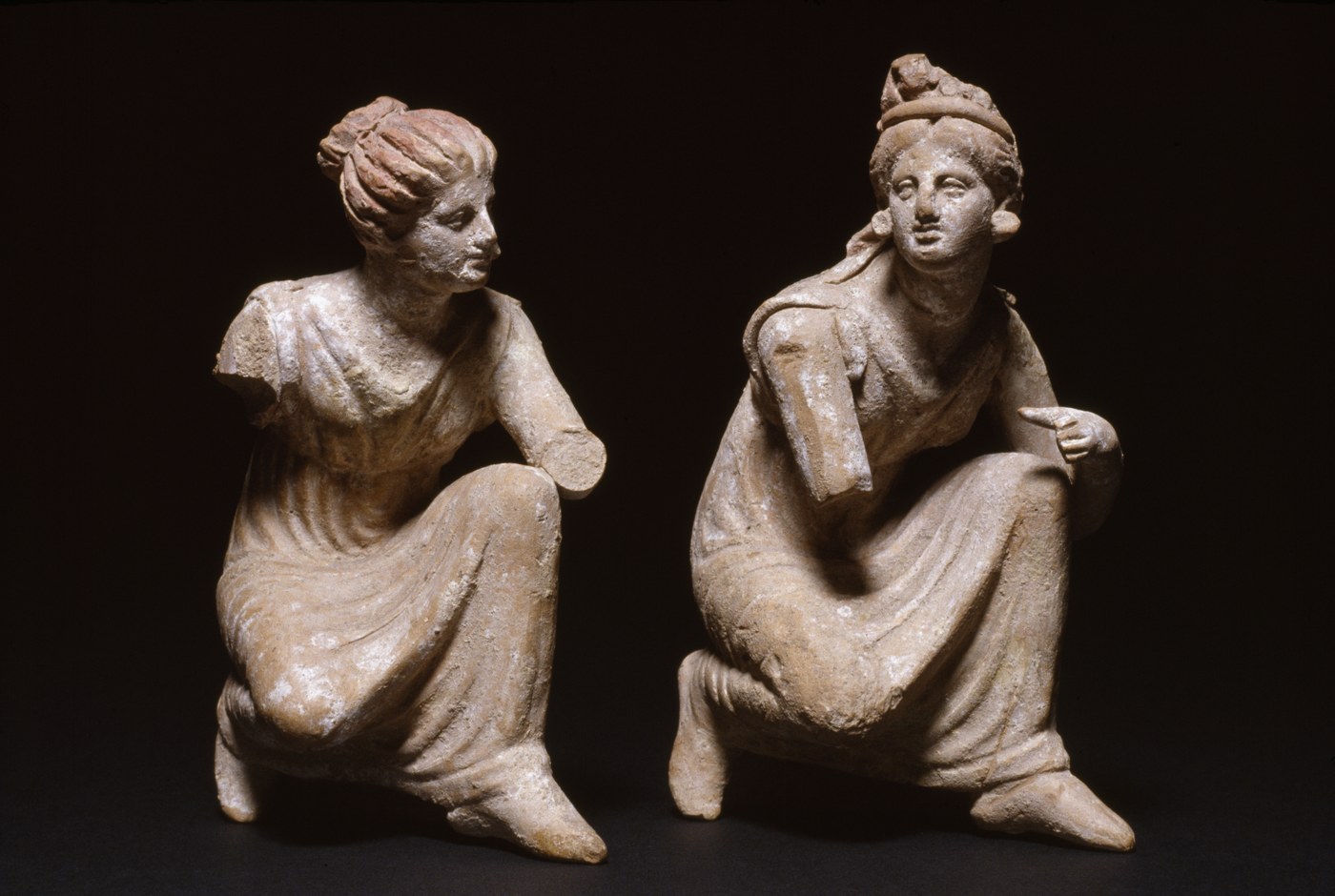
Played by everyone. Knucklebones was popular across Greece and Rome among children and adults alike. Greek vase painting shows girls and women playing; Roman writers describe adults gambling on it. It also had a serious side — astragalomancy, divination by throwing knucklebones, was widespread, and the same object that settled a children's game could be used to ask a question of the gods.
The Venus throw. The Romans named throws, and the best of them, the Venus, is generally described as the set showing all different values. Naming a throw only makes sense when it is rare, so the vocabulary of the game is itself evidence that players had a working feel for the odds. Note that ancient sources on scoring are incomplete and later reconstructions vary — as with senet, be wary of any confident single rule set.
The descendants. Cubic dice with pips eventually displaced astragali precisely because they are fair and easy to read. Knucklebones survived anyway as the children's game of jacks — throw, catch on the back of the hand, pick up. The bones became metal or plastic, the rules simplified, and a Bronze Age randomiser is still sold in toy shops.
यह ब्लूप्रिंट बनाता है
CC0 पब्लिक डोमेन
यह ब्लूप्रिंट CC0 के तहत जारी किया गया है। आप बिना अनुमति माँगे इस कार्य को किसी भी उद्देश्य के लिए कॉपी, संशोधित, वितरित और उपयोग करने के लिए स्वतंत्र हैं।
उनके ब्लूप्रिंट के माध्यम से उत्पाद खरीदकर मेकर का समर्थन करें जहाँ वे मेकर कमीशन कमाते हैं जो विक्रेताओं द्वारा निर्धारित होता है, या इस ब्लूप्रिंट का नया संस्करण बनाएँ और राजस्व साझा करने के लिए इसे अपने ब्लूप्रिंट में कनेक्शन के रूप में शामिल करें।