

Dental Engine
A hand-cranked dental drill turns a bur at perhaps fifteen revolutions per minute. At that speed the bur does not cut enamel so much as grind slowly against it, and the dentist must press hard to make progress — so the procedure is long, crude and agonising.
Speed is the whole cure, and speed needs a foot. A treadle frees both hands and can drive a bur two thousand times a minute. But the power then has to arrive at a tool that must reach any point in a mouth at any angle — so a rigid shaft is useless.
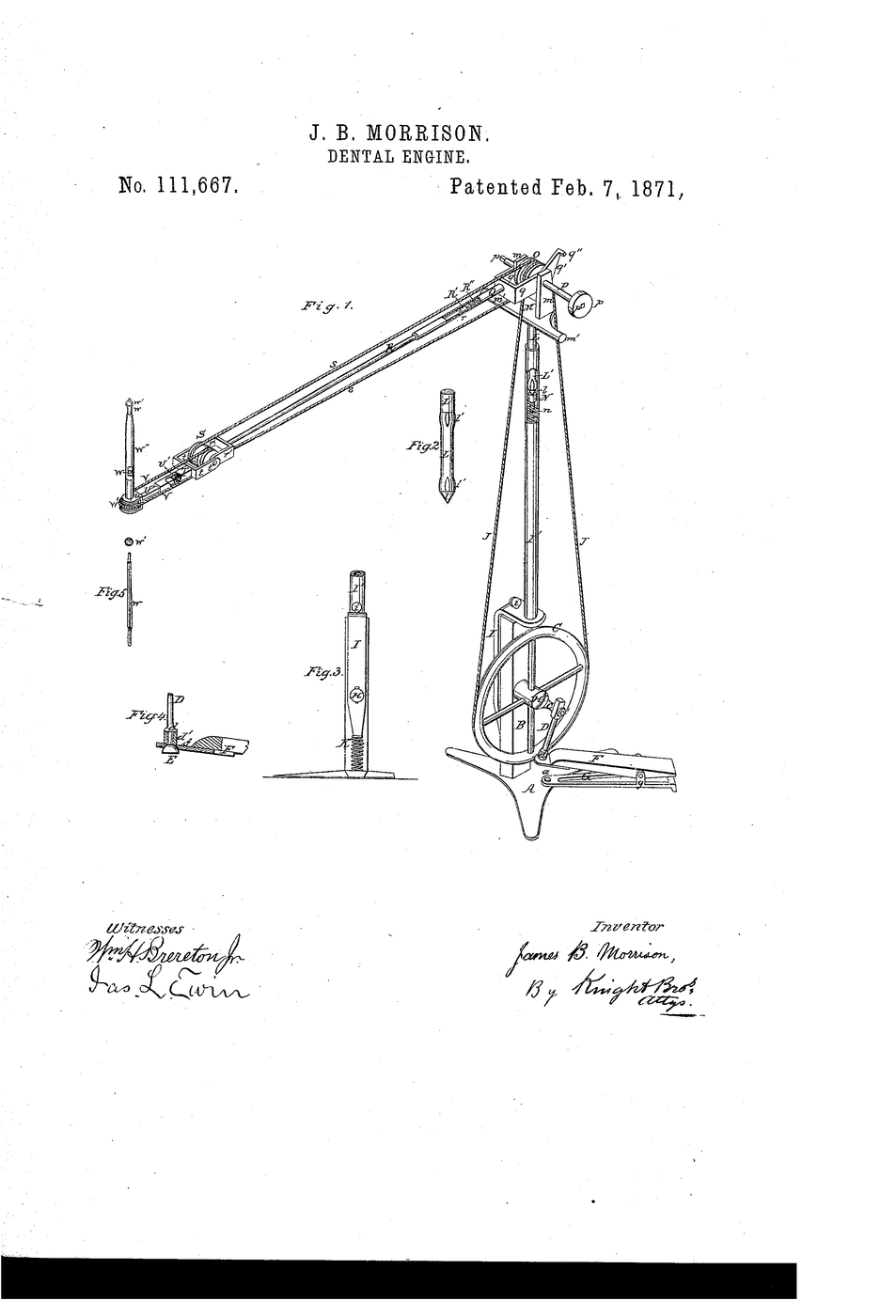
Morrison's answer is a chain of pivoted arms carrying pulleys, held extended by springs. The belt runs over them and the springs take up slack as the arms swing, so tension holds no matter where the handpiece is. The tool has, in his words, universal motion, and the belt never falls off.
US Patent 111,667, "Improvement in dental engines", granted 7 February 1871 to James B. Morrison of St. Louis. He also claims a ball-and-socket treadle so the foot can drive at any angle, and a bur head separable from its shank so a worn bur can be replaced instead of the whole tool.
निर्देश
Drill wood, never teeth
Drill wood, never teeth
This is a power-transmission model. Cut only scrap wood or plaster blocks. Never use it on a person or an animal, and keep fingers clear of the belt runs and pulleys.
Read US 111,667 and find universal motion
Read US 111,667 and find universal motion
Morrison's claim is power conveyed to a tool with universal motion, the arms "being swiveled and kept extended lengthwise by springs". The springs are what make the freedom possible.
Grind a hole by hand and time it
Grind a hole by hand and time it
Twist a small bur by hand into a plaster block for 60 seconds and measure the depth. This is roughly the 15 rpm baseline the invention replaces.
Build the treadle and flywheel
Build the treadle and flywheel
Make a foot treadle driving a crank on a heavy wheel. The flywheel's mass is what smooths a jerky foot into a steady speed.
इस चरण के लिए सामग्री:
 बाल्टिक बर्च प्लाईवुड1 शीट
Fit the treadle on a ball-and-socket
Fit the treadle on a ball-and-socket
Mount the footplate so it can tilt in any direction. Morrison wants the foot to drive "at any angle to the plane of the pulley" without being repositioned.
Run a belt straight to a fixed spindle
Run a belt straight to a fixed spindle
Drive a fixed spindle directly from the flywheel with a cord belt. Confirm it spins fast and steadily before adding any freedom of movement.
आवश्यक उपकरण:
 चपटे मुँह का प्लास
Drill the plaster and compare with step 3
Drill the plaster and compare with step 3
Sixty seconds again, same bur, same pressure. Record the depth. The ratio between the two is the entire clinical argument.
Try to move the fixed spindle around
Try to move the fixed spindle around
Attempt to bring the spinning tool to different positions and angles. The belt slackens, jumps or throws off. This is the problem Morrison actually solved.
Build the first pivoted arm
Build the first pivoted arm
Make an arm swivelling at the machine, carrying a pulley at each end so the belt turns a corner and continues.
इस चरण के लिए सामग्री:
 लकड़ी की डॉवेल छड़1 टुकड़ा
Add a second arm on a swivel
Add a second arm on a swivel
Hinge a second arm to the first, again with pulleys. Two jointed arms give the handpiece a working area rather than a point.
Fit the extension springs
Fit the extension springs
Spring-load each arm so it is pushed lengthwise outward. As the arms fold and unfold, the springs take up and give back belt length automatically.
इस चरण के लिए सामग्री:
 संपीड़न स्प्रिंग सेट1 सेट
Sweep the handpiece through its whole range
Sweep the handpiece through its whole range
Move the tool high, low, near, far and at odd angles while it runs. The belt stays taut throughout. Compare against step 8.
Remove one spring and repeat
Remove one spring and repeat
Disconnect a single spring and sweep again. The belt goes slack at one end of the travel and the bur stalls. The springs are not a refinement.
Swap the bur head without changing the shank
Swap the bur head without changing the shank
Fit a second bur onto the same shank. Morrison separates the two so a worn cutting head is replaced rather than the whole tool — a consumable, not a repair.
History & Context — faster drilling, and no anaesthetic
History & Context — faster drilling, and no anaesthetic
The patent. US 111,667, "Improvement in dental engines", granted 7 February 1871 to James Beall Morrison of St. Louis. Application and grant share a date. He secured further patents in 1872, and the first foot-pedal machines were sold at a dental meeting in Binghamton, New York in April 1872.
The gain is enormous and easy to state. Morrison claimed his engine reached about 2,000 rpm against roughly 15 rpm for the hand drills it replaced — a factor of over a hundred. Cutting rate scales with how many times a cutting edge passes the work per second, so a cavity that took a long, pressure-heavy grinding session became a short one. Step 3 against step 7 shows the effect at model scale.
Why the arms and springs are the real invention. Any treadle can spin a shaft; the difficulty is that a dentist's tool must reach the upper molars, the lower incisors and everything between, at whatever angle the patient's head allows. Rigid drive shafts cannot do that, and a belt over fixed pulleys goes slack the moment the geometry changes. Morrison's chain of swivelled, spring-extended arms keeps the total belt path constant as the linkage folds — the springs absorb exactly the length the geometry releases. Step 13 shows how completely it fails without them. The same problem recurs in anglepoise lamps, articulated microphone booms and surgical arms, all of which solve it with spring-balanced linkages.
The uncomfortable half. Faster drilling arrived decades before reliable dental anaesthesia was routine. Local anaesthesia with procaine came in the early twentieth century, so for a generation the dental engine meant faster, deeper, more thorough work performed on fully conscious patients — better dentistry and, quite possibly, a worse experience. The high-pitched whine that people associate with fear is a later artefact of air turbines running at hundreds of thousands of rpm, but the association between dentistry and dread is at least this old.
Where it went. Treadle engines gave way to electric motors with flexible shafts, and then in the 1950s to the air turbine, which spins the bur directly in the handpiece with compressed air. The modern handpiece is Morrison's problem solved a different way: instead of transmitting rotation through a movable linkage, put the motor at the tip and transmit only air. His replaceable bur head, though, is exactly how burs still work.
सामग्री
3- प्लेसहोल्डर
- 1 टुकड़ाप्लेसहोल्डर
- 1 सेटप्लेसहोल्डर
आवश्यक उपकरण
1- प्लेसहोल्डर
संबंधित ब्लूप्रिंट
ये ब्लूप्रिंट ज्ञान साझा करते हैं — तकनीक, सामग्री या सिद्धांत



CC0 पब्लिक डोमेन
यह ब्लूप्रिंट CC0 के तहत जारी किया गया है। आप बिना अनुमति माँगे इस कार्य को किसी भी उद्देश्य के लिए कॉपी, संशोधित, वितरित और उपयोग करने के लिए स्वतंत्र हैं।
उनके ब्लूप्रिंट के माध्यम से उत्पाद खरीदकर मेकर का समर्थन करें जहाँ वे मेकर कमीशन कमाते हैं जो विक्रेताओं द्वारा निर्धारित होता है, या इस ब्लूप्रिंट का नया संस्करण बनाएँ और राजस्व साझा करने के लिए इसे अपने ब्लूप्रिंट में कनेक्शन के रूप में शामिल करें।