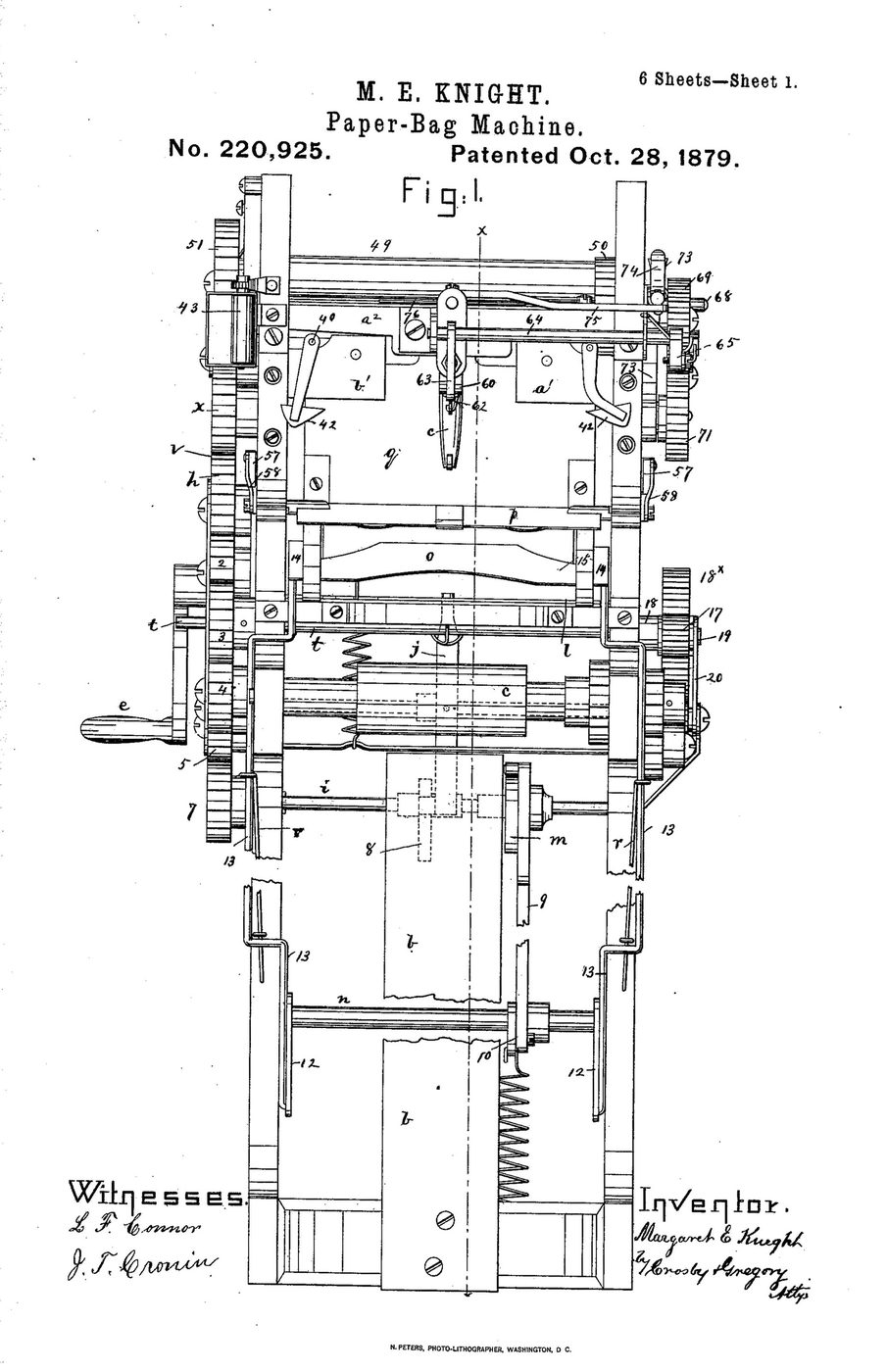


Flat-Bottom Paper Bag Machine
Before 1879 a paper bag was an envelope. It had a V-shaped bottom, it would not stand up, and it held whatever you could persuade to sit in a wedge. Shopkeepers filled them by hand, one at a time.
Margaret Knight's machine folds a square bottom. That single change turns a bag into a container: it stands open on the counter, it packs flat, it stacks, and its capacity is its footprint times its height rather than the volume of a cone. Every grocery bag since is her geometry.
The mechanism is a fold sequence — feed, form the tube, gusset the sides, tuck the corners, crease and glue — executed by cams so that a machine does in one pass what a skilled worker did in six moves. US Patent 220,925, granted 28 October 1879, is the improved version. Getting there required her to sue a man who had copied her prototype and claimed a woman could not have designed it.
निर्देश
Fold one bag entirely by hand first
Fold one bag entirely by hand first
Before building anything, make a square-bottom bag from a sheet of kraft paper with your hands. You cannot mechanise a sequence you cannot perform.
इस चरण के लिए सामग्री:
 पन्नी-अस्तर वाला क्राफ़्ट काग़ज़ का थैला5 शीट
Write the fold sequence down as numbered moves
Write the fold sequence down as numbered moves
List every crease in order. There are about six, and each one becomes a station on the machine — this list IS the design.
Compare against a V-bottom bag
Compare against a V-bottom bag
Fold a simple envelope-style bag too. Stand both on the table. The V-bottom collapses; that comparison is the entire commercial argument.
Study US 220,925 and identify the forming plate
Study US 220,925 and identify the forming plate
Find the part that pushes into the tube to open the bottom square. Knight's earlier 1871 patent introduced it; the 1879 patent refines the mechanism around it.
Build a mandrel the size of your bag
Build a mandrel the size of your bag
Cut a rectangular block whose cross-section is the finished bag's footprint. Every fold is made against this former — its accuracy sets the bag's.
इस चरण के लिए सामग्री:
 कठोर लकड़ी का तख़्ता1 टुकड़ा
आवश्यक उपकरण:
 हस्त आरी
Wrap the sheet round the mandrel and glue the side seam
Wrap the sheet round the mandrel and glue the side seam
Form the paper into a tube with a generous overlap and paste the lap. This is station one, and it must be square before anything else happens.
इस चरण के लिए सामग्री:
 PVA काष्ठ गोंद50 मिली
Crease the side gussets while it is still on the mandrel
Crease the side gussets while it is still on the mandrel
Press two inward folds down the sides. The gussets are what let a square-bottom bag fold flat for storage — without them it will not collapse.
Open the bottom into a diamond
Open the bottom into a diamond
Splay the end of the tube so the corners lift and the bottom flattens into a diamond. This is the single move the whole machine exists to automate.
Fold the four flaps in a fixed order
Fold the four flaps in a fixed order
Bring the side flaps in first, then the front and back over them. Change the order and the bag will not lie flat — the overlap has to be consistent.
Paste and press the bottom
Paste and press the bottom
Apply glue to the last flap and press the whole base while it is still supported by the mandrel. An unsupported base bulges and never sits flat.
Drive the stations from one shaft with cams
Drive the stations from one shaft with cams
Mount cams on a common shaft so each folder acts at its own point in the rotation. One input, a fixed sequence — that is what makes it a machine rather than a jig.
इस चरण के लिए सामग्री:
 मृदु इस्पात की छड़1 टुकड़ा
Time the cams by turning the shaft slowly by hand
Time the cams by turning the shaft slowly by hand
Crank one full revolution and watch for collisions. Timing errors are the commonest fault, and they are obvious at one revolution per minute and invisible at speed.
Add a stripper to lift the bag off the mandrel
Add a stripper to lift the bag off the mandrel
Fit a finger or a puff of air to release the finished bag. Without it the cycle stalls on the piece it just made.
Load a bag and check it stands
Load a bag and check it stands
Fill a finished bag and set it on the bench unsupported. Standing open, unaided, is the only test that matters.
Compendium — a square bottom and a court case
Compendium — a square bottom and a court case
The patents. Margaret E. Knight of Springfield, Massachusetts received US 220,925, "Improvement in Paper-Bag Machines", on 28 October 1879. It follows her foundational US 116,842 of 1871, which covered the machine that formed and folded the flat-bottomed bag. She held around twenty patents in total and had begun inventing far earlier — as a twelve-year-old mill worker she devised a stop-motion safety device for a loom after seeing another worker injured by a flying shuttle, and never patented it.
The theft, and the argument used against her. While her prototype was being built at a machine shop, Charles Annan observed it and filed his own patent. Knight sued. Annan's defence in the 1871 interference proceeding was, in substance, that a woman could not possibly understand mechanics well enough to have designed the machine. Knight produced her notebooks, drawings and the succession of dated models. She won, and the patent was hers. It is worth citing precisely because the argument used against her was not technical.
Why the square bottom matters commercially. A V-bottom bag has to be held. A flat-bottom bag stands on its own, which means one person can pack it while doing something else — the labour saving is at the counter, not in the factory. It also stacks, ships flat, and its capacity scales with footprint rather than with the awkward volume of a wedge, so a shopkeeper can predict what fits. This is a good example of a mechanical change whose value is entirely in the workflow it enables downstream.
The gussets are the non-obvious part. Folding a square base is easy if the bag may stay open forever; making one that ALSO folds flat requires the side gussets, and their crease lines have to be established before the bottom is formed. That ordering constraint is why the fold sequence is fixed and why the machine needs cams on a common shaft rather than independent stations. Anyone building one discovers the order matters at about the third attempt.
सामग्री
4- प्लेसहोल्डर
- 1 टुकड़ाप्लेसहोल्डर
- 50 मिलीप्लेसहोल्डर
- 1 टुकड़ाप्लेसहोल्डर
संबंधित ब्लूप्रिंट
ये ब्लूप्रिंट ज्ञान साझा करते हैं — तकनीक, सामग्री या सिद्धांत

CC0 पब्लिक डोमेन
यह ब्लूप्रिंट CC0 के तहत जारी किया गया है। आप बिना अनुमति माँगे इस कार्य को किसी भी उद्देश्य के लिए कॉपी, संशोधित, वितरित और उपयोग करने के लिए स्वतंत्र हैं।
उनके ब्लूप्रिंट के माध्यम से उत्पाद खरीदकर मेकर का समर्थन करें जहाँ वे मेकर कमीशन कमाते हैं जो विक्रेताओं द्वारा निर्धारित होता है, या इस ब्लूप्रिंट का नया संस्करण बनाएँ और राजस्व साझा करने के लिए इसे अपने ब्लूप्रिंट में कनेक्शन के रूप में शामिल करें।