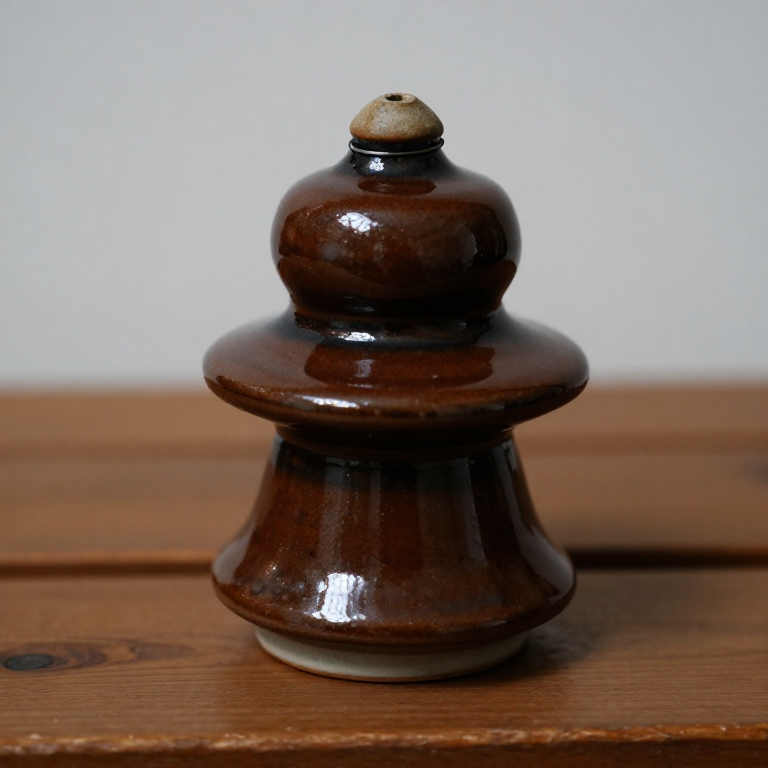


Pin Insulator
निर्देश
Measure the difference between dry and wet flashover
Measure the difference between dry and wet flashover
Establish the problem before shaping anything to solve it.
- Take a plain porcelain or glass cylinder and fit an electrode at each end.
- Raise the voltage from a high-voltage source until it flashes over the surface, and record the value.
- Now wet the surface thoroughly with a fine spray and repeat.
- Compare the two figures.
The wet flashover voltage is dramatically lower — often less than half. Water films bridge the surface and carry leakage current, which heats the film, dries patches of it, and produces small arcs that eventually join into a full flashover. An insulator designed only for its dry performance is an insulator that works until it rains.
Work with a high-voltage source you understand and respect: keep one hand behind your back, discharge everything before touching it, and never work alone. This blueprint deals with voltages that are dangerous by design.इस चरण के लिए सामग्री:
 मिट्टी1 bag
 काँच की नलियों का किट1 किट
आवश्यक उपकरण:
 प्रयोगशाला श्रेणी का डिजिटल मल्टीमीटर
 समायोज्य बेंच विद्युत आपूर्ति
 डिजिटल वर्नियर कैलिपर, 6 इंच
Throw a body with downward petticoats
Throw a body with downward petticoats
The skirts do one job: keep their own undersides dry.
- Throw or press a porcelain form with a central bore for the pin.
- Add two or three concentric skirts flaring downward and outward, each overhanging the one below.
- Keep the undersides smooth and free of ledges where water could collect.
- Measure the straight-line distance from top groove to pin, then measure the distance following the surface.
Those two measurements are the striking distance and the creepage distance, and the ratio is the design. Rain falls downward, so the underside of an overhanging skirt stays dry even in a downpour; the wet path has to travel up under each skirt and back down, several times over. A well-shaped insulator has a creepage distance several times its straight-line height.
Petticoats are also why insulators are ribbed on the underside only. Ribbing the top would collect water and achieve nothing.इस चरण के लिए सामग्री:
 बॉल क्ले1 bag
 मिट्टी की तार और चाकू का सेट1 सेट
आवश्यक उपकरण:
डिजिटल वर्नियर कैलिपर, 6 इंच संयुक्त गुनिया
 भट्ठी (किल्न)
Glaze it, and understand why the glaze matters electrically
Glaze it, and understand why the glaze matters electrically
The glaze is not decoration — it is part of the insulation system.
- Apply a hard, fully vitrified glaze over the whole surface.
- Fire to full maturity so the glaze is glassy and non-porous.
- Compare a glazed and an unglazed piece by wetting both and watching how water behaves.
- Test the wet flashover of each.
A glazed surface sheds water into discrete droplets; an unglazed one holds a continuous film. A continuous film is a conductor from end to end, while separated droplets are not. Unglazed porcelain also absorbs moisture into its body over years, which degrades it permanently — so the glaze protects both the surface behaviour and the material itself.
Manufacturing defects matter enormously here. A crack or an unglazed patch concentrates the electric field and becomes the origin of every future failure, which is why insulator production is inspected far more rigorously than ordinary pottery.इस चरण के लिए सामग्री:
 बॉल क्ले का चूर्ण1 bag
 बेंटोनाइट मिट्टी1 bag
आवश्यक उपकरण:
भट्ठी (किल्न)प्रयोगशाला श्रेणी का डिजिटल मल्टीमीटरडिजिटल वर्नियर कैलिपर, 6 इंच अवरक्त थर्मामीटर
Test with salt fog and find the real service limit
Test with salt fog and find the real service limit
Clean rain is the easy case. Contamination is what actually causes outages.
- Repeat the wet flashover test using a salt solution spray rather than clean water.
- Record the flashover voltage and compare with the clean-wet figure.
- Let the insulator dry with the salt still on it, then wet it lightly with clean water and test again.
- Wash it thoroughly and re-test.
आवश्यक उपकरण:
प्रयोगशाला श्रेणी का डिजिटल मल्टीमीटरसमायोज्य बेंच विद्युत आपूर्तिडिजिटल वर्नियर कैलिपर, 6 इंच स्टॉपवॉच
Where the shape came from, and history
Where the shape came from, and history
Pin insulators evolved from telegraph practice in the 1840s onward and were scaled up as electrical distribution arrived in the 1880s. Early forms were plain knobs; the petticoat shape emerged empirically as engineers discovered that lines flashed over in rain and that skirts fixed it. It is a design refined by failure rather than derived from theory.
The material choice is a real one. Wet-process porcelain is strong in compression and holds a glaze superbly, but it is brittle and a hidden crack is invisible. Toughened glass insulators shatter completely when they fail, which sounds worse but is actually an advantage — a failed glass unit is obvious from the ground, while a cracked porcelain unit looks perfectly normal. Utilities in different countries made opposite choices for exactly this reason.
Its hard limit is what drives the next blueprint in this chain. A pin insulator is one piece of porcelain, so its voltage rating is fixed by its size — and above roughly 60 kV the required piece becomes so large it cannot be fired reliably or supported on a pin. That ceiling is what forced the suspension insulator, which stacks many small units into a string and can be extended simply by adding more.
Its honest limits: the voltage ceiling; vulnerability to contamination; brittleness under mechanical shock; and the fact that the wire sits ON TOP of the insulator, so a broken pin drops a live conductor. Suspension designs hang the conductor below, which fails more gracefully.
सामग्री
6- 1 bagप्लेसहोल्डर
- प्लेसहोल्डर
- 1 bagप्लेसहोल्डर
- प्लेसहोल्डर
- 1 bagप्लेसहोल्डर
- 1 bagप्लेसहोल्डर
यह ब्लूप्रिंट बनाता है
संबंधित ब्लूप्रिंट
ये ब्लूप्रिंट ज्ञान साझा करते हैं — तकनीक, सामग्री या सिद्धांत


CC0 पब्लिक डोमेन
यह ब्लूप्रिंट CC0 के तहत जारी किया गया है। आप बिना अनुमति माँगे इस कार्य को किसी भी उद्देश्य के लिए कॉपी, संशोधित, वितरित और उपयोग करने के लिए स्वतंत्र हैं।
उनके ब्लूप्रिंट के माध्यम से उत्पाद खरीदकर मेकर का समर्थन करें जहाँ वे मेकर कमीशन कमाते हैं जो विक्रेताओं द्वारा निर्धारित होता है, या इस ब्लूप्रिंट का नया संस्करण बनाएँ और राजस्व साझा करने के लिए इसे अपने ब्लूप्रिंट में कनेक्शन के रूप में शामिल करें।