कला
सौंदर्य और कल्याण
हस्तशिल्प
संस्कृति और इतिहास
मनोरंजन
पर्यावरण
खाद्य और पेय
रिवर्स इंजीनियरिंग
विज्ञान
खेल
प्रौद्योगिकी
पहनने योग्य
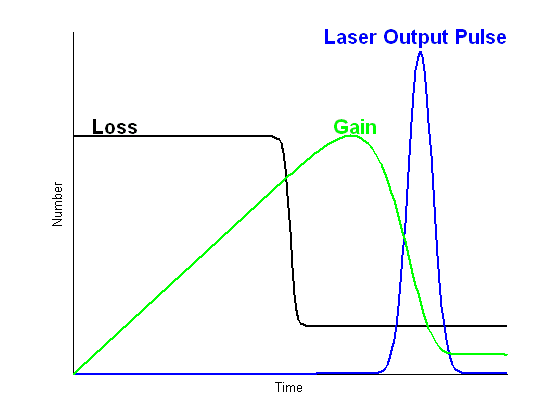


Q-Switching and the Giant Pulse
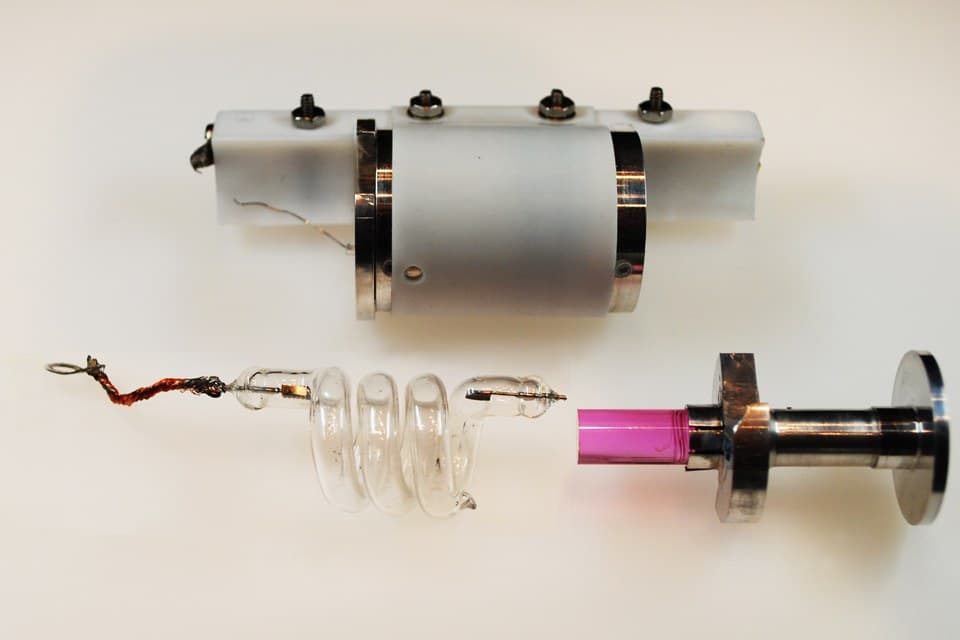
In 1962 Fred McClung and Robert Hellwarth, working at the same Hughes laboratory where the ruby laser had been built two years earlier, published a paper called 'Giant Optical Pulsations from Ruby'. They had not made a better laser. They had made the same laser refuse to fire.
A free-running ruby laser starts oscillating the instant the inversion crosses threshold, which clamps it there for the rest of the flash and dribbles the energy out as a messy train of microsecond spikes. Hellwarth's idea was to spoil the cavity — degrade its Q, hence the name — so that threshold is unreachably high while the flashlamp pumps. The inversion climbs to five or ten times what it could normally reach. Then the switch opens, threshold collapses, and every stored ion is stimulated within a few dozen cavity round trips.
The energy is almost unchanged. The DURATION drops from a millisecond to ten nanoseconds, so the peak power rises by five orders of magnitude. That is the entire invention: not more light, but a refusal to let it out slowly. Every laser rangefinder, every nanosecond marking laser and every laser that drives a nonlinear crystal is doing this.
MODELLED AND MEASURED. The rate equations are the honest heart of this blueprint and they run live in the notebook. The mechanical rotating-mirror switch that preceded the Kerr cell is genuinely buildable on a bench and step 3 builds it, because the timing problem it exposes — the switch must open faster than the pulse builds — is the same problem a Pockels cell solves with electronics.
उन्नत
4 hours
निर्देश
1
1
Decide whether Q-switching helps at all
Decide whether Q-switching helps at all
Work down the decision tree before touching hardware. Two of the four questions kill the idea outright for most media, and the reason is always the same number: the upper-state lifetime. A medium that cannot hold an inversion for the length of the pump has nothing to dump.
This is why the helium-neon laser earlier in this batch is never Q-switched and the laser diode that follows it never can be, while ruby — the hardest laser to start — is the easiest to Q-switch.
Flow
DECIDING WHETHER TO Q-SWITCH — work down, and stop at the first NO.

1. Do you need PEAK POWER, or ENERGY?
   - energy per shot only  -> NO. Free-running is simpler, cheaper and more efficient.
   - peak power (ablation, drilling, ranging, nonlinear optics) -> continue.

2. Is the upper-state lifetime longer than the pump pulse?
   - ruby 3 ms, Nd:YAG 230 us, Er:glass 8 ms  -> YES, there is a reservoir. Continue.
   - HeNe 100 ns, laser diode 3 ns            -> NO. Nothing to store. Stop here.

3. Can you open the switch faster than the pulse builds?
   - build-up is a few tens of cavity round trips, so tens of nanoseconds for a 20 cm
     cavity. The switch must beat that or the laser leaks out early as a weak spike.
   - rotating mirror (~1 us)      -> works, but only just; expect prelasing.
   - Pockels cell (~1 ns)         -> clean. The modern default.
   - saturable absorber (passive)  -> self-timed, no electronics, no jitter control.

4. Choose the switch:
   ROTATING MIRROR  cheap, mechanical, self-synchronising to the motor, slow, noisy.
                    This is what 1962 used and what step 3 has you build.
   KERR CELL        McClung and Hellwarth's actual switch: nitrobenzene between crossed
                    polarisers. Fast, and nitrobenzene is toxic. Historical only.
   POCKELS CELL     KD*P or lithium niobate, kilovolt drive, nanosecond switching,
                    fully triggerable. The standard answer today.
   SATURABLE ABSORBER  Cr4+:YAG. Bleaches when the flux gets high enough and opens
                    itself. No drive electronics at all; you give up timing control.

5. FAILURE MODES TO EXPECT
   - prelasing: the switch leaks, the inversion clamps, no giant pulse. Improve the
     hold-off contrast.
   - multiple pulses: the switch opened slowly, so the rod lased several times on the
     way. Same cure.
   - optics damage: peak power is now megawatts per square centimetre. Coatings and
     even air will break down. Expand the beam before you focus it.
2
2
Run the rate equations
Run the rate equations
Jupyter नोटबुक लोड हो रही है…
आवश्यक उपकरण:
 डेस्कटॉप कंप्यूटर
3
3
Build the rotating-mirror switch
Build the rotating-mirror switch
Epoxy a front-surface mirror to the shaft of a small brushless motor so the reflecting face sits on the axis, and balance it — an unbalanced mirror at 20 000 rpm is a projectile. Enclose the motor and mirror. Wear the safety goggles.
Set it as one end of the cavity from the Fabry-Perot blueprint. For all but a few microseconds of each revolution the mirror faces the wrong way and the round-trip loss is total; once per revolution it sweeps through alignment and the cavity exists.
Measure the open window: put the photodiode where the output coupler would be, shine the laser pointer down the axis, and read the pulse width on the oscilloscope. Measure the shaft speed with the optical tachometer.
Window in microseconds equals mirror aperture divided by the rim speed. Compare it against the notebook's build-up time of a few tens of nanoseconds. It is a hundred times too slow, and that gap is precisely why the Kerr cell existed by 1962 and the Pockels cell replaced it.
इस चरण के लिए सामग्री:
 अग्र-सतह दर्पण1 टुकड़ा
 RC मोटर (ब्रशरहित)1 टुकड़ा
 दो-भाग एपॉक्सी चिपकाव (शीघ्र जमने वाला)5 मिली
आवश्यक उपकरण:
 डिजिटल टैकोमीटर
 डिजिटल वर्नियर कैलिपर, 6 इंच
 फोटोडायोड (BPW34)
 डिजिटल ऑसिलोस्कोप
 बेंच विद्युत-आपूर्ति
 बंद सुरक्षा चश्मा
 लेज़र पॉइंटर
 प्रकाशिक बेंच किट
4
4
Compendium: four switches and the damage they cause
Compendium: four switches and the damage they cause
WHAT McCLUNG AND HELLWARTH ACTUALLY USED. A Kerr cell: nitrobenzene between crossed polarisers, with a kilovolt across it. With the voltage on, the liquid rotates the polarisation and light passes; with it off, the crossed polarisers block the cavity. Nitrobenzene is toxic and absorbs through skin, which is one reason nobody builds these any more.
WHAT REPLACED IT, LABELLED AS THE MODERN EQUIVALENT. A Pockels cell does the same job in a crystal — KD*P or lithium niobate — with no liquid, switching in about a nanosecond. A passive saturable absorber such as Cr4+:YAG does it with no electronics at all: it is opaque until the flux inside the cavity bleaches it, at which point it opens itself. You trade all timing control for a part with no wires.
WHY THE PULSE LENGTH IS WHAT IT IS. The pulse cannot be shorter than a few cavity round trips, because the light has to physically traverse the rod enough times to sweep the inversion out. For a 20 cm cavity a round trip is 1.3 ns, and a giant pulse lands at ten to twenty nanoseconds. Shorter pulses need a different idea entirely — mode-locking, which fixes the PHASE relationship between the modes you plotted in the helium-neon blueprint rather than gating the loss.
THE COST NOBODY MENTIONS. At 10 MW in a 5 mm beam you have 50 megawatts per square centimetre. Dielectric coatings damage, dust on a mirror becomes a crater, and focused in air the pulse ionises it and you get a spark. Every Q-switched laser is engineered around its own output. Expanding the beam before any focusing element is not a refinement, it is the difference between a working laser and a scrapped optic.
THE SIBLING, MEASURED. Free-running: about 1 ms, roughly 100 mJ, about 100 W peak. Q-switched at five times threshold in a 20 cm cavity: about 5 ns and tens of megawatts, for a peak-power gain of order a hundred thousand. The energy is nearly the same — the rate equations say almost all of it comes out, and a real rod delivers 50 to 80 % once spatial hole burning and the beam profile are accounted for. What you actually pay is hardware, alignment and the damage budget. If your application does not care about peak power, do not do it.
सामग्री
3- 1 टुकड़ाप्लेसहोल्डर
- 1 टुकड़ाप्लेसहोल्डर
- प्लेसहोल्डर
आवश्यक उपकरण
9- प्लेसहोल्डर
- प्लेसहोल्डर
- प्लेसहोल्डर
- प्लेसहोल्डर
- 1 vendor sell this, none ship to you yetप्लेसहोल्डर
- प्लेसहोल्डर
- प्लेसहोल्डर
- प्लेसहोल्डर
- प्लेसहोल्डर
संबंधित ब्लूप्रिंट
ये ब्लूप्रिंट ज्ञान साझा करते हैं — तकनीक, सामग्री या सिद्धांत

CC0 पब्लिक डोमेन
यह ब्लूप्रिंट CC0 के तहत जारी किया गया है। आप बिना अनुमति माँगे इस कार्य को किसी भी उद्देश्य के लिए कॉपी, संशोधित, वितरित और उपयोग करने के लिए स्वतंत्र हैं।
उनके ब्लूप्रिंट के माध्यम से उत्पाद खरीदकर मेकर का समर्थन करें जहाँ वे मेकर कमीशन कमाते हैं जो विक्रेताओं द्वारा निर्धारित होता है, या इस ब्लूप्रिंट का नया संस्करण बनाएँ और राजस्व साझा करने के लिए इसे अपने ब्लूप्रिंट में कनेक्शन के रूप में शामिल करें।