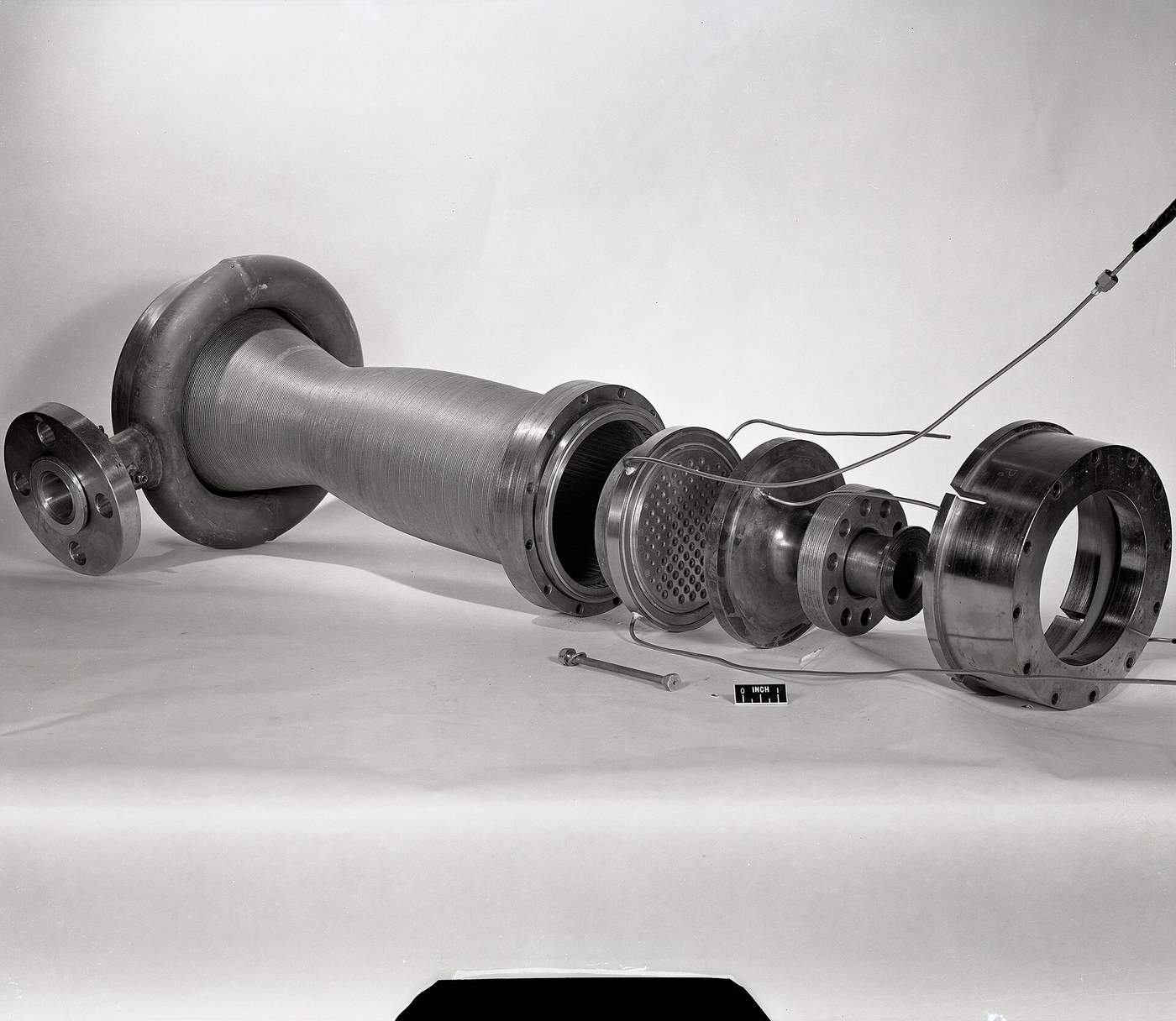


Regenerative Cooling
निर्देश
Prove a thin wall with flowing water cannot get hot
Prove a thin wall with flowing water cannot get hot
The counter-intuitive claim first, demonstrated with a blowtorch and a copper tube.
- Take a thin-walled copper tube and run water through it at a good rate.
- Play a propane torch directly on the outside and measure the OUTER wall temperature with an infrared thermometer.
- Measure the water temperature in and out.
- Now stop the flow, briefly, and watch the wall temperature.
With water flowing, the wall sits barely above the water temperature even under direct flame; the moment flow stops it climbs immediately toward destruction.
The reason is that heat must cross three resistances in series — gas to wall, through the wall, wall to coolant — and the wall’s own resistance is tiny if it is thin and made of copper. Wall temperature is set almost entirely by the coolant side, not by the flame. Which is why chamber liners are made of copper alloy rather than something with a high melting point: conductivity beats heat resistance.
That is worth pausing on, because it inverts the obvious approach. You do not fight a 3300°C fire by finding a material that survives 3300°C — no such material is practical. You fight it by making sure the material never experiences it.इस चरण के लिए सामग्री:
 ताँबे की नली1 टुकड़ा
 प्रोपेन1 canister
आवश्यक उपकरण:
 प्रोपेन टॉर्च
 अवरक्त थर्मामीटर
 ऊष्मीय प्रतिबिंबन कैमरा
 पाठक सहित तापयुग्म
 दाबमापी
 पारदर्शी सुरक्षा चश्मा
 मुखावरण
 अग्निशामक
Machine cooling channels and compute the heat load
Machine cooling channels and compute the heat load
Size the passages from the heat they must remove, not by eye.
- Estimate the heat flux at the chamber wall — for a small engine, a few megawatts per square metre is a realistic starting figure, and it PEAKS at the nozzle throat.
- Multiply by wall area to get total heat load.
- Divide by the coolant’s mass flow and specific heat capacity to find its temperature rise.
- Machine axial channels in a copper liner sized to give the required coolant velocity.
The throat is where the heat flux peaks, often by a factor of two or three over the chamber, because the gas is fastest and densest there. So the channels must be narrowest at the throat, where the coolant is forced to speed up exactly where it is needed most.
Reverse-engineering note: this is why a rocket chamber is not a plain tube but a machined liner with dozens of individually-contoured channels, closed out by an electroformed or brazed outer jacket. The channel cross-section varies continuously along the length, and that variation is the cooling design.इस चरण के लिए सामग्री:
 तांबे का ब्लॉक1 टुकड़ा
 ग्राफ़ पेपर1 pad
आवश्यक उपकरण:
 धातु खराद
 मिलिंग शिकंजा 4 इंच
 डिजिटल वर्नियर कैलिपर, 6 इंच
 माइक्रोमीटरअवरक्त थर्मामीटरपाठक सहित तापयुग्मपारदर्शी सुरक्षा चश्मा
Find the boiling limit that ends the party
Find the boiling limit that ends the party
Liquid cooling has one abrupt failure mode and it is worth meeting deliberately, at small scale.
- Heat a small test section with a controlled electrical heater and flow coolant through it.
- Raise the heat input in steps, recording wall temperature at each.
- Continue past the point where small bubbles first appear at the wall.
- Stop the moment wall temperature starts climbing rapidly for no extra heat input.
Wall temperature rises gently, and then at a certain flux it jumps sharply. Below that point bubbles form at the wall and immediately collapse back into the cooler bulk liquid — nucleate boiling, which actually improves heat transfer. Above it the bubbles merge into a continuous vapour film that insulates the wall from the liquid entirely.
That is departure from nucleate boiling, and it is not a gradual degradation. The wall goes from well-cooled to uncooled in milliseconds, and a copper liner burns through immediately.
Keeping coolant pressure ABOVE its critical pressure avoids the problem entirely, because above the critical point there is no distinction between liquid and vapour and therefore no film to form. This is one reason regenerative circuits run at such high pressure — not only to reach the injector, but to stay out of the boiling regime altogether.इस चरण के लिए सामग्री:
ताँबे की नली1 टुकड़ा कार्ट्रिज हीटर तत्त्व2 टुकड़ेग्राफ़ पेपर1 pad
आवश्यक उपकरण:
पाठक सहित तापयुग्मअवरक्त थर्मामीटरदाबमापी डिजिटल तराज़ूपारदर्शी सुरक्षा चश्मामुखावरण
Add film cooling as the second line of defence
Add film cooling as the second line of defence
Protect the wall from inside as well as outside.
- Add a ring of small holes near the injector face, angled to direct fuel ALONG the chamber wall rather than into the core.
- Cold-flow and confirm a continuous liquid film forms on the wall.
- Measure how far downstream the film survives before breaking up.
- Compute the propellant fraction being spent on it.
A thin layer of fuel flowing along the wall keeps the hottest gas physically away from the metal, and its evaporation absorbs heat where it matters most. Typically a few percent of total fuel flow is diverted this way.
The cost is real: that fuel burns at a lower mixture ratio than optimal, so it produces less energy per kilogram, and specific impulse drops slightly. You are deliberately running the engine worse in order to keep it intact.
Some engines take this further and run the entire outer injector ring fuel-rich, accepting a measurable Isp penalty for a large margin against wall failure. The choice is not efficiency versus laziness — it is efficiency versus the engine existing at the end of the burn.इस चरण के लिए सामग्री:
 ताँबे की चादर1 टुकड़ा
 खाद्य रंग (प्रवाह दिखाने वाला रंग)1 बोतल
आवश्यक उपकरण:
 ड्रिल मशीन (खंभेदार)मिलिंग शिकंजा 4 इंचडिजिटल वर्नियर कैलिपर, 6 इंच
 धीमी गति के वीडियो वाला स्मार्टफ़ोनदाबमापीअवरक्त थर्मामीटरपारदर्शी सुरक्षा चश्मा
Close the loop, and see the heat come back as thrust
Close the loop, and see the heat come back as thrust
Now connect the coolant outlet to the injector and understand why this is called regenerative.
- Trace the full path: tank, pump, cooling channels, injector, chamber.
- Measure the coolant temperature rise across the channels from the earlier test.
- Consider where that absorbed energy goes once the warmed fuel is injected and burned.
The heat removed from the wall is not dumped overboard — it is carried into the chamber inside the fuel and released again during combustion. Almost none of it is lost. The cooling system is thermodynamically nearly free, which is why it beats every alternative.
Compare the alternatives honestly. Ablative cooling lines the chamber with material that chars and erodes away, carrying heat off as vapour — simple, needs no plumbing, and strictly single-use as the liner is consumed. Radiative cooling lets a refractory nozzle extension glow white-hot and radiate to space — no coolant at all, but only workable where heat flux is low. Regenerative cooling is reusable, adds no propellant cost, and demands precision machining and high pressure.
Real engines mix all three: regenerative chamber and throat where flux is highest, radiative niobium skirt where it is low, ablative for cheap or short-lived stages. The right answer varies along the length of a single engine, which is exactly the kind of detail that only appears once you know what each method actually costs.इस चरण के लिए सामग्री:
तांबे का ब्लॉक1 टुकड़ाग्राफ़ पेपर1 padआवश्यक उपकरण:
पाठक सहित तापयुग्मअवरक्त थर्मामीटरऊष्मीय प्रतिबिंबन कैमरादाबमापीडिजिटल वर्नियर कैलिपर, 6 इंच TIG वेल्डिंग मशीनपारदर्शी सुरक्षा चश्मामुखावरण
सामग्री
7- 1 टुकड़ाप्लेसहोल्डर
- 1 canisterप्लेसहोल्डर
- 1 टुकड़ाप्लेसहोल्डर
- 1 padप्लेसहोल्डर
- 2 टुकड़ेप्लेसहोल्डर
- 1 टुकड़ाप्लेसहोल्डर
- प्लेसहोल्डर
आवश्यक उपकरण
16- प्लेसहोल्डर
- प्लेसहोल्डर
- प्लेसहोल्डर
- प्लेसहोल्डर
- प्लेसहोल्डर
- प्लेसहोल्डर
- प्लेसहोल्डर
- प्लेसहोल्डर
- प्लेसहोल्डर
- प्लेसहोल्डर
- प्लेसहोल्डर
- प्लेसहोल्डर
- प्लेसहोल्डर
- प्लेसहोल्डर
- प्लेसहोल्डर
- प्लेसहोल्डर
संबंधित ब्लूप्रिंट
ये ब्लूप्रिंट ज्ञान साझा करते हैं — तकनीक, सामग्री या सिद्धांत

CC0 पब्लिक डोमेन
यह ब्लूप्रिंट CC0 के तहत जारी किया गया है। आप बिना अनुमति माँगे इस कार्य को किसी भी उद्देश्य के लिए कॉपी, संशोधित, वितरित और उपयोग करने के लिए स्वतंत्र हैं।
उनके ब्लूप्रिंट के माध्यम से उत्पाद खरीदकर मेकर का समर्थन करें जहाँ वे मेकर कमीशन कमाते हैं जो विक्रेताओं द्वारा निर्धारित होता है, या इस ब्लूप्रिंट का नया संस्करण बनाएँ और राजस्व साझा करने के लिए इसे अपने ब्लूप्रिंट में कनेक्शन के रूप में शामिल करें।