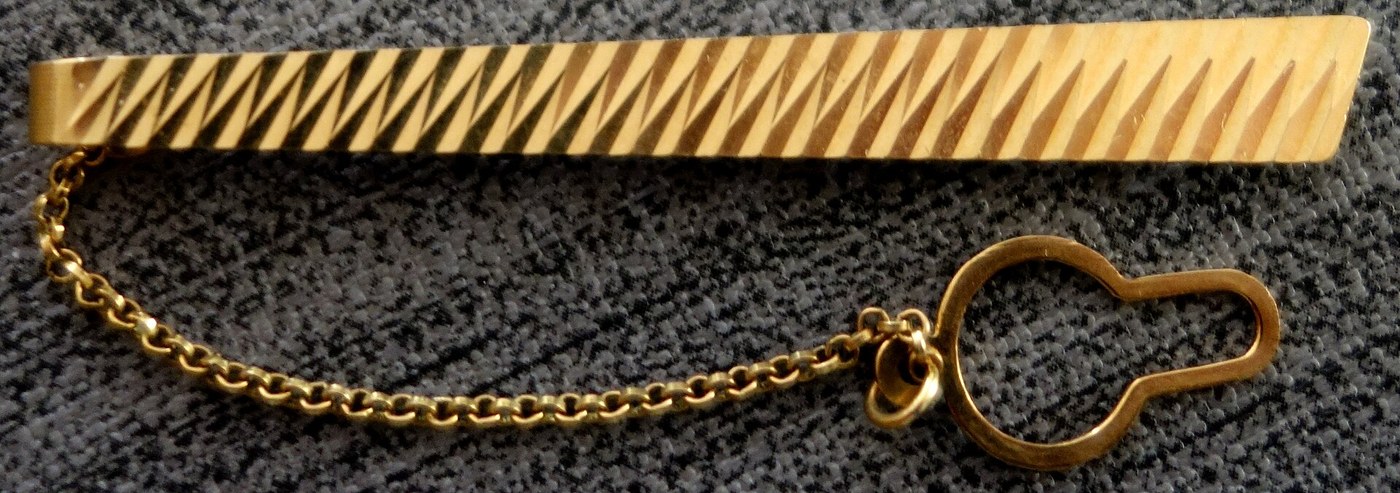


The Tie Clip
A tie clip is one of the smallest useful objects a metalworker can make, and it is a genuinely good first exercise because it has to work. It is not jewellery that merely sits there: it has to grip a tie and a shirt placket together, hold against a day of movement, and let go without creasing the silk.
All of that comes from one property — spring. A strip of annealed metal folded double will close and stay closed; it has no memory. The clip needs the metal to be work-hardened or heat-treated so that bending it open stores energy and releases it as clamping force. That is the whole engineering content, and it is why a beautifully finished clip made from dead-soft brass is a failure.
The second property is geometry. The gap at the mouth must be smaller than the thickness it clamps, so the clip is always working slightly open. Too little and it slides; too much and it marks the fabric or splays permanently past its elastic limit and never recovers.
The distinction to get right: a tie bar is a sprung folded clip that slides on; a tie tack is a pin that pierces the tie; a tie chain hangs. This blueprint makes the sprung bar.
Cut, form, harden, finish, and then measure the clamping force — because that is the number that decides whether it works.
निर्देश
Cut the blank
Cut the blank
Mark a strip on brass sheet about 55 mm long and 6 mm wide, in stock around 0.8 mm thick. Saw it out with a jeweller's saw, cutting outside the line.
File the edges straight and true, then round the corners.
Thickness is the design variable. Too thin and it will not grip; too thick and you cannot get it to spring at all in this width.
इस चरण के लिए सामग्री:
 पीतल की चादर1 शीट
आवश्यक उपकरण:
 जौहरी की आरी
 सुई-रेती सेट
Anneal it before you bend it
Anneal it before you bend it
Heat the brass to a dull red in low light, then let it cool. Brass can be quenched in water or air-cooled — either way it comes out soft.
Clean off any oxide.
Annealing before forming, hardening after, is the order that matters. Bending hard brass cracks it; the strength has to be put back in afterwards.
आवश्यक उपकरण:
 गरम हवा की बंदूक
Form the fold over a mandrel
Form the fold over a mandrel
Bend the strip back on itself around a rod about 3 mm across, roughly one third from one end, so you get a long face and a shorter sprung leg.
Close it until the tips overlap slightly and the mouth is closed.
A radiused fold, not a sharp crease. A sharp bend concentrates stress and is where the clip will eventually snap.
आवश्यक उपकरण:
 पट्टीदार क्लैंप
Work-harden the spring leg
Work-harden the spring leg
Planish the short leg with light, even hammer blows on a smooth steel surface, or draw it repeatedly between smooth jaws. Work along its length, not one spot.
Test by opening and releasing: it should snap back.
Cold work deforms the crystal grains and multiplies the dislocations that resist further movement — the metal is stiffer because you made it harder for its own internal structure to slide.
Measure the clamping force
Measure the clamping force
Hook a spring scale into the mouth and record the force needed to open it to 2 mm, the thickness of a tie plus a shirt.
Compare against a commercial clip.
Then over-open it to 10 mm, release, and re-measure.
Expect a drop if you exceeded the elastic limit. That drop is permanent — you have bent it, not sprung it, and no amount of re-closing recovers the force.
आवश्यक उपकरण:
 बल-मापी (स्प्रिंग तुला)
 डिजिटल वर्नियर कैलिपर, 6 इंच
Finish, and check it does not mark silk
Finish, and check it does not mark silk
Work through progressively finer abrasives on the visible face, then polish. Break every edge that will touch fabric until it cannot be felt with a fingernail.
Test on an offcut of silk or fine cotton: clip, leave an hour, remove, inspect.
Expect no permanent mark. If there is one, the culprit is nearly always a sharp inner edge or too much force — and it is a defect, not a characteristic.
आवश्यक उपकरण:
 चमकाने का लेप
 गहने चमकाने का कपड़ा
History & Context
History & Context
The tie clip exists because of a change in clothing, not a change in taste. Through the nineteenth century a necktie was held by a stickpin or a cravat pin thrust through the fabric, which suited the heavy, loosely knotted cravats of the period. The modern long necktie — light, narrow, worn over a button-through shirt — appears in the early twentieth century, and a pin through fine silk is a poor answer to it. The sprung tie bar and the tie tack both belong to that period, and the tie bar won for the same reason most clips win: it does not make a hole.
Why work-hardening is the real subject. Metals deform because planes of atoms slide over one another along defects called dislocations. Annealing lets the crystal grains recrystallise into a low-defect, easily-sliding state — soft and formable. Cold working multiplies and tangles those dislocations until they obstruct each other, so further deformation needs more force: the metal becomes harder, stronger and springier, and simultaneously more brittle. Every spring in every mechanism, from a safety pin to a watch hairspring, sits somewhere on that trade-off, and a maker chooses the point deliberately.
Materials, honestly compared. Brass is forgiving, cheap and takes a superb polish, but its spring is modest and it fatigues; it is the right material to learn on. Nickel silver is similar to work and much whiter. Phosphor bronze and spring steel are what a clip that must last decades is actually made from — spring steel needs proper hardening and tempering rather than cold work, and tempering to a blue is the traditional way to get a springy, non-brittle result. Sterling silver looks the part and is a poor spring. The clip that fails first is usually the prettiest one.
Fatigue is the failure mode. A tie clip is opened and closed perhaps a thousand times a year, always at the same fold. Metal that survives a single large deflection can still fail after many small ones, because each cycle grows a microscopic crack at the point of highest stress — which is precisely the inside of a sharp bend. A generous radius at the fold is not cosmetic; it is the difference between a clip that lasts a decade and one that snaps in a year.
Safe practice. Hot metal looks identical to cold metal — set down annealed work in one designated place and assume anything on the bench is hot. Wear eye protection when sawing and filing; brass swarf is sharp and travels. Work in ventilation when heating, and do not overheat brass to the point where it fumes, as zinc vapour from overheated brass is genuinely unpleasant to breathe. Nothing in this blueprint is toxic in normal use — the hazards are heat, edges and fumes from overheating, all of which are handled by ordinary workshop discipline.
सामग्री
1- 1 शीटप्लेसहोल्डर
आवश्यक उपकरण
8- प्लेसहोल्डर
- प्लेसहोल्डर
- 1 vendor sell this, none ship to you yetप्लेसहोल्डर
- प्लेसहोल्डर
- प्लेसहोल्डर
- प्लेसहोल्डर
- प्लेसहोल्डर
- प्लेसहोल्डर
कनेक्टेड ब्लूप्रिंट सामग्री
संबंधित ब्लूप्रिंट
ये ब्लूप्रिंट ज्ञान साझा करते हैं — तकनीक, सामग्री या सिद्धांत
CC0 पब्लिक डोमेन
यह ब्लूप्रिंट CC0 के तहत जारी किया गया है। आप बिना अनुमति माँगे इस कार्य को किसी भी उद्देश्य के लिए कॉपी, संशोधित, वितरित और उपयोग करने के लिए स्वतंत्र हैं।
उनके ब्लूप्रिंट के माध्यम से उत्पाद खरीदकर मेकर का समर्थन करें जहाँ वे मेकर कमीशन कमाते हैं जो विक्रेताओं द्वारा निर्धारित होता है, या इस ब्लूप्रिंट का नया संस्करण बनाएँ और राजस्व साझा करने के लिए इसे अपने ब्लूप्रिंट में कनेक्शन के रूप में शामिल करें।