
Understanding Barium from Baryte — The Heavy Earth That Glows in the Dark
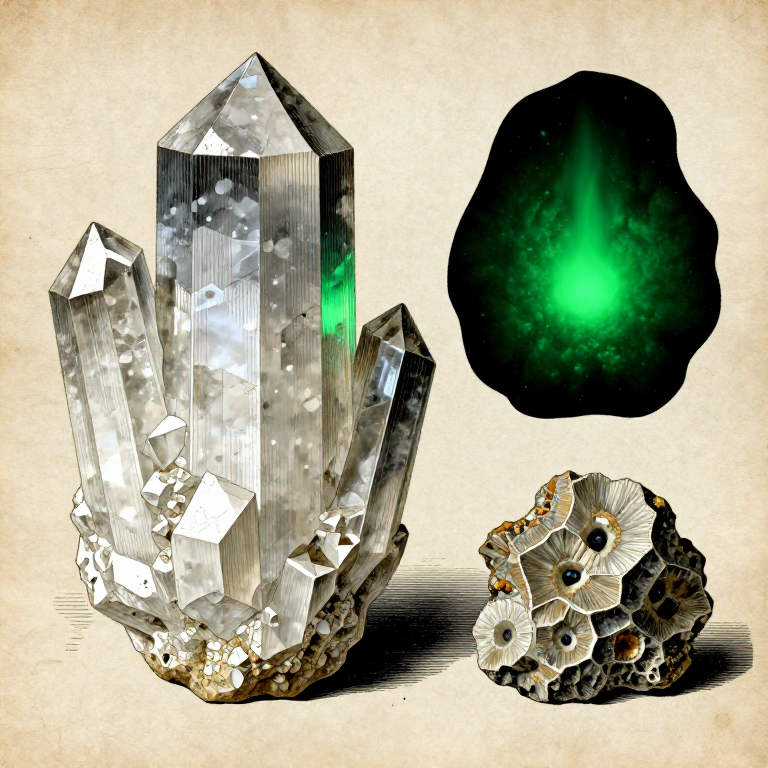
Barium (Ba, element 56) takes its name from the Greek barys ('heavy'), because its primary mineral baryte (BaSO₄, barium sulfate) is unusually dense for a non-metallic mineral. The mineral was known to 17th-century alchemists as lapis Bononiensis (Bologna stone) — specimens of baryte from Monte Paderno near Bologna were found to glow in the dark after being heated with charcoal, a phenomenon of phosphorescence that captivated natural philosophers for over a century.
Carl Wilhelm Scheele identified barium as a distinct 'earth' (oxide) in 1774 by distinguishing baryta (BaO) from lime (CaO) and stite (SrO). Humphry Davy first isolated metallic barium in 1808 by electrolysis of molten barium hydroxide — the same year he isolated strontium, calcium, magnesium, potassium, and sodium. Davy's electrochemical work in 1807–1808 was one of the most productive periods in the history of element discovery.
Metallic barium cannot be produced by carbon reduction — like the alkali and alkaline earth metals, it requires electrolysis. This blueprint focuses on identifying baryte, understanding its remarkable properties (the heaviest common non-metallic mineral, phosphorescence, X-ray opacity), and demonstrating the Bologna stone phosphorescence phenomenon.
HAZARD: Barium metal is reactive and toxic. Soluble barium compounds (barium chloride, barium carbonate) are acutely poisonous — lethal dose approximately 1–15 grams for an adult. However, barium sulfate (baryte) is completely insoluble and non-toxic — it is safely swallowed by patients for barium meal X-ray imaging. The hazard distinction depends entirely on solubility.
निर्देश
Understand barium chemistry and its alkaline earth nature
Understand barium chemistry and its alkaline earth nature
Barium (Ba, element 56) is an alkaline earth metal in Group 2, below beryllium, magnesium, calcium, and strontium. It has a density of 3.51 g/cm³, melting point of 727 °C, and is a soft, silvery-white metal that oxidizes rapidly in air and reacts vigorously with water: Ba + 2H₂O → Ba(OH)₂ + H₂↑. It must be stored under mineral oil or in sealed containers to prevent oxidation.
Barium's most distinctive property is the green color it imparts to flames — barium compounds burn with a vivid, apple-green flame that is used in fireworks, signal flares, and tracer ammunition. The green color comes from emission lines of BaCl and BaOH molecules at 524 nm and 513 nm. This flame color is one of the most reliable qualitative tests for barium.
Despite the toxicity of soluble barium compounds, barium sulfate (BaSO₄) is so insoluble (Ksp = 1.1 × 10⁻¹⁰) that it passes through the human digestive system without being absorbed. This makes it the ideal X-ray contrast medium: patients drink a thick barium sulfate suspension ('barium meal'), and the dense barium atoms absorb X-rays, producing a clear image of the gastrointestinal tract. Millions of barium meals are administered annually in medical imaging worldwide.
Identify baryte in the field
Identify baryte in the field
Baryte (BaSO₄, also spelled barite) is a white to colorless mineral with a vitreous to pearly luster. Key identification features: Mohs hardness 3–3.5, specific gravity 4.48 (remarkably heavy for a white, non-metallic mineral — this exceptional density is the primary field diagnostic), perfect cleavage in three directions producing rectangular fragments, and a white streak.
The density test is definitive: pick up a baryte specimen and compare its weight to similarly sized specimens of calcite (SG 2.71), quartz (SG 2.65), or feldspar (SG 2.56–2.76). Baryte feels approximately 60–70% heavier than these common minerals — the difference is immediately obvious in the hand. This exceptional heft for a pale, non-metallic mineral is unique to baryte and celestine (SrSO₄, SG 3.97).
Baryte commonly forms tabular crystals, rosette aggregates ('desert roses'), and massive, granular bodies. It occurs in hydrothermal veins (associated with lead, zinc, and fluorite mineralization), as concretions in sedimentary rocks, and as desert roses in arid evaporite environments. Major deposits include China, India, Morocco, Turkey, and the United States. Baryte is the primary commercial source of barium and is also used directly as a weighting agent in oil-well drilling mud (due to its high density).
आवश्यक उपकरण:
 भूवैज्ञानिक हथौड़ा
 हस्त आवर्धक लेंस 10x
 धारी-पट्ट (बिना पॉलिश का चीनी मिट्टी)
Demonstrate the Bologna stone phosphorescence
Demonstrate the Bologna stone phosphorescence
The Bologna stone phenomenon — baryte that glows after heating with charcoal — was discovered by Vincenzo Casciarolo, an Italian cobbler and amateur alchemist, around 1602. He noticed that baryte heated with charcoal glowed in the dark for hours afterward. This was the first recorded observation of persistent phosphorescence and caused a sensation in European natural philosophy.
To replicate this: mix 50 grams of finely powdered baryte with 10 grams of finely powdered charcoal and 5 grams of flour (as a binding agent). Form the mixture into small pellets or cakes. Heat these in a crucible at 900–1000 °C for 30–60 minutes in a charcoal furnace. The carbon partially reduces the barium sulfate to barium sulfide (BaS): BaSO₄ + 4C → BaS + 4CO.
After cooling, expose the pellets to bright light (sunlight or a UV lamp) for several minutes, then take them into a completely dark room. They should glow with a pale bluish or yellowish phosphorescence that persists for minutes to hours. The phosphorescence comes from trace impurities in the barium sulfide that create crystal defect centers capable of storing light energy and releasing it slowly. The glow varies with impurity content — historical Bologna stones varied considerably in brightness, which led to much debate about the cause.
इस चरण के लिए सामग्री:
 लकड़ी का कोयला (ढेलेदार)10 gramsलकड़ी का कोयला (ढेलेदार)2 किलो
आवश्यक उपकरण:
 गहरी मिट्टी की घरिया
 कोयला भट्ठी
 धौंकनी
 धूल मास्क
 चमड़े के लंबे दस्ताने
Perform the barium flame test
Perform the barium flame test
The most visually striking demonstration of barium is its flame color. Barium compounds produce a vivid, distinctive apple-green flame — one of the purest green flame colors of any element. To perform the test, you need a soluble barium compound and a clean platinum or nichrome wire (a straightened steel paperclip works adequately).
Since baryte (BaSO₄) is insoluble and will not adhere to a wire for a flame test, first convert a small amount to a soluble compound. Heat 5 grams of powdered baryte with an equal weight of sodium carbonate (Na₂CO₃) in a crucible at 800–900 °C for 30 minutes. This converts insoluble BaSO₄ to soluble barium carbonate (BaCO₃): BaSO₄ + Na₂CO₃ → BaCO₃ + Na₂SO₄. Dissolve the cooled product in dilute hydrochloric acid to form barium chloride solution.
Dip a clean wire into the barium chloride solution and hold it in the edge of a Bunsen burner or gas flame. The flame turns a brilliant, clear green. This green color is used in fireworks — barium chlorate (Ba(ClO₃)₂) is the traditional green-flame oxidizer in pyrotechnics, though it is being gradually replaced by less toxic alternatives.
इस चरण के लिए सामग्री:
 सोडियम कार्बोनेट (सज्जीक्षार)5 grams
आवश्यक उपकरण:
गहरी मिट्टी की घरिया काँच की नमूना शीशी
 नाइट्राइल रबर दस्ताने
Understand why electrolysis was needed
Understand why electrolysis was needed
Barium, like calcium, magnesium, and the alkali metals, cannot be reduced by carbon. The Ellingham diagram shows that barium oxide (BaO) is more thermodynamically stable than carbon monoxide at all achievable temperatures — carbon cannot steal the oxygen from barium. This same barrier applies to calcium oxide (quicklime, CaO), which has been known since antiquity but from which metallic calcium was not isolated until Davy's electrolysis in 1808.
Humphry Davy's method was to pass a strong electric current through slightly damp barium hydroxide (Ba(OH)₂) or, in later experiments, through a molten mixture of barium chloride and other salts. The electrical energy forces the reduction that thermochemistry forbids: Ba²⁺ + 2e⁻ → Ba (at the cathode). The barium metal, being reactive, oxidizes rapidly in air and reacts with water, making it extremely difficult to collect and preserve.
Davy's 1807–1808 electrolysis campaign was revolutionary: using the newly invented voltaic pile (battery), he isolated potassium, sodium, calcium, strontium, barium, and magnesium — six elements in approximately 18 months. He demonstrated that the 'earths' and 'alkalis' known to chemistry for centuries (lime, baryta, strontia, magnesia, potash, soda) were actually oxides of previously unknown metals. This was arguably the most productive period in the history of element discovery.
Clean up and document results
Clean up and document results
WARNING: Barium sulfide (BaS), produced in the Bologna stone experiment, is a soluble barium compound and is toxic. The phosphorescent pellets must be handled with gloves and stored or disposed of responsibly. Do not allow barium sulfide to enter water sources. Wash all surfaces and tools that contacted the heated material. Barium chloride solution from the flame test is also toxic — neutralize with sodium sulfate (Na₂SO₄) to precipitate insoluble, non-toxic barium sulfate before disposal.
Unreacted baryte (BaSO₄) is completely non-toxic and can be discarded normally. The clear distinction between toxic soluble barium compounds and non-toxic insoluble barium sulfate is a critical safety principle — the same element can range from harmless to lethal depending on the compound's solubility.
Document the complete set of experiments: baryte identification (density, streak, cleavage), Bologna stone phosphorescence (glow color, duration, intensity), flame test (color), and the carbon reduction failure (demonstrating why electrolysis is needed). This series of observations connects a 17th-century alchemical curiosity to 18th-century analytical chemistry to 19th-century electrochemistry — the intellectual progression that transformed natural philosophy into modern chemistry.
सामग्री
2- 2 किलोप्लेसहोल्डर
- प्लेसहोल्डर
आवश्यक उपकरण
11- प्लेसहोल्डर
- प्लेसहोल्डर
- प्लेसहोल्डर
- प्लेसहोल्डर
- प्लेसहोल्डर
- प्लेसहोल्डर
- प्लेसहोल्डर
- प्लेसहोल्डर
- प्लेसहोल्डर
- प्लेसहोल्डर
- प्लेसहोल्डर
CC0 पब्लिक डोमेन
यह ब्लूप्रिंट CC0 के तहत जारी किया गया है। आप बिना अनुमति माँगे इस कार्य को किसी भी उद्देश्य के लिए कॉपी, संशोधित, वितरित और उपयोग करने के लिए स्वतंत्र हैं।
उनके ब्लूप्रिंट के माध्यम से उत्पाद खरीदकर मेकर का समर्थन करें जहाँ वे मेकर कमीशन कमाते हैं जो विक्रेताओं द्वारा निर्धारित होता है, या इस ब्लूप्रिंट का नया संस्करण बनाएँ और राजस्व साझा करने के लिए इसे अपने ब्लूप्रिंट में कनेक्शन के रूप में शामिल करें।