

Understanding Tantalum from Columbite-Tantalite — The Conflict Metal Inside Every Phone
Tantalum is element 73 — a dense, blue-grey, extraordinarily corrosion-resistant transition metal that is almost impossible to dissolve. Only hydrofluoric acid and oleum attack it; all other acids, including boiling aqua regia, leave tantalum untouched. This chemical inertness, combined with the ability to form a thin, stable, insulating oxide layer (Ta₂O₅), makes tantalum irreplaceable in miniature capacitors — the components that filter power and store charge in virtually every smartphone, laptop, and implantable medical device on Earth.
Tantalum's name comes from Tantalus of Greek mythology, who was condemned to stand in a pool of water that receded whenever he reached for it — an allusion to the element's frustrating insolubility in acid. It was discovered in 1802 by Anders Ekeberg in a Finnish mineral, but for decades was confused with niobium (element 41), its inseparable chemical twin. The two elements occur together in the mineral series columbite-tantalite ((Fe,Mn)(Nb,Ta)₂O₆), commonly called coltan — the ore at the centre of conflict mining controversies in the Democratic Republic of Congo.
This blueprint covers the identification, processing chemistry, and significance of tantalum from columbite-tantalite ore. Because tantalum extraction requires hydrofluoric acid and high-temperature metallurgy beyond safe laboratory scale, the blueprint focuses on mineral identification, chemical understanding, the industrial extraction pathway, and the geopolitical context that makes tantalum one of the most consequential elements in modern technology.
HAZARD: Tantalum metal itself is biocompatible and non-toxic (it is used in surgical implants). However, the industrial extraction of tantalum involves hydrofluoric acid (HF) — one of the most dangerous laboratory chemicals, causing deep tissue burns and potentially fatal systemic fluoride poisoning through skin contact. HF procedures are NOT described as hands-on steps. The mineral identification and density testing steps described here are safe.
निर्देश
Understand tantalum's chemistry and significance
Understand tantalum's chemistry and significance
Tantalum (Ta, atomic number 73, atomic mass 180.95) is a Group 5 transition metal with an electron configuration [Xe]4f¹⁴5d³6s². It is extremely dense (16.69 g/cm³ — denser than lead), has the fourth-highest melting point of all metals (3017 °C, after tungsten, rhenium, and osmium), and forms a passivating oxide layer (Ta₂O₅) only 1–5 nm thick that is one of the best dielectric materials known — with a dielectric constant of approximately 25, far higher than silicon dioxide (3.9).
This oxide layer is the basis of tantalum capacitors: a porous tantalum pellet is anodized to form a thin, uniform Ta₂O₅ film, which serves as the dielectric between the tantalum anode and a conductive cathode (manganese dioxide or conductive polymer). The high dielectric constant and thin film allow enormous capacitance in tiny volumes — a tantalum capacitor the size of a grain of rice can store more charge than an aluminum electrolytic capacitor ten times its volume. Every smartphone contains 20–40 tantalum capacitors. Global demand is approximately 1800 tonnes per year, with supply concentrated in Australia, Brazil, and Central Africa.
Identify columbite-tantalite (coltan) ore
Identify columbite-tantalite (coltan) ore
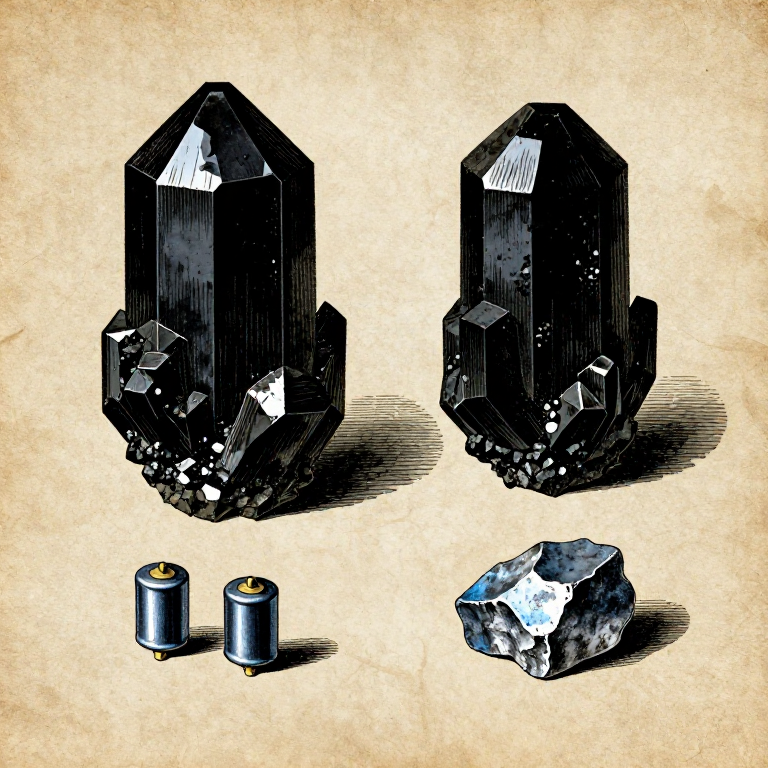
Columbite-tantalite forms a continuous solid solution series: columbite ((Fe,Mn)Nb₂O₆) is the niobium-rich end-member, tantalite ((Fe,Mn)Ta₂O₆) is the tantalum-rich end-member. The mineral is commonly called coltan — a portmanteau of columbite-tantalite. Obtain a specimen from a mineral supplier (specify tantalite-rich if possible).
Coltan crystals are typically black to dark brown, opaque, with a submetallic to resinous lustre. They form short prismatic or tabular orthorhombic crystals, often with striations on the prism faces. Hardness is 6–6.5 on the Mohs scale (scratches glass easily). The key identifying feature is density: tantalite has a specific gravity of 7.9–8.2, while columbite is lighter at 5.2–6.6. A specimen that feels noticeably heavier than similarly-sized iron ore or hematite is likely tantalite-rich. The high density is what makes coltan recoverable by gravity concentration in artisanal mining.
आवश्यक उपकरण:
 परिशुद्ध तराज़ू
Measure density to estimate tantalum content
Measure density to estimate tantalum content
The simplest way to assess whether a coltan specimen is tantalite-rich or columbite-rich is by measuring its specific gravity using Archimedes' method. Weigh the dry specimen on a precision scale (record as W_air). Then suspend the specimen from a thread and weigh it while fully submerged in distilled water (record as W_water). Specific gravity = W_air / (W_air − W_water).
Interpret the result: below 5.5 — predominantly columbite (niobium-rich); 5.5–7.0 — mixed columbite-tantalite; above 7.0 — tantalite-rich (high tantalum). The continuous variation arises because niobium (atomic mass 92.91) and tantalum (atomic mass 180.95) substitute freely for each other in the crystal lattice — tantalum is nearly twice as heavy as niobium, so the more tantalum present, the denser the mineral. This simple density test is used by artisanal miners and mineral buyers worldwide to estimate ore value in the field without chemical analysis.
इस चरण के लिए सामग्री:
 आसुत जल200 मिली
आवश्यक उपकरण:
परिशुद्ध तराज़ू बोरोसिलिकेट बीकर
Test tantalum's chemical inertness
Test tantalum's chemical inertness
If you have a small piece of tantalum metal (available from element collectors — tantalum wire, foil, or rod), demonstrate its extraordinary corrosion resistance. Place pieces of tantalum in separate test tubes containing: concentrated hydrochloric acid (37%), concentrated nitric acid (70%), concentrated sulfuric acid (96%), and aqua regia (3:1 HCl:HNO₃ by volume). Heat each gently on a hot plate to 60–80 °C.
After 30 minutes, the tantalum is completely unchanged in every acid — no dissolution, no tarnishing, no gas evolution. This resistance surpasses even platinum and gold (both dissolve in aqua regia). Only hydrofluoric acid (HF) and mixtures of HF with strong oxidizers attack tantalum, by dissolving the protective Ta₂O₅ layer and forming soluble fluorotantalate complexes (TaF₇²⁻). This test dramatically illustrates why tantalum is used for chemical process equipment in the harshest acid environments — and why its extraction from ore requires HF, the one acid that defeats it.
आवश्यक उपकरण:
 परखनली (बोरोसिलिकेट)
 हॉट प्लेट
 रासायनिक छींट-रोधी चश्मा
 रसायन-रोधी दस्ताने
 अम्ल-गैस कार्ट्रिज युक्त श्वसन-यंत्र
Understand the industrial extraction process
Understand the industrial extraction process
Industrial tantalum extraction follows a specific sequence designed to separate tantalum from niobium — the two elements with the most similar chemistry of any pair in the periodic table. The Marignac process (1866): coltan ore is fused with potassium hydroxide (KOH), then dissolved in dilute HF. The resulting solution contains potassium fluorotantalate (K₂TaF₇) and potassium fluoroniobate (K₂NbOF₅). K₂TaF₇ is far less soluble in cold water than K₂NbOF₅ — fractional crystallization separates them.
The modern industrial method uses liquid-liquid extraction: the ore is dissolved in HF, producing H₂TaF₇ and H₂NbOF₅ in aqueous solution. This is contacted with methyl isobutyl ketone (MIBK) — tantalum preferentially partitions into the organic phase while niobium stays in the aqueous phase. Multiple counter-current stages achieve >99.9% separation. The purified K₂TaF₇ is then reduced to tantalum metal by sodium reduction in an inert atmosphere at 900 °C: K₂TaF₇ + 5Na → Ta + 5NaF + 2KF. The resulting tantalum powder is pressed and sintered at 2500 °C under high vacuum to form solid metal.
Examine a tantalum capacitor under magnification
Examine a tantalum capacitor under magnification
Obtain a tantalum capacitor from a discarded circuit board (they are the small, drop-shaped components marked with a stripe indicating polarity, often yellow, orange, or black). Using pliers, carefully crack open the case to reveal the interior. Inside is a small pellet of sintered tantalum powder — a sponge-like structure with enormous surface area (up to 1 m²/g after pressing and sintering).
The pellet surface is covered with a thin film of Ta₂O₅ formed by electrochemical anodization — this invisible oxide layer (typically 30–200 nm thick) is the dielectric that stores charge. The counter-electrode is a layer of manganese dioxide (dark brown) or conductive polymer (grey-blue) deposited over the oxide. The entire structure — tantalum sponge + oxide + counter-electrode — exploits the same property that makes tantalum unique: its oxide is thin, uniform, self-healing (if a defect occurs, re-anodization repairs it), and has a high dielectric constant. This is why no substitute has replaced tantalum capacitors in critical applications despite decades of effort.
Understand the Nb-Ta separation challenge
Understand the Nb-Ta separation challenge
Tantalum and niobium are among the hardest elements to separate because their ionic radii are nearly identical: Ta⁵⁺ = 0.64 Å, Nb⁵⁺ = 0.64 Å. This is a consequence of the lanthanide contraction — the 14 f-electrons added between niobium (period 5) and tantalum (period 6) contract the electron cloud so precisely that tantalum ends up almost exactly the same size as niobium despite having 32 more electrons. They form identical crystal structures, identical oxidation states, and nearly identical complexes.
The one exploitable difference is in their fluoride complex stability: H₂TaF₇ is more stable and more extractable into organic solvents than H₂NbOF₅ (note the oxo-fluoride vs pure fluoride — niobium more readily forms the oxo species). This subtle thermodynamic difference, amplified by multi-stage liquid-liquid extraction, is the basis of all modern Ta-Nb separation. Before the MIBK process was developed in the 1950s, separation required 20–30 fractional crystallization steps — a process so tedious that pure tantalum was more expensive per gram than gold.
Understand the conflict minerals context
Understand the conflict minerals context
Tantalum has a geopolitical dimension unlike any other element. The Democratic Republic of Congo (DRC) holds significant coltan reserves, and artisanal mining of coltan in eastern Congo has funded armed groups during the country's ongoing conflicts. The term 'conflict minerals' — covering tantalum, tin, tungsten, and gold (the '3TG') — entered public discourse in the early 2000s when investigations linked coltan mining to human rights abuses.
The Dodd-Frank Act (2010, Section 1502) required US-listed companies to trace their tantalum supply chains and disclose whether their minerals originated from conflict regions. The EU Conflict Minerals Regulation (2021) established mandatory due diligence for importers. These regulations drove the creation of the Responsible Minerals Initiative (RMI) and conflict-free smelter certification programmes. Today, the majority of tantalum is sourced from Australia (Greenbushes mine) and certified conflict-free operations in Rwanda and Brazil. Understanding this context is essential — tantalum is not just a chemical element but a nexus of technology, ethics, and global governance.
Compare tantalum with its sister elements
Compare tantalum with its sister elements
Tantalum belongs to the refractory metals — a group defined by extremely high melting points and exceptional hardness. Arrange a comparison table of the refractory metals you have studied: tungsten (3422 °C), tantalum (3017 °C), molybdenum (2623 °C), niobium (2477 °C), and chromium (1907 °C). Note how melting point correlates with the number of unpaired d-electrons available for metallic bonding — tungsten's half-filled 5d shell provides maximum bonding strength.
Tantalum's combination of properties — high melting point, excellent corrosion resistance, biocompatibility, and superb dielectric oxide — is unique among the refractory metals. Tungsten surpasses it in melting point but is brittle and lacks the oxide quality. Niobium is lighter and cheaper but its oxide is inferior for capacitors. Molybdenum oxidizes readily in air above 500 °C (forming volatile MoO₃). Each refractory metal occupies a specific niche defined by its unique combination of properties. Record your observations comparing physical appearance, density, hardness, and chemical resistance across whatever specimens you have available.
Test tantalum's biocompatibility context
Test tantalum's biocompatibility context
Tantalum is one of the most biocompatible metals known — the human body does not reject it, and its corrosion resistance means it does not release ions into surrounding tissue. Tantalum is used in orthopaedic implants (porous tantalum for bone ingrowth in hip and knee replacements), dental implants, surgical clips, stents, and cranial plates. The trabecular metal (Zimmer Biomet's porous tantalum) mimics the structure of cancellous bone — an open-cell foam with 80% porosity that allows bone tissue to grow directly into the implant.
This biocompatibility arises from the same Ta₂O₅ passivation layer that makes tantalum capacitors work: the oxide is chemically inert, does not dissolve in body fluids, and does not provoke an immune response. Compare this to other implant metals: titanium (biocompatible but forms a thicker, less stable oxide), stainless steel (can release nickel ions, causing allergic reactions in ~15% of the population), and cobalt-chromium alloys (can release metal ions under wear conditions). Tantalum's limitation is cost and density — at 16.69 g/cm³, a tantalum hip implant would be noticeably heavy.
आवश्यक उपकरण
7- प्लेसहोल्डर
- प्लेसहोल्डर
- प्लेसहोल्डर
- प्लेसहोल्डर
- प्लेसहोल्डर
- प्लेसहोल्डर
- प्लेसहोल्डर
कनेक्टेड ब्लूप्रिंट सामग्री

CC0 पब्लिक डोमेन
यह ब्लूप्रिंट CC0 के तहत जारी किया गया है। आप बिना अनुमति माँगे इस कार्य को किसी भी उद्देश्य के लिए कॉपी, संशोधित, वितरित और उपयोग करने के लिए स्वतंत्र हैं।
उनके ब्लूप्रिंट के माध्यम से उत्पाद खरीदकर मेकर का समर्थन करें जहाँ वे मेकर कमीशन कमाते हैं जो विक्रेताओं द्वारा निर्धारित होता है, या इस ब्लूप्रिंट का नया संस्करण बनाएँ और राजस्व साझा करने के लिए इसे अपने ब्लूप्रिंट में कनेक्शन के रूप में शामिल करें।