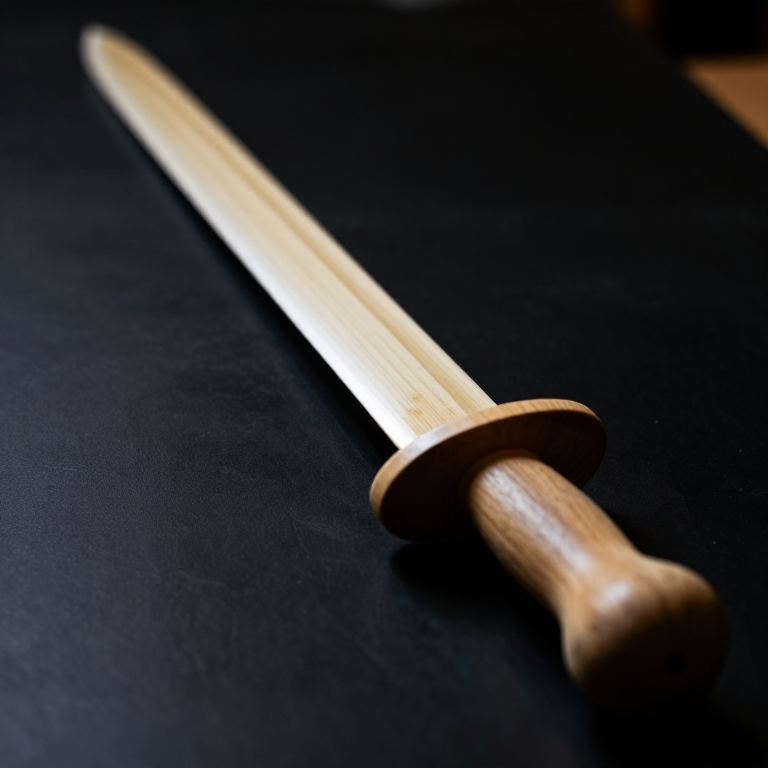


Wooden Waster
You cannot learn to fence with a sharp sword against another person, and you cannot learn it without another person. Every fencing tradition in history has had to solve that, and the medieval and Renaissance answer in England was the waster — a sword-shaped club of ash or oak, no edge, no point, the right length and roughly the right weight, cheap enough that breaking one did not matter.
The whole design problem is grain. A waster is a long thin lever that gets hit hard, and wood only tolerates that when the fibres run unbroken from tip to pommel. Get the grain right and it lasts years; get it wrong and it snaps at the first hard bind, usually into the other person.
This blueprint makes a single-handed waster for use with a buckler, from a riven ash billet.
निर्देश
Understand what this is and is not
Understand what this is and is not
A waster is blunt but it is a hardwood club, and it breaks bone. Any use against a person needs a mask, gloves and gorget as a minimum, an experienced instructor, and mutual consent. Never swing one at someone who is not equipped and expecting it.
Choose a straight, clear ash billet
Choose a straight, clear ash billet
Take air-dried ash, or white oak or hickory, at least 1000 mm long and free of knots. Ash is traditional because it is tough and bends before it breaks.
इस चरण के लिए सामग्री:
 कठोर लकड़ी का तख़्ता1 टुकड़ा
Rive the billet rather than sawing it
Rive the billet rather than sawing it
Split the billet along its length with a froe or wedges. Riving follows the fibres; a saw cuts across them wherever the grain wanders. This one decision does more for strength than any other step.
Reject any blank with grain run-out
Reject any blank with grain run-out
Look along the split faces. If the fibres run off the side of the blank rather than the length of it, set it aside for something else. Run-out at the blade is a guaranteed break.
Mark the overall dimensions
Mark the overall dimensions
Mark a blade of about 800 mm and a grip of about 110 mm, with a cross line between them. Match the length to the sword you are actually training with, not to a general rule.
आवश्यक उपकरण:
 रूलर
रूलरPlane the blank to a rectangular section
Plane the blank to a rectangular section
Work it down to roughly 32 mm wide by 20 mm thick at the base of the blade, keeping every face true. Everything after this is shaping from a known reference.
Taper the blade in width toward the tip
Taper the blade in width toward the tip
Draw the width down from 32 mm at the base to about 22 mm at the tip. Keep the taper even — a sudden change in section is where it will fail.
Taper the blade in thickness as well
Taper the blade in thickness as well
Reduce the thickness from about 20 mm at the base to 14 mm near the tip. Tapering both dimensions moves mass toward the hand, which is what makes it handle like a sword instead of a stick.
Round over the edges generously
Round over the edges generously
Ease all four long edges to a full radius with a spokeshave. A crisp square edge on a waster cuts skin and concentrates impact — it is meant to be blunt in every direction.
Round the tip fully
Round the tip fully
Work the tip into a smooth dome. A flat or squared tip behaves like a punch and will break ribs even through a jacket.
Shape the grip oval, not round
Shape the grip oval, not round
Cut the grip to an oval section with the long axis in the plane of the blade. The hand then knows the blade's orientation without looking — this is how real hilts work.
Fit a cross guard
Fit a cross guard
Cut a mortise through a hardwood cross about 200 mm long and drive it onto the blade shoulder, or fit a leather disc. Fingers get struck constantly in sword-and-buckler play.
Add a pommel to set the balance
Add a pommel to set the balance
Fit a turned wooden or metal pommel at the butt. Adjust its mass until the balance point sits about 100-130 mm forward of the guard — this is what makes it feel like a sword rather than a bat.
Oil it and leave it unsealed
Oil it and leave it unsealed
Rub in linseed oil and let it cure. Avoid a hard varnish: it hides the cracks you need to be able to see.
इस चरण के लिए सामग्री:
 खाद्य-श्रेणी का खनिज तेल100 मिली
Inspect it before every single session
Inspect it before every single session
Flex it and look along it for splinters, cracks or a dull sound when tapped. Retire it at the first crack. A waster that fails mid-bind sends a hardwood fragment at a partner's face.
History & Context — the sword you were allowed to practise with
History & Context — the sword you were allowed to practise with
A documented object, not a modern reconstruction. Wasters appear in English records from at least the fifteenth and sixteenth centuries, in the context of the London schools of defence and the Corporation of Masters of Defence chartered under Henry VIII. Prize playings — the public examinations by which a scholar advanced to free scholar, provost and master — were fought with specified weapons, and blunt training arms including wasters and blunted steel were part of that world. The word itself is generally taken to mean a thing that is worn away or expendable, which is a fair description of its working life.
What it is not. A waster is not a singlestick and not a foil. The singlestick is a later English tradition using a slender ash rod with a basket hilt, mainly for cutting practice at the head; the foil is a light thrusting weapon developed for the rapier and smallsword traditions. Wasters, singlesticks and blunt steel federschwerter coexisted and did different jobs, and the modern habit of using "waster" for any wooden training sword blurs distinctions the sources actually make.
Why grain direction decides everything. Wood is strong along the fibre and weak across it. In a riven blank the fibres run continuously from end to end, so a bending load is carried by whole fibres in tension. In a sawn blank the saw crosses wandering grain and leaves short fibres ending at the surface — under load those act as ready-made crack starters. This is the same reasoning behind riving bow staves and tool handles, and it is the reason a hand-split ash waster outlasts a machined one from the same tree.
An honest limitation. A wooden waster is heavier in the hand for its stiffness than steel and does not flex like a sharp sword or a modern feder, so the bind behaves differently and thrusts are far less forgiving. It teaches structure, measure and timing well; it does not fully reproduce the handling of the weapon it stands in for. Historical fencers knew this — which is why the sources describe training with blunt steel too, and why wasters were the cheap everyday option rather than the only one.
सामग्री
2- 1 टुकड़ाप्लेसहोल्डर
- 100 मिलीप्लेसहोल्डर
यह ब्लूप्रिंट बनाता है
संबंधित ब्लूप्रिंट
ये ब्लूप्रिंट ज्ञान साझा करते हैं — तकनीक, सामग्री या सिद्धांत
CC0 पब्लिक डोमेन
यह ब्लूप्रिंट CC0 के तहत जारी किया गया है। आप बिना अनुमति माँगे इस कार्य को किसी भी उद्देश्य के लिए कॉपी, संशोधित, वितरित और उपयोग करने के लिए स्वतंत्र हैं।
उनके ब्लूप्रिंट के माध्यम से उत्पाद खरीदकर मेकर का समर्थन करें जहाँ वे मेकर कमीशन कमाते हैं जो विक्रेताओं द्वारा निर्धारित होता है, या इस ब्लूप्रिंट का नया संस्करण बनाएँ और राजस्व साझा करने के लिए इसे अपने ब्लूप्रिंट में कनेक्शन के रूप में शामिल करें।