

Safety Belt
A painter on a mast, a lineman on a telegraph pole, a fireman on a ladder — all have the same problem. They need both hands for the work and both hands for holding on, and they only have two hands. Everything they carry has to be carried somewhere else, and their weight has to be taken by something that is not their grip.
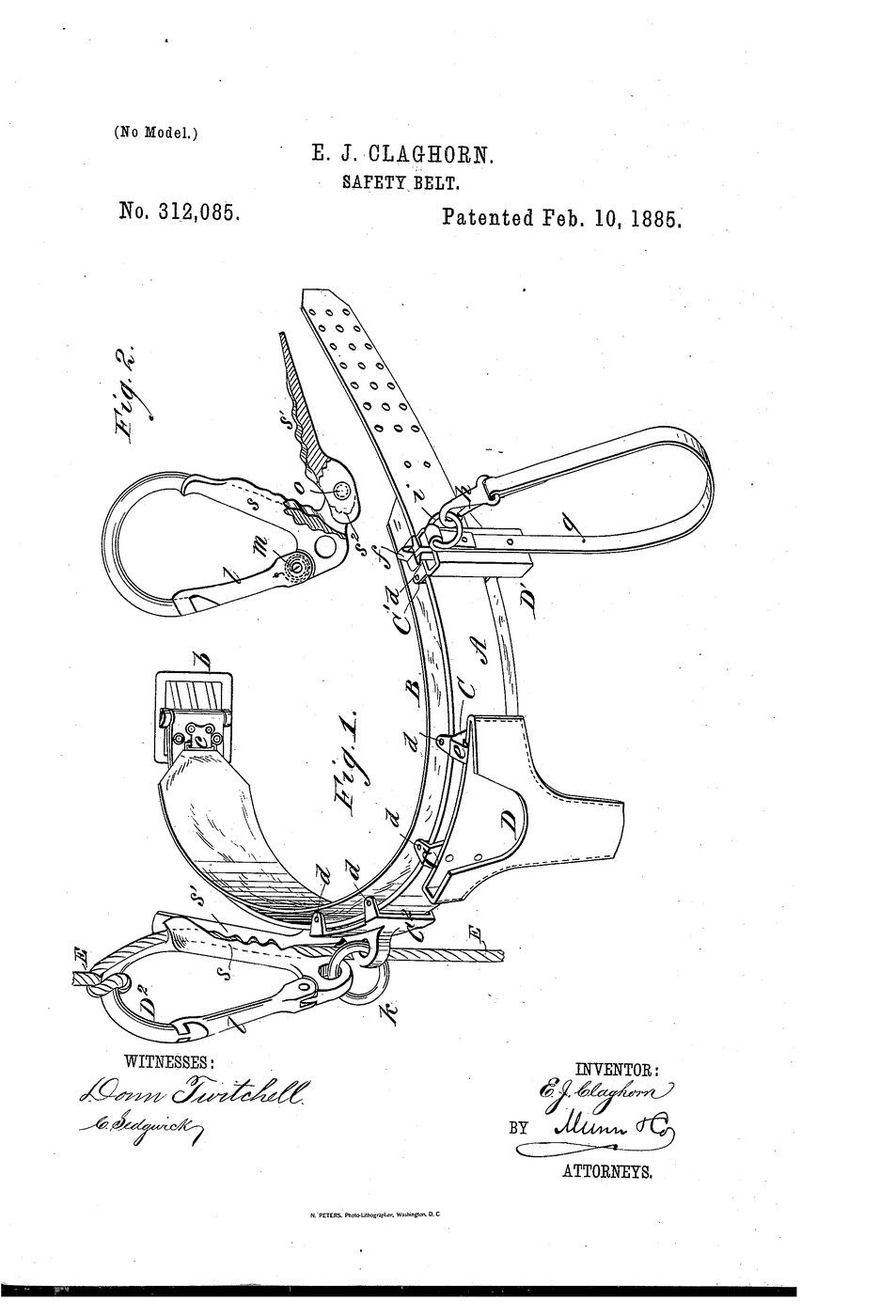
Claghorn's belt does both jobs from the waist. Two belts, an outer stout one and a wider inner one, with a gap between them; metal slides run around the outer belt and carry whatever the trade needs — hatchet, spikes, loops, holders. A hook with corrugated jaws grips a rope, and the wearer regulates a descent by hand pressure on those jaws instead of falling.
US Patent 312,085, "Safety Belt", filed 24 June 1884 and granted 10 February 1885 to Edward J. Claghorn. The patent names its users precisely — "tourists, sailors, painters, farmers, firemen, telegraph-men, and others" — and the aim is to "make the ascent or descent without incumbrance to either hands or feet".
This is not a car seat belt, despite being cited as one constantly. See the closing step.
دستورالعملها
This is a tool belt and a demonstration — never life support
This is a tool belt and a demonstration — never life support
Build it to carry tools and to understand the mechanism. Do NOT hang a person from anything you made here. Fall protection is certified equipment, tested to standards, and a home-made harness is not a substitute for it at any height.
Read US 312,085 and count the belts
Read US 312,085 and count the belts
Claghorn claims an outer stout belt and a wider inner belt with a space between them. Two belts, not one — and the gap is deliberate.
Hang a loaded single belt on a rail
Hang a loaded single belt on a rail
Put 3 kg of tools on one plain belt and load it over a rail. It digs into a narrow line. Note where the pressure concentrates.
Cut the wide inner belt
Cut the wide inner belt
Cut a leather or heavy webbing band about 100 mm wide to fit the waist. Width is what spreads the load — this band carries the body.
مواد مورد نیاز این مرحله:
 چرم دبّاغی گیاهی1 قطعه
Cut the narrow outer belt
Cut the narrow outer belt
Cut a stout band about 40 mm wide and slightly longer. This one takes the hardware, not the body — the two jobs are separated on purpose.
Join them leaving a gap
Join them leaving a gap
Stitch the two belts together only at intervals, so a channel remains between them. The slides will run in that channel.
Make the sliding hardware carriers
Make the sliding hardware carriers
Bend rectangular slides from steel wire or strip so each grips the outer belt and can be pushed along it. Make four.
مواد مورد نیاز این مرحله:
 سیم فولادی گالوانیزه1 متر
ابزارهای مورد نیاز:
 انبردست تخت
Fit tool loops to the slides
Fit tool loops to the slides
Add a hammer loop, a small pouch and two open holders. Each hangs from its own slide so it can be repositioned without unthreading the belt.
Reload and compare against step 3
Reload and compare against step 3
Put the same 3 kg on the finished belt and load it over the rail. The wide inner band spreads what the narrow one concentrated.
Move a tool without removing anything
Move a tool without removing anything
Slide the hammer loop from the hip to the back. Claghorn's arrangement lets a trade rearrange its own kit — the belt is not fixed to one job.
Make the corrugated friction jaws
Make the corrugated friction jaws
Form two short steel plates with a ribbed face and hinge them so they close on a rope. The ribs are the working surface, not decoration.
Test the friction hook with a weight, never a person
Test the friction hook with a weight, never a person
Hang a 3 kg weight from the jaws on a rope. Squeeze to hold, ease to let it run. Descent is regulated by grip pressure — that is Claghorn's claim.
Repeat with smooth jaws
Repeat with smooth jaws
File the ribs off a spare pair and try again. The rope slips unpredictably. The corrugation is what makes the grip progressive instead of on-or-off.
Measure the holding force
Measure the holding force
Pull the weighted rope through the closed jaws with a spring scale and record the force at light, medium and firm squeeze. Three numbers, one continuous control.
ابزارهای مورد نیاز:
 نیروسنج (ترازوی فنری)
History & Context — the seat belt that isn't
History & Context — the seat belt that isn't
The patent. US 312,085, "Safety Belt", filed 24 June 1884 and granted 10 February 1885 to Edward J. Claghorn of New York.
It is repeatedly described as the first automotive seat-belt patent. It is not, and the document says so plainly. Claghorn lists his users as "tourists, sailors, painters, farmers, firemen, telegraph-men, and others"; the stated purpose is to let a worker ascend and descend "without incumbrance to either hands or feet"; the hardware is hatchet holders, spike holders and tool loops; and the central mechanism is a friction hook for controlled rope descent. Every one of those points describes a work-at-height harness. There were essentially no automobiles in the United States in 1884 to belt anyone into — the first American production cars are a decade later. The claim seems to have spread because the title is "Safety Belt", the date is impressively early, and nobody read past the title. It belongs in the same family as the mis-attributions elsewhere in this programme: the title of a patent is not its claim.
What Claghorn actually got right. Splitting the belt in two is a genuinely good piece of design. A single belt has to be narrow enough to carry hardware neatly and wide enough not to cut into the wearer under load, and those requirements fight. Using a wide inner band for the body and a narrow outer band for the ironmongery resolves the conflict, and it puts the tool slides on a member that is not being deformed by the wearer's weight. Modern tool belts and climbing harnesses still separate load-bearing webbing from gear-carrying loops for exactly this reason, and step 3 versus step 9 shows why in about a minute.
The friction hook is the more interesting half. Descending a rope is not a strength problem, it is a control problem: what a climber needs is not a device that holds or a device that releases, but one that can be held at any point in between and modulated with one hand. Corrugated jaws give a grip that rises smoothly with squeeze rather than jumping from slipping to locked, which is what makes a controlled descent possible at all. Every descender and belay device since works on the same idea — increase the rope's contact and wrap under a control the user can vary continuously.
Why the safety warning in step 1 is not boilerplate. Real fall protection is engineered around forces most people badly underestimate: arresting a short fall generates loads many times body weight, and a waist-only belt — which is what Claghorn describes — can cause severe internal injury even when it holds, which is why waist belts were eventually banned for fall arrest in favour of full-body harnesses. Claghorn's design is a legitimate historical object and a good lesson in load spreading and friction control. It is not modern safety equipment, and this blueprint deliberately stops at a tool belt and a weighted bench test.
مواد
2- 1 قطعهجایگزین
- 1 مترجایگزین
ابزارهای لازم
2- جایگزین
- جایگزین
CC0 مالکیت عمومی
این نقشه تحت مجوز CC0 منتشر شده است. شما آزاد هستید آن را کپی، ویرایش، توزیع و برای هر هدفی بدون نیاز به اجازه استفاده کنید.
با خرید محصولات از طریق نقشه از سازنده حمایت کنید و او کمیسیون سازنده تعیین شده توسط فروشندگان، دریافت میکند یا یک نسخه جدید از این نقشه ایجاد کنید و آن را به عنوان اتصال در نقشه خود قرار دهید تا درآمد به اشتراک گذاشته شود.