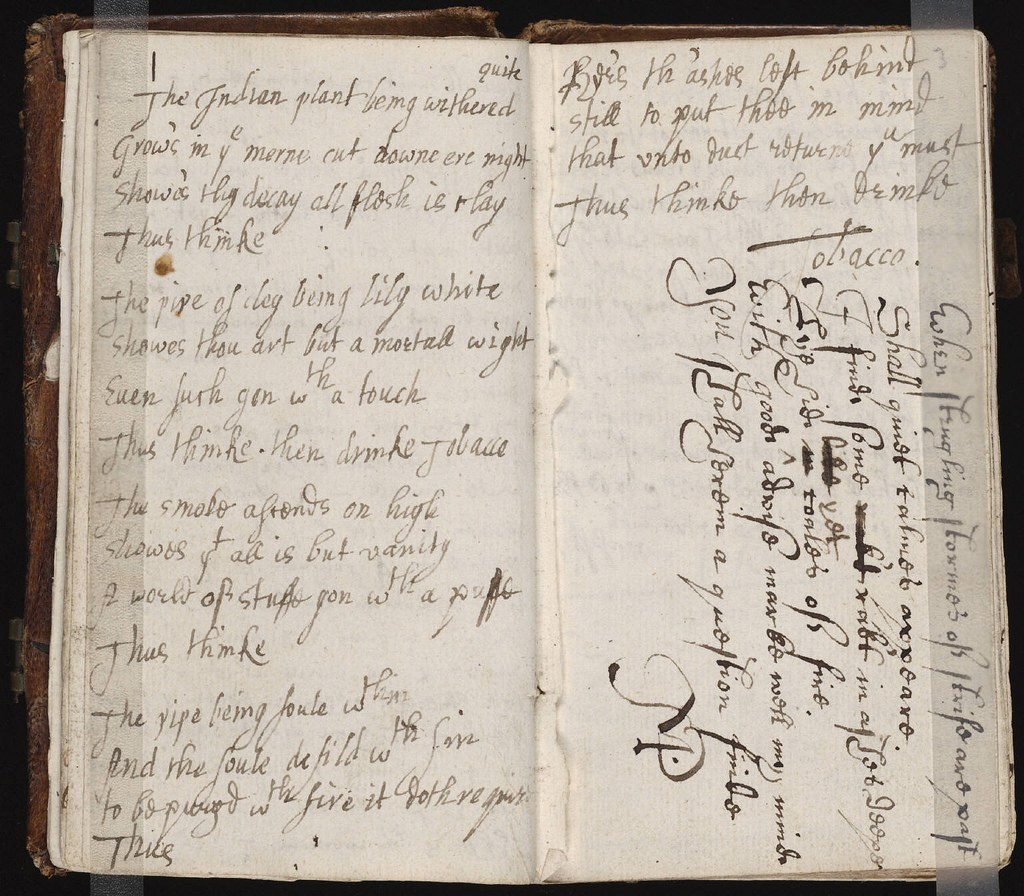


Commonplace Book
A commonplace book is a personal collection of anything worth keeping — passages, recipes, remedies, arguments, addresses — written into one blank book and indexed so it can be found again. For three centuries it was the standard way an educated person held on to what they read.
The hard problem is not the writing. It is retrieval. Fill a book front to back and you have a diary; you cannot find the note on beekeeping you made two years ago. Reserve a block of pages per subject and you run out of space in the busy subjects and waste the rest.
John Locke's answer, published in English in 1706, solves it with a two-page index and one rule: entries go wherever there is space, and the index remembers where. It costs two pages and a moment per entry, and it never runs out.
دستورالعملها
Take a blank bound book
Take a blank bound book
Use a sewn blank book that opens flat, at least 100 pages. It must be bound, not loose-leaf — the whole system depends on page numbers that never move.
مواد مورد نیاز این مرحله:
 دفترچهٔ ثبت1 قطعه
Number every page in ink
Number every page in ink
Number all pages in the top outer corner before writing anything else. The index points at numbers; if the numbers arrive later they will be wrong somewhere.
ابزارهای مورد نیاز:
 مجموعه خودکار دفترچه (بدون اسید)
Reserve the first two pages as the index
Reserve the first two pages as the index
Set aside the opening two pages, facing each other, for the whole index. Locke's claim, and it holds, is that two pages are sufficient for a book of any length.
Rule the index into rows
Rule the index into rows
Rule the two pages into 25 narrow horizontal rows, one per letter of the alphabet, marking every fifth line in a second colour so the eye can land on a row without counting.
ابزارهای مورد نیاز:
 خطکش
خطکشDivide each row into five vowel columns
Divide each row into five vowel columns
Divide each lettered row into five short columns headed a, e, i, o, u. Every row is now a set of five cells: Ba, Be, Bi, Bo, Bu, and so on down the alphabet.
Learn the addressing rule
Learn the addressing rule
A subject's address is its first letter plus the first vowel that follows it. Beauty goes in B-e. Epistola goes in E-i. Nothing else about the word is used, which is what keeps the index down to two pages.
Start your first entry on the first free page
Start your first entry on the first free page
Turn to the first empty page after the index. Write the subject head at the top and the passage under it. There is no reserved section for any subject — you take the next space available.
Record the page in the right index cell
Record the page in the right index cell
Go back to the index, find the cell for that head's letter and vowel, and write the page number in it. This is the only bookkeeping the system asks of you.
Add later entries under the same head
Add later entries under the same head
When you have more to add to a head that already exists, look it up in the index, turn to that page and continue there if there is room.
When a page fills, write v. and jump
When a page fills, write v. and jump
If the page is full, write v. — for verte, turn over — at the foot, continue on the next genuinely empty page, and add that new page number to the same index cell. The head now lives in two places, chained.
Keep heads short and concrete
Keep heads short and concrete
One or two words: Bees, Cider, Rent, Grief. Long phrases produce heads you cannot re-derive later, and the index only works if you arrive at the same head next time.
Cite the source under every entry
Cite the source under every entry
Write the author, title and page beneath each passage as you copy it. An unsourced quotation is worth much less later, and this is the habit the practice was built on.
Test the retrieval
Test the retrieval
Ask someone to name one of your heads. Go index cell, page number, entry. If it takes more than a few seconds, the head was probably too abstract — the failure is in the naming, not the system.
History & Context
History & Context
Where it comes from. The commonplace book descends from the florilegium, the 'gathering of flowers' — collections of extracts compiled from the eighth century onward, arranged chronologically at first and under thematic headings by the thirteenth. Renaissance humanists made the practice standard, and it stayed standard from then into the Enlightenment. Its ancestry is rhetorical: the classical loci communes, the common places from which arguments were drawn.
Locke's contribution. Locke began keeping one as an Oxford undergraduate in 1652 and spent the next decade refining an indexing method. He wrote it up in French in the mid-1680s for the scholarly press; the English version, A New Method of Making Common-Place-Books, was published in 1706, after his death. Sources differ over whether the French text appeared in 1685, 1686 or 1687, and the honest position is that the exact year is unsettled — the English date is not.
Why the index is the invention. Every other scheme allocates space by subject in advance and therefore has to guess how much each subject will need. Locke's separates storage from retrieval: pages are filled in the order they are used, and a fixed-size index maps subjects to positions. It is the same argument as an index in a database, three hundred years early, and it is why blank books were later sold pre-ruled to his design.
Who kept them. The habit was near-universal among the literate: Linnaeus used commonplacing while developing his classification, and Newton, Erasmus Darwin, Charles Darwin and Virginia Woolf all kept collections. They are not diaries. A commonplace book records what was worth keeping from outside, not what happened to you — which is exactly why they remain useful to read.
مواد
1- 1 قطعهجایگزین
نقشههای مرتبط
این نقشهها دانش مشترکی دارند — تکنیکها، مواد یا اصول


CC0 مالکیت عمومی
این نقشه تحت مجوز CC0 منتشر شده است. شما آزاد هستید آن را کپی، ویرایش، توزیع و برای هر هدفی بدون نیاز به اجازه استفاده کنید.
با خرید محصولات از طریق نقشه از سازنده حمایت کنید و او کمیسیون سازنده تعیین شده توسط فروشندگان، دریافت میکند یا یک نسخه جدید از این نقشه ایجاد کنید و آن را به عنوان اتصال در نقشه خود قرار دهید تا درآمد به اشتراک گذاشته شود.