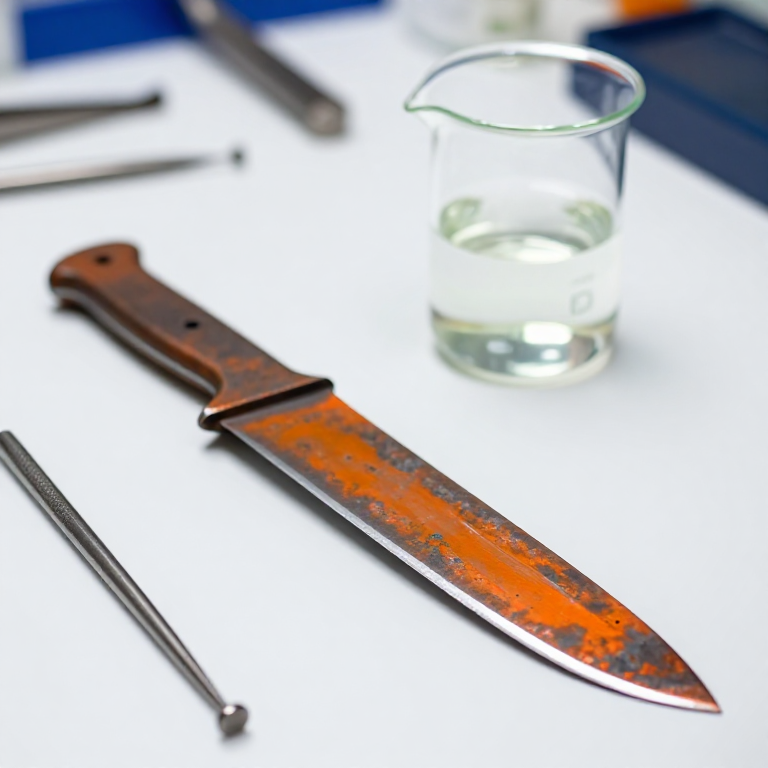


Conserving an Iron Find
An iron object that has survived a thousand years in the ground can destroy itself within months of being dug up. Buried, it reaches a slow chemical equilibrium. Excavated, it meets oxygen and swinging humidity, and the chloride ions locked inside the corrosion start a cycle that does not stop.
Chlorides drive the formation of akaganeite, a corrosion product whose growth splits the rust layer off in flakes, taking the surface — and the object's shape — with it. Every following flake exposes fresh metal and more chloride. Conservation of archaeological iron is therefore not cleaning. It is getting the chloride out, and then keeping the object dry enough that what remains cannot act.
This blueprint follows the professional sequence at a scale a well-equipped workshop can manage — and is equally clear about the point where an object should go to a conservator instead.
دستورالعملها
Establish that it is yours to treat
Establish that it is yours to treat
Confirm the object's legal status and ownership before anything else. Excavated finds are frequently subject to reporting law, and a significant object belongs with a conservator and a museum, not on a workshop bench.
Do not let it dry out uncontrolled
Do not let it dry out uncontrolled
Keep a freshly excavated iron object in the condition it came out in until you can treat it. An object that dries fast on a windowsill can shed its surface before you have even looked at it.
Photograph and weigh it before touching
Photograph and weigh it before touching
Record the object from all sides with a scale, and weigh it. Everything after this alters it, and the record you take now is the only evidence of what it was.
مواد مورد نیاز این مرحله:
 دفترچهٔ ثبت1 قطعه
X-ray it if you possibly can
X-ray it if you possibly can
Have the object radiographed. A shapeless lump of corrosion routinely turns out to contain a knife with a pattern-welded blade or inlaid decoration — and the surviving surface is usually inside the corrosion, not on top of it. Cleaning without an X-ray is cleaning blind.
Never use acid
Never use acid
Do not put archaeological iron in acid, rust remover or electrolysis without training. These strip corrosion — including the corrosion layer that is the original surface. The object comes out shiny and its shape is gone permanently.
Clean mechanically, under magnification
Clean mechanically, under magnification
Remove soil and loose corrosion with hand tools under a microscope or strong lens, working toward the original surface identified on the X-ray. Slow, reversible, and it stops the moment you reach the surface.
ابزارهای مورد نیاز:
 ذرهبین
 تیغ جراحی
Prepare an alkaline desalination bath
Prepare an alkaline desalination bath
Make up an alkaline sulphite solution — the published treatment uses roughly 0.1 M sodium hydroxide with 0.05 M sodium sulphite — or a deoxygenated sodium hydroxide solution. Wear gloves and eye protection: sodium hydroxide is caustic and burns skin and eyes.
مواد مورد نیاز این مرحله:
 سود سوزآور (هیدروکسید سدیم)40 گرم
ابزارهای مورد نیاز:
 عینک محافظ در برابر پاشش مواد شیمیایی
 دستکش لاستیکی نیتریل
Immerse and exclude oxygen
Immerse and exclude oxygen
Submerge the object fully and keep the vessel closed. Oxygen in the bath lets corrosion continue during the treatment that is supposed to stop it.
Change the bath and test the chloride
Change the bath and test the chloride
Change the solution regularly and test each spent bath for chloride. Plot the chloride released against time — the curve falls steeply and then flattens, and the flattening is what tells you the treatment is finished.
Expect months, and expect imperfection
Expect months, and expect imperfection
Treatments typically run for months. Published results extract most of the chloride — commonly in the region of 60 to 99 % — because chloride adsorbed on surfaces comes away readily while chloride held inside the akaganeite structure comes out slowly and incompletely. You are reducing the problem, not abolishing it.
Rinse thoroughly in deionised water
Rinse thoroughly in deionised water
Rinse in several changes of deionised water until the rinse runs neutral. Alkali left in the object is a new salt problem replacing the old one.
Dry it in a controlled way
Dry it in a controlled way
Dry slowly and completely, finishing with solvent dehydration or a desiccator. Water left inside is what the remaining chloride needs in order to act.
Consolidate and coat
Consolidate and coat
Apply a reversible consolidant and a microcrystalline wax coating. Reversible matters: a future conservator with better methods must be able to undo what you did.
مواد مورد نیاز این مرحله:
 گلولهٔ موم زنبور عسل20 گرم
Store it dry and monitor it
Store it dry and monitor it
Store below about 15 % relative humidity with silica gel in a sealed box, and inspect regularly for orange weeping droplets or fresh flaking. Those are the signs that active corrosion has restarted, and they mean the treatment has to be repeated.
Write the treatment record
Write the treatment record
Record every solution, concentration, duration, chloride reading and material applied, and keep it with the object forever. An object whose treatment history is unknown is one a future conservator has to guess about.
Compendium — the chemistry and the ethics
Compendium — the chemistry and the ethics
Why chloride is the enemy. Chloride ions concentrate at the metal-corrosion interface and support a self-sustaining electrochemical cycle. In humid air with chloride present, akaganeite (β-FeOOH) forms, and its growth is associated with the corrosion layer exfoliating — spalling off in flakes. Each flake exposes fresh metal, more chloride migrates, more akaganeite forms. This is why a stable-looking find can disintegrate on a shelf.
Why the corrosion is the object. On badly corroded archaeological iron the original shaped surface is often preserved as a layer within the corrosion crust, marked by the boundary where the metal used to be. Strip the corrosion and you strip the artefact, leaving a smaller lump of sound metal with no form. This is the single most important thing separating archaeological conservation from restoring a rusty tool, and it is why acid and aggressive electrolysis are wrong here even though they work beautifully on a garden spade.
Treatment is a reduction, not a cure. Desalination removes most of the chloride and slows the cycle drastically. It does not remove all of it — the chloride trapped in the akaganeite structure resists extraction. Long-term survival therefore depends on dry storage as much as on the treatment, and any claim that an iron find has been "stabilised permanently" is overstated.
Reversibility as a principle. Conservation ethics require, wherever possible, that a treatment can be undone. Methods improve; today's best practice is tomorrow's regrettable intervention. An irreversible coating or a hard consolidant forecloses options for everyone who comes after — which is why a plain wax over a reversible consolidant beats anything permanent, however good it looks now.
مواد
3- 1 قطعهجایگزین
- جایگزین
- 20 گرمجایگزین
نقشههای مرتبط
این نقشهها دانش مشترکی دارند — تکنیکها، مواد یا اصول

CC0 مالکیت عمومی
این نقشه تحت مجوز CC0 منتشر شده است. شما آزاد هستید آن را کپی، ویرایش، توزیع و برای هر هدفی بدون نیاز به اجازه استفاده کنید.
با خرید محصولات از طریق نقشه از سازنده حمایت کنید و او کمیسیون سازنده تعیین شده توسط فروشندگان، دریافت میکند یا یک نسخه جدید از این نقشه ایجاد کنید و آن را به عنوان اتصال در نقشه خود قرار دهید تا درآمد به اشتراک گذاشته شود.