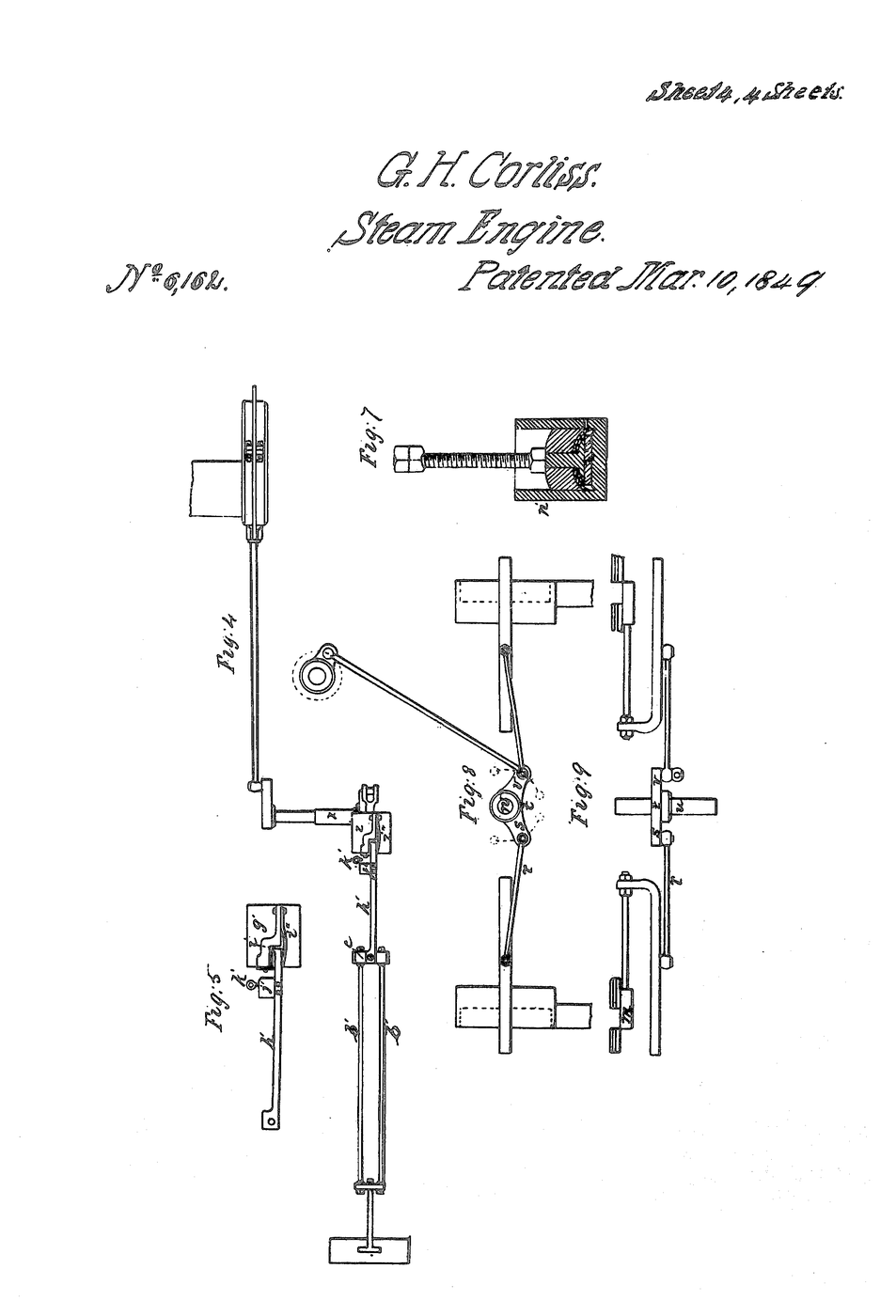


Corliss Valve Gear
An early steam engine let steam push the piston for the whole stroke and then dumped it, still under pressure, out the exhaust. That wasted steam is wasted coal. The fix is to admit steam for only part of the stroke and let it expand for the rest — but that means a valve that opens, then snaps shut at a precise, adjustable moment, every stroke, forever.
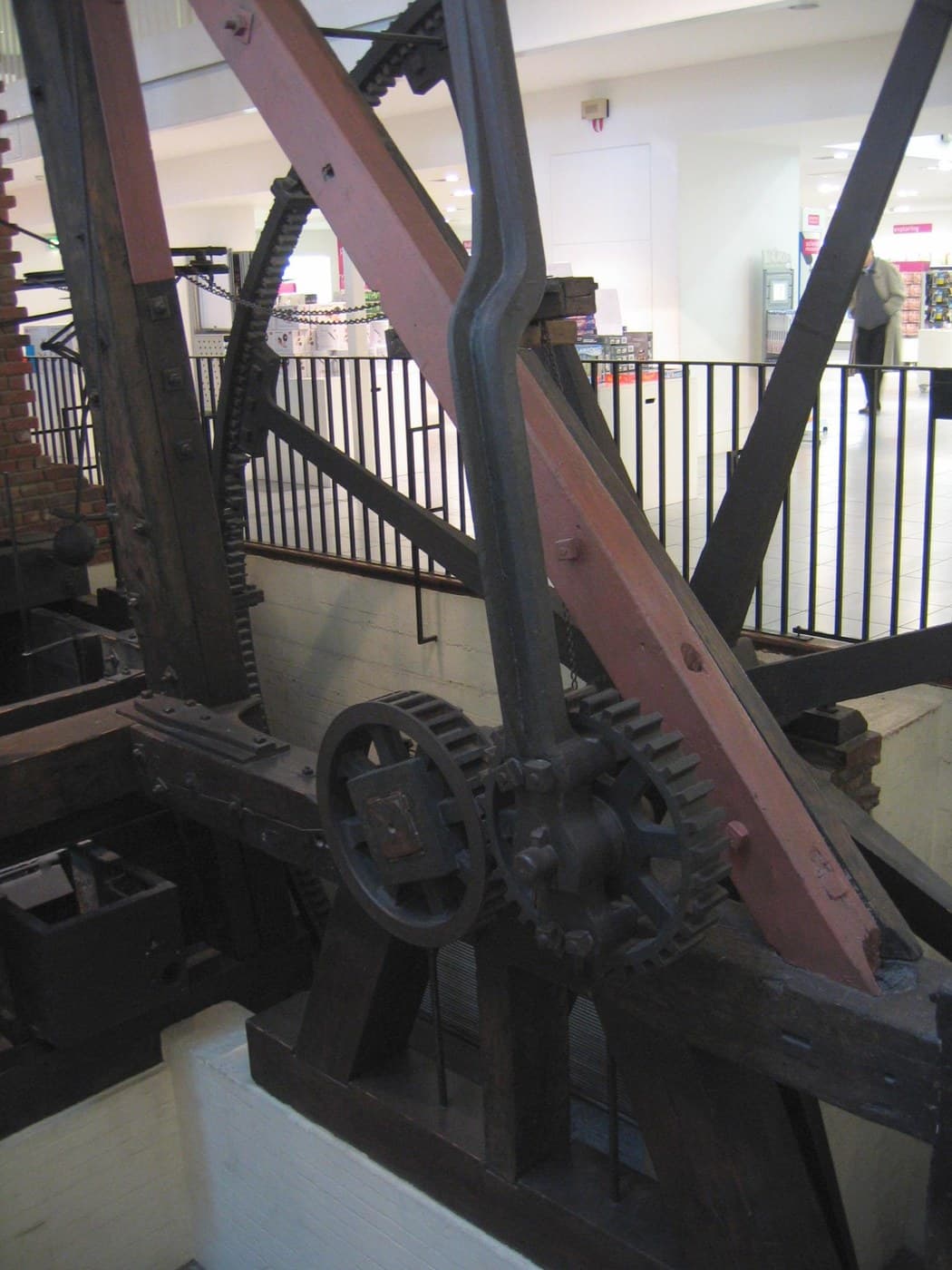
Corliss's gear does exactly that. A single eccentric rocks one wrist-plate, and the wrist-plate works all four valves — two for admission, two for exhaust. The admission valves are tripped: pulled open, then released to slam shut under a spring, with the release point set by the governor. Fast cutoff, driven by the engine's own speed.
The result is regulation and economy at once — the engine holds its speed against a changing load and burns far less coal doing it.
US Patent 6,162, "Cut-off and working the valves of steam-engines", granted 10 March 1849 to George H. Corliss of Providence, Rhode Island (reissued 1851, No. 206).
دستورالعملها
Read the granted title carefully
Read the granted title carefully
US 6,162 is "Cut-off and working the valves of steam-engines" — a valve gear, not an engine. The whole patent is about when the valves move.
Cut a base and mark four valve ports
Cut a base and mark four valve ports
On a plywood base, mark four points around a central pivot: two admission (top), two exhaust (bottom). This is the layout Corliss uses.
مواد مورد نیاز این مرحله:
 Baltic Birch Plywood1 ورق
ابزارهای مورد نیاز:
 Combination Pliers
Pivot a wrist-plate at the centre
Pivot a wrist-plate at the centre
Mount a disc that can rock a few degrees each way on a central pin. This is the wrist-plate — one part that will drive all four valves.
مواد مورد نیاز این مرحله:
 Dowel Rod1 قطعه
Link a single eccentric to the wrist-plate
Link a single eccentric to the wrist-plate
Make an offset crank on a shaft and connect it by a rod to the wrist-plate. Turn the shaft: the wrist-plate rocks back and forth from one input.
مواد مورد نیاز این مرحله:
 Mild Steel Rod (6mm)1 قطعه
Connect all four valves to the wrist-plate
Connect all four valves to the wrist-plate
Run four link-rods from the wrist-plate to four pivoting "valves". One rocking plate now opens and closes all four in sequence. Turn the shaft and watch the cycle.
Watch admission open before exhaust closes
Watch admission open before exhaust closes
Note the timing: an admission valve opens as its exhaust closes, on each side alternately. The single plate enforces the correct order automatically.
Add a trip and a return spring to one admission valve
Add a trip and a return spring to one admission valve
Instead of linking the admission valve rigidly, let the wrist-plate pull it open through a catch, with a spring trying to close it. This is the trip mechanism.
مواد مورد نیاز این مرحله:
 Galvanised Steel Wire1 متر
Release the catch mid-stroke and watch it snap shut
Release the catch mid-stroke and watch it snap shut
Set the catch to release partway through the opening. The valve is yanked shut by the spring almost instantly — far faster than a linked valve. Fast cutoff is the whole point.
Move the release point and time the closure
Move the release point and time the closure
Shift where the catch releases and mark the shaft angle at closure each time with the stopwatch cycle. Earlier release = steam admitted for less of the stroke = earlier cutoff.
ابزارهای مورد نیاز:
 Stopwatch
Tie the release point to a sliding weight
Tie the release point to a sliding weight
Connect the catch position to a weight that stands in for the governor. Move the weight "out" and the cutoff comes earlier. Now speed controls fuel admission.
Compare a rigid valve against the tripped one
Compare a rigid valve against the tripped one
Run one side rigid, one side tripped. The rigid valve opens and closes slowly and symmetrically; the tripped valve opens gently and closes like a trap. That sharp closure is what saves steam.
Measure the wrist-plate's swing angle
Measure the wrist-plate's swing angle
With a protractor, measure how few degrees the wrist-plate actually rocks. A small, precise oscillation runs the whole valve set — elegance through geometry.
ابزارهای مورد نیاز:
 Protractor/Angle Finder
History & Context — the engine that ran an exposition
History & Context — the engine that ran an exposition
The patent. US 6,162, "Cut-off and working the valves of steam-engines", granted 10 March 1849 to George H. Corliss of Providence, Rhode Island, and reissued 13 May 1851 as No. 206. The reissue matters: a granted patent can be re-examined and re-granted with amended claims, and this one was.
What the claim actually covers. Corliss claims the use of a wrist-plate to carry the valve motion from a single eccentric to four separate valves, and the use of releasing (trip) valves with variable cutoff under governor control. Both halves matter. The wrist-plate is the mechanical economy — one moving part times four valves, in the right order, for free. The trip-and-drop cutoff is the thermodynamic economy — steam is admitted for only part of the stroke and then expands, and the exact cutoff point is set by the governor, so the engine trims its own fuel to the load.
Why the trip is cleverer than a linked valve. A valve linked rigidly to the drive opens and closes at the same slow, symmetric rate. Corliss instead has the wrist-plate latch the admission valve open and then release it, letting a spring (or a falling weight, the "dashpot") slam it shut in a fraction of the time. A sharp cutoff wastes almost no steam in a half-open valve. Steps 7 to 11 build and measure exactly that difference.
Regulation as a side effect of the same mechanism. Because the governor sets the release point, a Corliss engine holds its speed remarkably steady as the load changes — an early, elegant example of feedback control built into linkage rather than electronics. The governor does not throttle the steam (which wastes it); it changes how long steam is admitted.
What it became. The Corliss engine dominated heavy stationary power for half a century — mills, waterworks, factories — precisely because it burned perhaps a third less coal than the engines it replaced. Its most famous moment came at the 1876 Centennial Exhibition in Philadelphia, where a single gigantic Corliss engine in Machinery Hall drove the shafting for the entire building's exhibits through a forest of belts. When it was ceremonially started, it became the symbol of American industrial power. The valve gear you modelled here is what made it sip coal while doing it.
مواد
4- 1 ورقجایگزین
- 1 قطعهجایگزین
- 1 قطعهجایگزین
- جایگزین
ابزارهای لازم
3- جایگزین
- جایگزین
- جایگزین
نقشههای مرتبط
این نقشهها دانش مشترکی دارند — تکنیکها، مواد یا اصول


CC0 مالکیت عمومی
این نقشه تحت مجوز CC0 منتشر شده است. شما آزاد هستید آن را کپی، ویرایش، توزیع و برای هر هدفی بدون نیاز به اجازه استفاده کنید.
با خرید محصولات از طریق نقشه از سازنده حمایت کنید و او کمیسیون سازنده تعیین شده توسط فروشندگان، دریافت میکند یا یک نسخه جدید از این نقشه ایجاد کنید و آن را به عنوان اتصال در نقشه خود قرار دهید تا درآمد به اشتراک گذاشته شود.