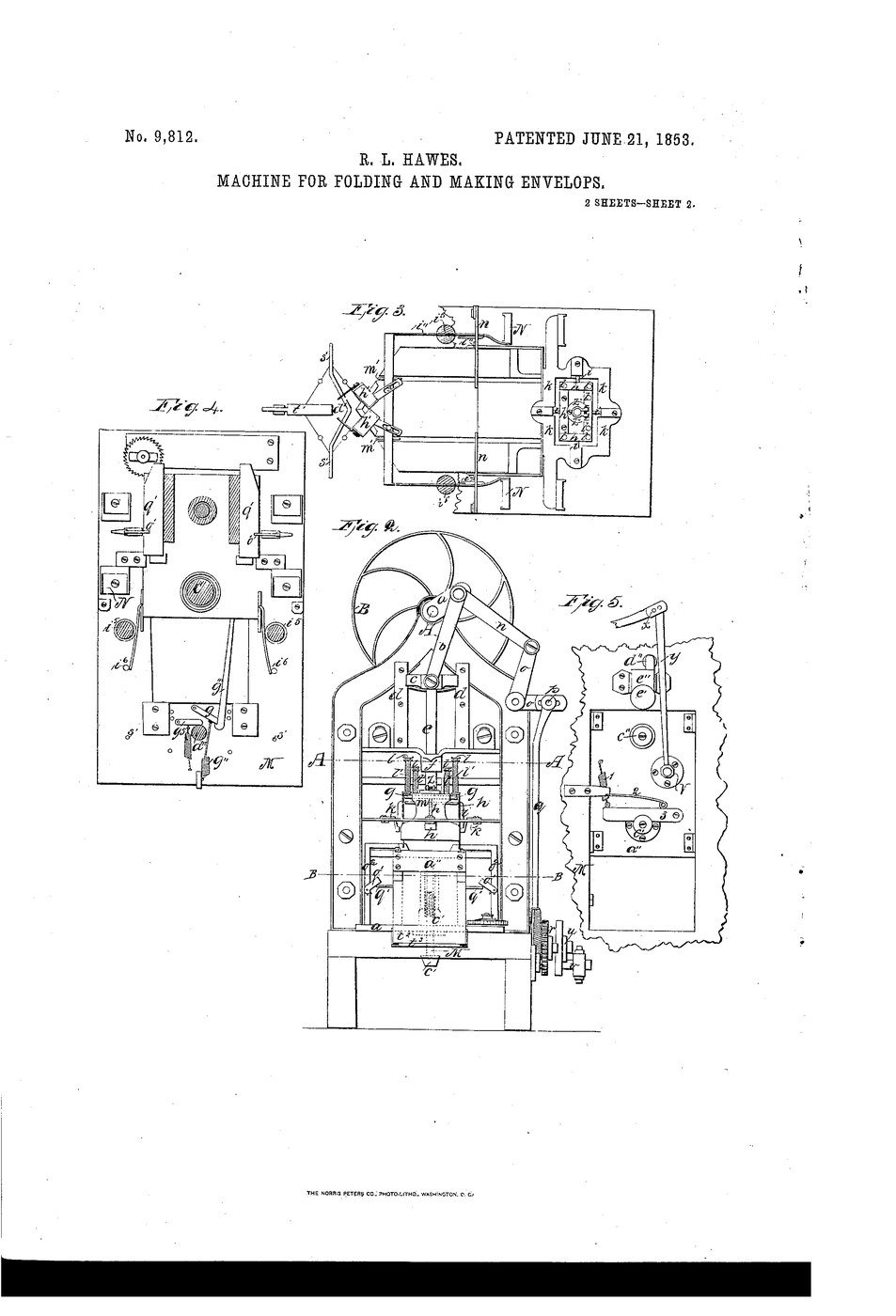


Envelope Folding Machine
Before 1853 an envelope was folded by hand, one at a time, by a person with a bone folder. Dr Russell L. Hawes of Worcester, Massachusetts — a physician who left medicine to build papermaking machinery — patented a machine that did it automatically.
US 9,812, granted 21 June 1853. Google Patents catalogues it as “Envelop-folding machine”; the drawing sheet itself is headed “Machine for Folding and Making Envelops”. Where the catalogue and the document disagree, the document wins — both are given here. The claim is not simply “a machine that folds”. It is a sequence: a self-feeding device lifts one blank from a stack, a double follower crimps it, then four folding blades — “four in number, or one for each of the four sides” — descend at staggered heights so each flap folds in turn rather than all at once, and paste fountains with ratchet-driven rollers gum the flaps as they close. The whole cycle takes seven revolutions of the main shaft.
The staggered blade heights are the insight worth building. Four flaps cannot close simultaneously — they overlap, so they must arrive in order. That single detail is the difference between a machine that folds envelopes and a machine that crushes paper. Hawes's machines produced 10,000 to 12,500 envelopes a day.
دستورالعملها
Read the claim before you build
Read the claim before you build
Hawes claims a sequence, not a shape: self-feed, crimp, four blades at staggered heights, paste, press. Write those five stages down — you will build them in order.
Cut a cross-shaped envelope blank
Cut a cross-shaped envelope blank
Cut one 200 mm square of paper. Mark a 100 mm square centred inside it. The four outer strips are the flaps.
مواد مورد نیاز این مرحله:
 کاغذ4 ورق
ابزارهای مورد نیاز:
 چاقوی کاردستی
 خطکش
خطکشFold it by hand and time yourself
Fold it by hand and time yourself
Fold all four flaps by hand. Time one envelope with the stopwatch. This is the baseline Hawes was competing against.
ابزارهای مورد نیاز:
 کرونومتر
Cut the forming bed
Cut the forming bed
Cut a 100 mm square of corrugated cardboard. This is the former the blank wraps around.
مواد مورد نیاز این مرحله:
 ورقهای مقوای کنگرهای1 ورق
ابزارهای مورد نیاز:
چاقوی کاردستیGlue the former to a base board
Glue the former to a base board
Glue the 100 mm former centrally onto the wooden board. Let it set 10 minutes.
مواد مورد نیاز این مرحله:
 چسب چوب5 میلیلیتر
ابزارهای مورد نیاز:
 تختهٔ چوبی تخت
Cut four folding blades
Cut four folding blades
Cut four cardboard strips 100 × 30 mm. These are Hawes's four blades, one per side.
مواد مورد نیاز این مرحله:
ورقهای مقوای کنگرهای1 ورقابزارهای مورد نیاز:
چاقوی کاردستیSet the blades to four different heights
Set the blades to four different heights
Glue a card spacer under each blade: 0 mm, 3 mm, 6 mm, 9 mm. This staggering is the patent's core mechanical idea — the flaps must arrive in sequence.
مواد مورد نیاز این مرحله:
ورقهای مقوای کنگرهای1 ورقچسب چوب5 میلیلیترابزارهای مورد نیاز:
خطکشHinge each blade to the base
Hinge each blade to the base
Tape or wire each blade so it pivots down onto the former. Check each swings freely.
مواد مورد نیاز این مرحله:
 سیم فولادی گالوانیزه0.5 متر
ابزارهای مورد نیاز:
 قیچی
قیچیLoad a blank
Load a blank
Centre one blank over the former, printed side down.
مواد مورد نیاز این مرحله:
کاغذ1 ورقClose the blades in height order
Close the blades in height order
Press the blades down from lowest to highest. Each flap folds over the one before it.
Apply paste to the last flap only
Apply paste to the last flap only
Brush a 5 mm line of glue along the final flap and close it. Hawes used ratchet-driven paste rollers to do exactly this.
مواد مورد نیاز این مرحله:
چسب چوب2 میلیلیترTime the machine-folded envelope
Time the machine-folded envelope
Time one envelope through your jig. Compare with your hand-folded time from step 3.
ابزارهای مورد نیاز:
کرونومترRun ten and measure consistency
Run ten and measure consistency
Fold ten envelopes. Measure the finished width of each with the ruler and record the spread. Consistency, not speed, is what a machine actually sells.
مواد مورد نیاز این مرحله:
کاغذ10 ورقابزارهای مورد نیاز:
خطکشDeliberately mis-order the blades
Deliberately mis-order the blades
Now close the blades in the wrong order — highest first. Observe the jam. This is why the staggered heights are claimed.
History & Context
History & Context
US 9,812, “Envelop-folding machine”, R. L. Hawes of Worcester, Massachusetts, granted 21 June 1853.
Hawes trained and practised as a physician before leaving medicine for Goddard, Rice & Co., where he designed papermaking machinery. His envelope machine was the first commercially successful one in the United States, turning out 10,000–12,500 envelopes per day where a skilled hand folder managed a few hundred.
His specific contribution over earlier designs was the self-feeding device that picked up blanks automatically. That cut the number of human attendants a machine needed and set the pattern later used in self-gumming plunger machines.
A note on the record. Google Patents lists the filing date for US 9,812 as the same day as the grant, 21 June 1853. That is a cataloguing artefact of very early patents, not a real same-day filing — this blueprint therefore cites the grant date only. The same problem affects several 1830s–1890s patents, including Lanston's Monotype in this very batch.
The envelope itself was a newer idea than most people assume. Pre-gummed, mass-produced envelopes only became normal once machines like this made them cheap; before that, a letter was commonly folded and sealed with wax, the sheet acting as its own wrapper.
مواد
4- 15 ورقجایگزین
- جایگزین
- 12 میلیلیترجایگزین
- 0.5 مترجایگزین
مواد نقشههای متصل
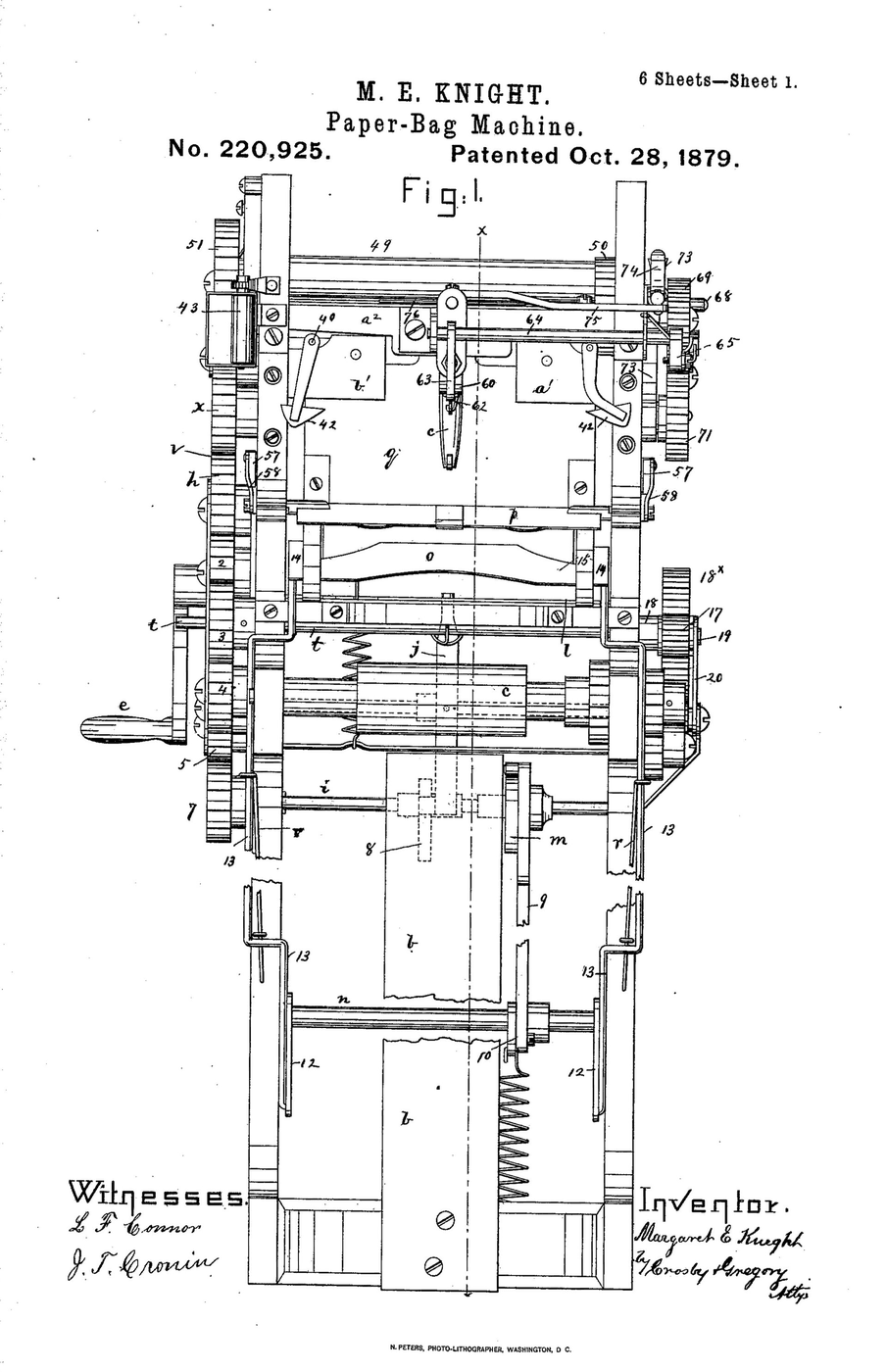

نقشههای مرتبط
این نقشهها دانش مشترکی دارند — تکنیکها، مواد یا اصول

CC0 مالکیت عمومی
این نقشه تحت مجوز CC0 منتشر شده است. شما آزاد هستید آن را کپی، ویرایش، توزیع و برای هر هدفی بدون نیاز به اجازه استفاده کنید.
با خرید محصولات از طریق نقشه از سازنده حمایت کنید و او کمیسیون سازنده تعیین شده توسط فروشندگان، دریافت میکند یا یک نسخه جدید از این نقشه ایجاد کنید و آن را به عنوان اتصال در نقشه خود قرار دهید تا درآمد به اشتراک گذاشته شود.