

Fountain Pen
A reservoir pen is easy to make and nearly impossible to make work. Ink is heavy, air is not, and a tube full of ink hanging over paper will either refuse to flow at all or empty itself in one blot. Reservoir pens existed for a century before 1884 and every one of them did both, unpredictably.
The problem is not the ink channel. It is the air. Ink can only leave the reservoir if the same volume of air gets in to replace it. If air enters in a slug, the pressure jumps and ink floods out; if it cannot enter at all, the vacuum holds the ink back and the nib runs dry.
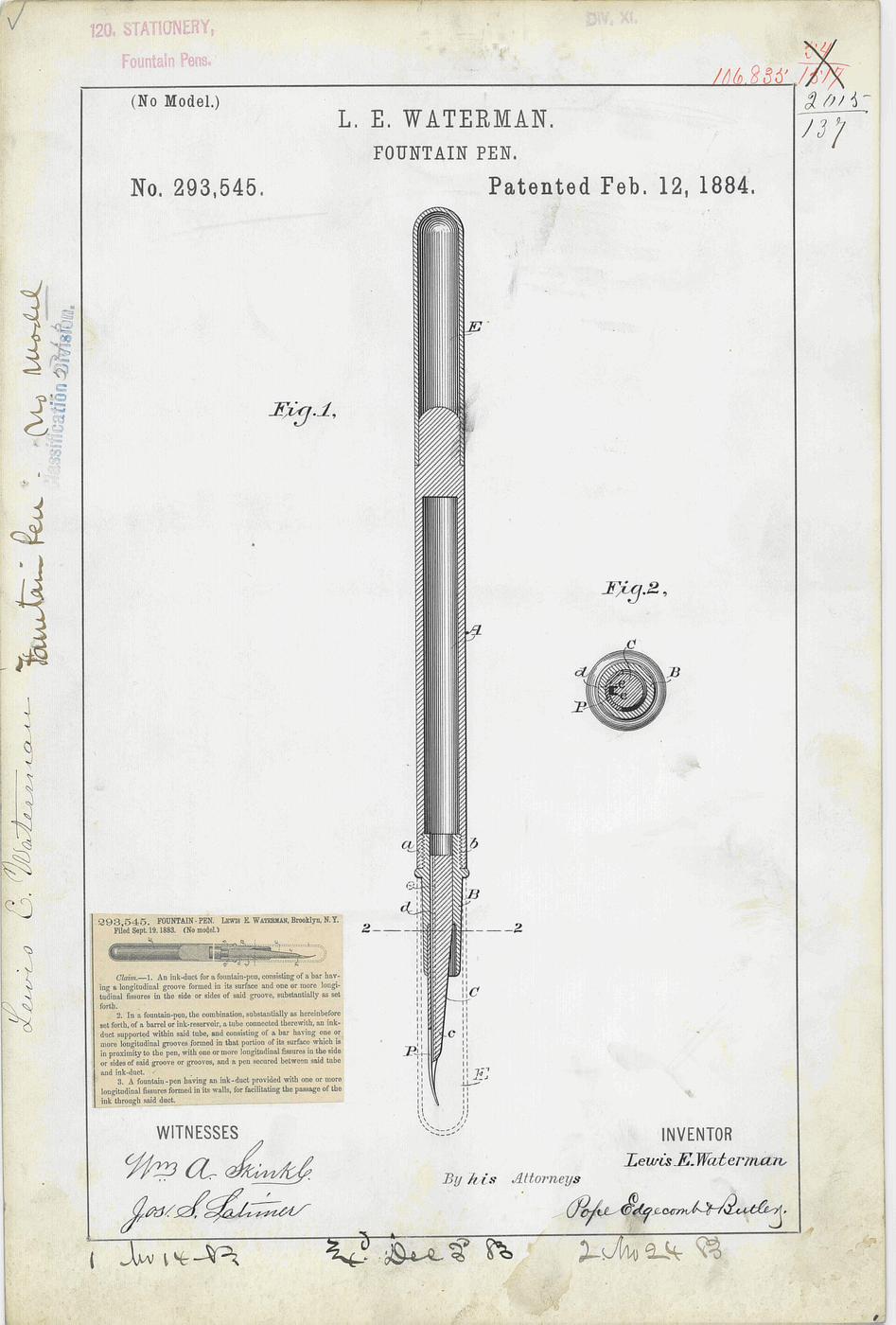
Lewis Waterman's answer was a feed cut with fine capillary fissures so air travels IN along the same piece of hard rubber that ink travels OUT along, continuously and in balance. US Patent 293,545, granted 12 February 1884.
دستورالعملها
Read US 293,545 and find the fissures
Read US 293,545 and find the fissures
Waterman's claim is a feed bar with capillary channels that admit air while ink leaves. Everything else in the pen was already known — this is the whole invention.
Prove the problem with a plain tube first
Prove the problem with a plain tube first
Fill a narrow tube with water and invert it over paper. It either holds by vacuum or dumps in one go. That is a pre-1884 reservoir pen, and it is why they were hated.
Dismantle a modern fountain pen
Dismantle a modern fountain pen
Pull the nib and feed out of the section. Three parts: nib, feed, reservoir. Identify the fins and the narrow slit along the feed's top face.
Understand what the fins are for
Understand what the fins are for
The comb of fins is a buffer. When warming air expands in the barrel and pushes ink forward, the fins catch the surplus instead of letting it reach the paper — which is why a modern pen survives a warm pocket.
Cut a feed blank from hard rubber or acrylic rod
Cut a feed blank from hard rubber or acrylic rod
Turn or file a rod to a snug fit inside the section. Waterman used vulcanised hard rubber; acrylic works and lets you see the ink move.
مواد مورد نیاز این مرحله:
 میلهٔ اکریلیک1 قطعه
ابزارهای مورد نیاز:
 سوهان فلز
Cut the main ink channel along the underside
Cut the main ink channel along the underside
File a shallow groove running the length of the feed. This carries ink forward to the nib, and it must run unbroken from reservoir to tip.
Cut a much finer air fissure on the top face
Cut a much finer air fissure on the top face
Score a fine slit along the opposite side with a saw blade. Finer than the ink channel — if the air path is as wide as the ink path, air enters in bubbles and the pen floods.
Cut a comb of shallow fins across the feed
Cut a comb of shallow fins across the feed
Saw a series of narrow transverse grooves. Each one is a small ink trap, and together they give the pen its tolerance to temperature and pressure changes.
Fit the nib so it seats flat on the feed
Fit the nib so it seats flat on the feed
Press the nib down so its underside contacts the feed along the whole channel. Any gap breaks capillary contact and the ink stops at the break.
Check the nib slit runs to the breather hole
Check the nib slit runs to the breather hole
The slit up the middle of the nib carries ink to the tip by capillary action; the round hole at its top stops the slit from splitting further under flex.
ابزارهای مورد نیاز:
 ذرهبین
Mix an iron-free writing ink
Mix an iron-free writing ink
Use a dye-based ink, not iron gall. Iron gall ink corrodes steel nibs and clogs narrow feeds — it was made for quills, which were disposable.
مواد مورد نیاز این مرحله:
 مرکّب نوشتن50 میلیلیتر
Fill the reservoir and watch the exchange
Fill the reservoir and watch the exchange
With an acrylic feed you can see it: ink creeping forward along the underside while a thread of air travels back along the top. Both at once, steadily.
Write a full page and look for two faults
Write a full page and look for two faults
Railroading — two thin lines instead of one wet line — means flow is too slow. Blobbing at the start of a stroke means the air fissure is too wide.
Warm the pen in your hand and watch the fins
Warm the pen in your hand and watch the fins
Body heat expands the air in the barrel. A good feed parks the displaced ink in the fins; a bad one puts it on your page.
Compendium — the invention is the air, not the ink
Compendium — the invention is the air, not the ink
The patent. Lewis Edson Waterman was granted US 293,545, "Fountain-Pen", on 12 February 1884. Waterman was an insurance salesman. The often-told story is that a pen flooded and ruined a contract he was about to sign, costing him the sale, and that he went away and fixed it. The anecdote is probably embellished — it appears mainly in the company's own later marketing — but the technical problem it describes was entirely real and universal.
Why reservoir pens failed for a century. Pens with an ink reservoir are recorded well before Waterman; a Romanian inventor, Petrache Poenaru, held a French patent for one in 1827, and there are earlier claims still. They all failed on the same physics. Ink leaving a closed reservoir must be replaced by an equal volume of air, and if that air arrives as discrete bubbles the pressure inside oscillates: a bubble in, a surge of ink out. Waterman's fissured feed lets air travel back along fine capillary channels as a continuous thread rather than as bubbles, so reservoir pressure stays near-constant and flow is steady.
Three capillaries in series. Ink moves from reservoir to feed channel to nib slit to paper, and each stage is narrower than the last. Capillary rise varies inversely with channel radius, so the narrowing sequence pulls ink forward continuously without pumping. The paper is the final and narrowest capillary — which is why a fountain pen writes on paper and merely drips on plastic, and why the pen must physically touch the sheet to start.
What changed around it. The pen forced a change of ink. Iron gall ink — the standard writing ink for a thousand years, and genuinely corrosive — destroys steel nibs and blocks fine feeds, so dye-based inks were formulated for fountain pens specifically. Filling systems then evolved fast: eyedropper, then Sheaffer's lever filler of 1908, then the piston and the cartridge. None of those touched Waterman's feed. The air-exchange principle he patented in 1884 is in every fountain pen made since, and the visible fins on a modern feed are simply a more refined version of the fissures in his drawing.
مواد
2- 1 قطعهجایگزین
- 50 میلیلیترجایگزین
نقشههای مرتبط
این نقشهها دانش مشترکی دارند — تکنیکها، مواد یا اصول

CC0 مالکیت عمومی
این نقشه تحت مجوز CC0 منتشر شده است. شما آزاد هستید آن را کپی، ویرایش، توزیع و برای هر هدفی بدون نیاز به اجازه استفاده کنید.
با خرید محصولات از طریق نقشه از سازنده حمایت کنید و او کمیسیون سازنده تعیین شده توسط فروشندگان، دریافت میکند یا یک نسخه جدید از این نقشه ایجاد کنید و آن را به عنوان اتصال در نقشه خود قرار دهید تا درآمد به اشتراک گذاشته شود.