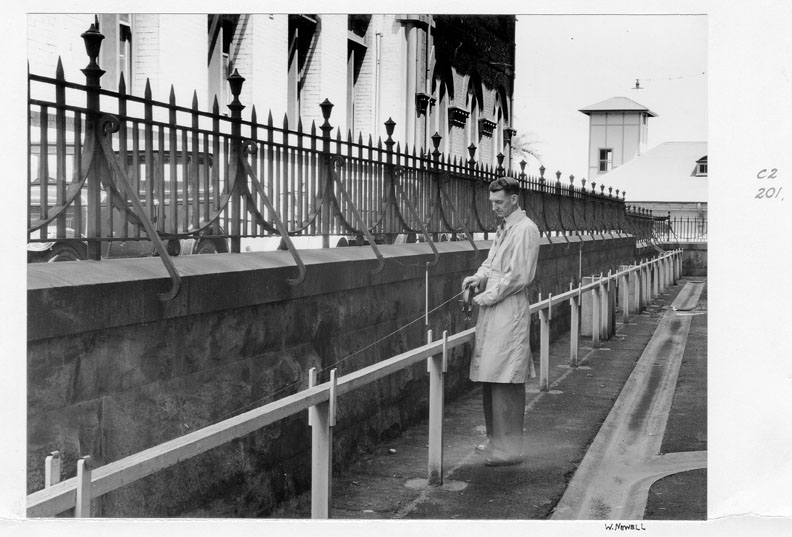


Gunter's Chain
دستورالعملها
Check the arithmetic that makes it work
Check the arithmetic that makes it work
Before building anything, verify the numbers actually line up.
- 1 chain = 66 ft = 4 rods (a rod is 16½ ft).
- 10 chains = 1 furlong; 80 chains = 1 mile (80 × 66 = 5280 ft).
- 1 acre = 10 square chains (66 × 660 = 43,560 sq ft).
مواد مورد نیاز این مرحله:
 خطکش1 قطعه
Build a scale chain
Build a scale chain
Make a proportional model — 100 links, whatever total length suits your space.
- Cut 100 identical wire links and join them with rings.
- Fit a handle at each end.
- Mark every tenth link with a distinctive tag.
مواد مورد نیاز این مرحله:
 سیم مسی1 length
Measure a field and compute an area
Measure a field and compute an area
Chain a rectangle and do the calculation the way a surveyor would.
- Measure two sides in chains and decimal links.
- Multiply to get square chains.
- Divide by 10 for acres.
Find the errors that plagued real chains
Find the errors that plagued real chains
A chain is a physical object and it lies in predictable ways.
- Pull the chain slack, then taut, and compare the readings.
- Measure up a slope and then measure the horizontal distance.
- Check for stretch after repeated hard pulls.
مواد مورد نیاز این مرحله:
 ترازوی دیجیتال آشپزخانه1 قطعه
History and context
History and context
Edmund Gunter (1581-1626) was an English clergyman and Professor of Astronomy at Gresham College. He introduced the chain in 1620. He also invented the logarithmic scale known as Gunter's line — the direct ancestor of the slide rule — and gave us the words cosine and cotangent. He was, in effect, a professional simplifier of calculation.
It surveyed a continent. The United States Public Land Survey System, which laid out most of the country west of the original states, was run in chains. A section is one mile square — 80 chains — and a quarter-quarter section is 40 acres, the classic homestead unit. The rectangular grid visible from the air over the American Midwest is Gunter's chain drawn on the land.
It survives in ordinary places. A cricket pitch is one chain — 22 yards — between the wickets. British railway distances were and often still are recorded in miles and chains. The word furlong is a furrow-long, the distance a team could plough before resting, and ten chains is exactly that.
What replaced it: steel tapes, then electronic distance measurement, then GNSS. But the chain's real idea — put a decimal scale on top of an awkward traditional system so people can calculate easily and report in the units the law demands — is what every unit-conversion layer in software still does.
نقشههای مرتبط
این نقشهها دانش مشترکی دارند — تکنیکها، مواد یا اصول
CC0 مالکیت عمومی
این نقشه تحت مجوز CC0 منتشر شده است. شما آزاد هستید آن را کپی، ویرایش، توزیع و برای هر هدفی بدون نیاز به اجازه استفاده کنید.
با خرید محصولات از طریق نقشه از سازنده حمایت کنید و او کمیسیون سازنده تعیین شده توسط فروشندگان، دریافت میکند یا یک نسخه جدید از این نقشه ایجاد کنید و آن را به عنوان اتصال در نقشه خود قرار دهید تا درآمد به اشتراک گذاشته شود.