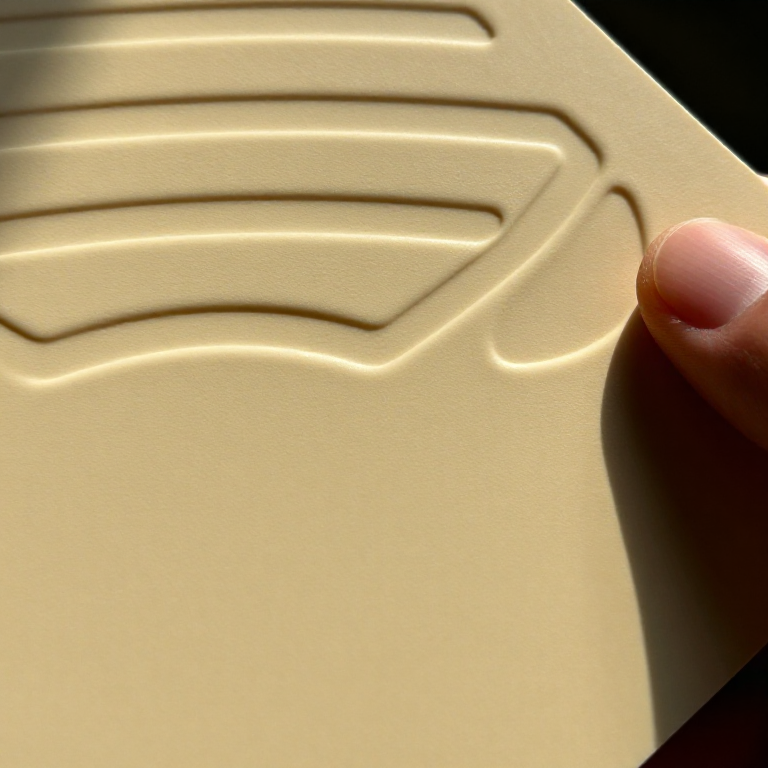


Moon Type
دستورالعملها
Feel the problem the system solves
Feel the problem the system solves
Establish why a second tactile alphabet exists at all.
- Emboss a row of small dots into card and try to read them by touch with your eyes closed.
- Now emboss a row of bold curves and straight lines and try again.
- Repeat both with cold hands.
مواد مورد نیاز این مرحله:
 مقوا1 بسته
 درفش1 قطعه
Build the fourteen shapes
Build the fourteen shapes
The alphabet is a small set of forms, reused by rotation.
- Draw the basic strokes: a straight line, a hook, an open curve, an angle, a closed loop.
- Rotate each through the four quarter turns to generate the letters.
- Lay the full alphabet out on one sheet for reference.
مواد مورد نیاز این مرحله:
 خطکش1 قطعه
 مجموعه مداد گرافیتی1 مجموعه
Emboss a line and add the return turn
Emboss a line and add the return turn
The boustrophedon layout is a real usability decision.
- Emboss a short sentence left to right by pressing from the reverse side of the card.
- At the line end, emboss a raised turn mark.
- Emboss the NEXT line right to left, with every letter mirrored.
Measure both systems on the axes that differ
Measure both systems on the axes that differ
Compare fairly — on several axes, not one.
- Emboss the same sentence in Moon and in Braille. Measure the space each takes.
- Time how long it takes an untrained person to learn five letters in each.
- Time a practised reader on each.
مواد مورد نیاز این مرحله:
 کرونومتر1 قطعه
History and context
History and context
William Moon (1818-1894) lost the sight of one eye to scarlet fever as a child and of the other by the age of twenty-one. Teaching blind children in Brighton, he found that his adult pupils could not manage the dot-based systems then in use, and in 1845 he published his embossed alphabet. He built a printing operation for it and it spread widely — Moon material has been produced in some 400 languages.
Both systems came out of the same decade of experiment, and neither won outright. Louis Braille published in 1829; his system's compactness and writability made it the standard for education, and it can be WRITTEN by hand with a slate and stylus, which Moon effectively cannot. Moon persisted for exactly the population Braille serves worst, and RNIB and others still produce it today.
Why keep both in a catalogue of approaches: this is the clearest case that "best" is meaningless without naming the user. A system optimised for lifetime fluency and one optimised for late-life accessibility are not competitors to be ranked; they cover different regions of the same problem. Discarding the less popular one would delete the only option that works for a substantial group of people.
An honest note on its limits: Moon's bulk is not a small matter — a book can run to many volumes — and the difficulty of writing it by hand means readers are usually consumers of Moon rather than producers. Those are conditions of use, and they are precisely what a maker choosing between the two needs to know.
نقشههای مرتبط
این نقشهها دانش مشترکی دارند — تکنیکها، مواد یا اصول

CC0 مالکیت عمومی
این نقشه تحت مجوز CC0 منتشر شده است. شما آزاد هستید آن را کپی، ویرایش، توزیع و برای هر هدفی بدون نیاز به اجازه استفاده کنید.
با خرید محصولات از طریق نقشه از سازنده حمایت کنید و او کمیسیون سازنده تعیین شده توسط فروشندگان، دریافت میکند یا یک نسخه جدید از این نقشه ایجاد کنید و آن را به عنوان اتصال در نقشه خود قرار دهید تا درآمد به اشتراک گذاشته شود.