

Stud Welding
Sometimes the thing you need to attach is not another plate but a single threaded stud — a fixing point on a deck, an anchor in a concrete floor, a mounting boss inside a panel. Drilling and tapping means making a hole in something you would rather keep solid, and on a ship's deck a hole is a leak.
Stud welding attaches the fastener directly. The gun holds the stud against the work, lifts it a fraction of a millimetre to draw an arc, waits a few milliseconds while both faces melt, then plunges the stud into its own molten pool. The whole cycle is over before you can react to it, and the result is a full-cross-section weld with a collar of expelled metal round the base — stronger, in a good weld, than the stud itself.
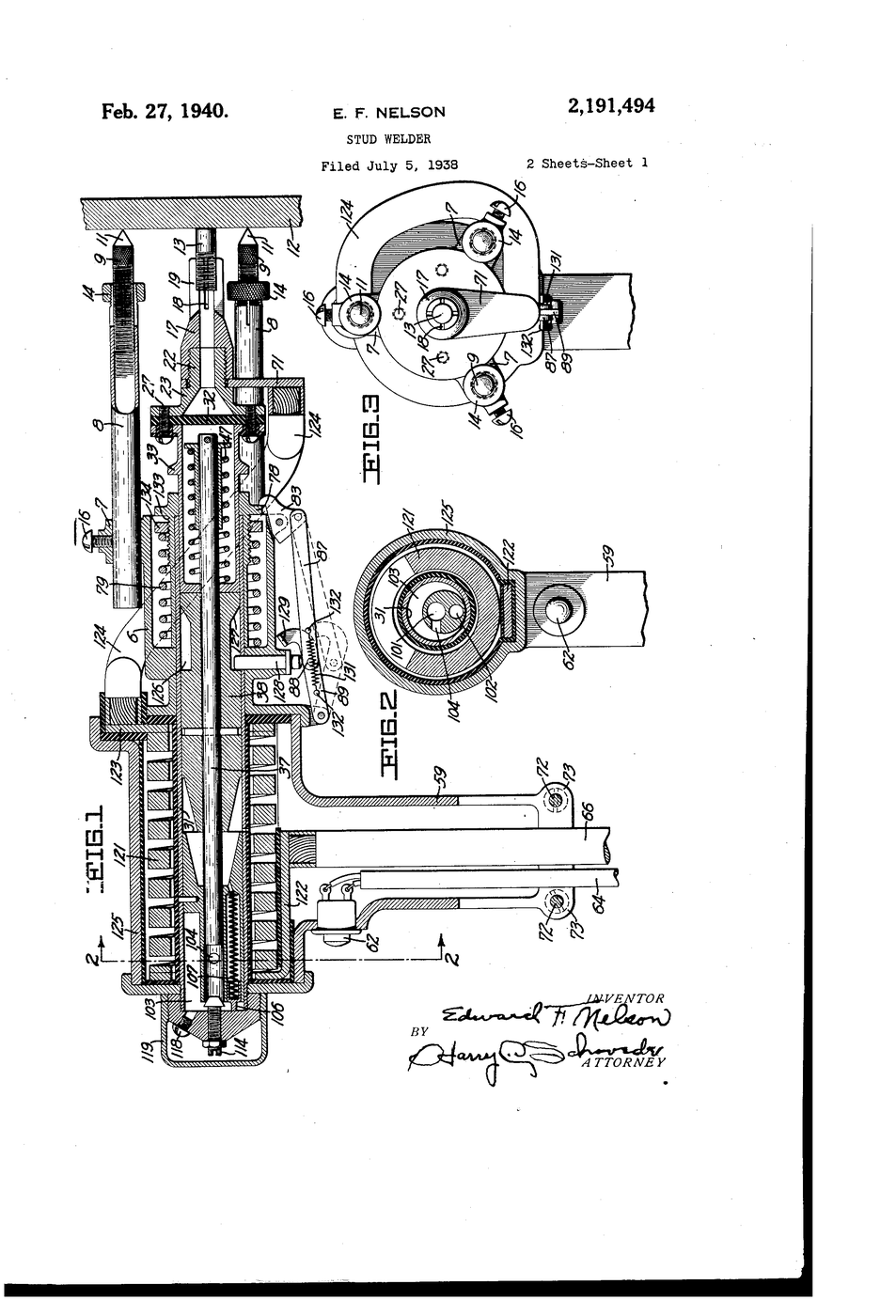
Edward F. Nelson patented the “Stud welder” as US 2,191,494, filed 5 July 1938 and granted 27 February 1940. Nelson developed it at the New York Navy Yard, where the job of fixing wooden decking and equipment to steel warship decks without piercing them was a real and urgent problem.
This blueprint studies the joint the process produces and the timing that produces it, using measurement rather than a stud gun.
دستورالعملها
Write down the constraint that created the process
Write down the constraint that created the process
Record it: attach a fastener to a plate without drilling through it. Sketch a ship's deck and mark why a hole is unacceptable.
Measure the stud and calculate its cross-section
Measure the stud and calculate its cross-section
Measure a steel round bar offcut standing in for the stud. Calculate its area, πr², in square millimetres.
مواد مورد نیاز این مرحله:
 میلهٔ گرد فولاد نرم1 قطعه
 کاغذ شطرنجی1 ورق
ابزارهای مورد نیاز:
 کولیس ورنیه
Predict the joint strength from the area
Predict the joint strength from the area
Mild steel yields around 250 N/mm². Multiply by your area to predict the force the stud itself could carry. Record the prediction.
مواد مورد نیاز این مرحله:
کاغذ شطرنجی1 ورقWork out the arc time from the energy
Work out the arc time from the energy
A 10 mm stud is welded in roughly 0.5 s at about 1000 A. Multiply out the energy at 25 V and note how small the total is.
مواد مورد نیاز این مرحله:
کاغذ شطرنجی1 ورقCompare that with a hand-welded joint
Compare that with a hand-welded joint
A manual fillet of the same size takes several seconds. Write down the ratio — stud welding is fast because the arc is short, not because it is hot.
مواد مورد نیاز این مرحله:
کاغذ شطرنجی1 ورقMake a comparison joint by spot welding
Make a comparison joint by spot welding
Use the battery spot welder to attach a strip to a coupon. This stands in for the stud weld: a short, machine-timed, single-shot joint.
مواد مورد نیاز این مرحله:
 مس1 قطعه
 تسمه فولاد نرم1 قطعه
ابزارهای مورد نیاز:
 دستگاه جوش نقطهای باتری
 عینک ایمنی شفاف
Pull the comparison joint apart
Pull the comparison joint apart
Clamp and pull with the force meter until failure. Record the peak force and compare it with your step 3 prediction, scaled for area.
ابزارهای مورد نیاز:
 نیروسنج (ترازوی فنری)
 گیرهٔ رومیزی
Note where a good stud weld fails
Note where a good stud weld fails
Record the rule from industrial practice: a sound stud weld bends the stud rather than breaking the joint. The joint is meant to be stronger than the fastener.
Bend-test a stud to see what that means
Bend-test a stud to see what that means
Clamp a round bar in the vice and bend it 30 degrees. The bend is the acceptance test used on real stud welds — the joint must survive it.
مواد مورد نیاز این مرحله:
میلهٔ گرد فولاد نرم1 قطعهابزارهای مورد نیاز:
گیرهٔ رومیزی دستکش چرمی
Sketch the ceramic ferrule and say what it does
Sketch the ceramic ferrule and say what it does
Draw the ring that surrounds the stud during welding. It contains the pool, shapes the collar of expelled metal and shields the arc from air.
مواد مورد نیاز این مرحله:
کاغذ شطرنجی1 ورقMeasure a fillet collar for comparison
Measure a fillet collar for comparison
Measure the collar of any welded joint you have available. That ring of expelled metal is the visible evidence that the whole face fused, not just the rim.
ابزارهای مورد نیاز:
کولیس ورنیه ذرهبین
List the three variables the gun controls
List the three variables the gun controls
Record them: lift (arc gap), time, and plunge. Every stud weld is those three numbers, exactly as a spot weld is current, time and force.
Safety awareness — a millisecond arc is still an arc
Safety awareness — a millisecond arc is still an arc
Short does not mean harmless. A stud weld lasts a fraction of a second and delivers hundreds or thousands of amperes while it does. The flash is bright enough to cause arc eye from a single cycle, and because it is over before you can look away, protection has to be on before the trigger, not after the first one surprises you.
The stud is a projectile if the weld fails. A misfire can eject the stud from the gun. Never point a stud gun at anyone, including yourself, and keep the ferrule seated.
In this blueprint the spot welder and the vice are the hazards. Expelled molten metal from the spot weld, and a bar under bending load in a vice that can spring when it releases. Glasses on, and keep your face out of the plane of the bend.
ابزارهای مورد نیاز:
عینک ایمنی شفافدستکش چرمیHistory & Context
History & Context
US 2,191,494, “Stud welder”, Edward F. Nelson, filed 5 July 1938, granted 27 February 1940. Nelson worked at the New York Navy Yard, and the process was developed to solve a naval problem: fastening wooden decking, cable runs and equipment to steel decks and bulkheads without drilling holes that would have to be sealed and would weaken the plate.
The mechanism is a controlled retreat. The gun presses the stud onto the plate, then lifts it by a fraction of a millimetre to strike an arc across the gap. Both the stud's end face and a matching disc of the plate melt. A spring then plunges the stud into the pool, which freezes almost instantly because the surrounding cold steel is an enormous heat sink. Total elapsed time is measured in milliseconds — and the whole cross-section is fused, which is why the joint outlives the stud.
Two families came out of it. Drawn-arc stud welding, the patent's own method, uses a ceramic ferrule and suits studs from about 3 to 25 mm. Capacitor-discharge stud welding, developed later, dumps a charged capacitor bank through a small ignition tip in one to three milliseconds — so fast that the far side of a thin sheet shows no mark at all. That is how a stainless appliance panel gets its internal mounting studs without any visible blemish on the show face.
Where it ended up. Structural steel shear studs on composite floor decks, insulation pins in ductwork, fixing studs in car bodies, and the mounting bosses inside almost every metal appliance you own. It is one of the most-used welding processes in the world and one of the least-noticed, precisely because a good stud weld looks like nothing happened.
مواد
4- 1 قطعهجایگزین
- 1 ورقجایگزین
- 1 قطعهجایگزین
- 1 قطعهجایگزین
ابزارهای لازم
7- جایگزین
- جایگزین
- جایگزین
- جایگزین
- جایگزین
- جایگزین
- جایگزین
مواد نقشههای متصل

نقشههای مرتبط
این نقشهها دانش مشترکی دارند — تکنیکها، مواد یا اصول


CC0 مالکیت عمومی
این نقشه تحت مجوز CC0 منتشر شده است. شما آزاد هستید آن را کپی، ویرایش، توزیع و برای هر هدفی بدون نیاز به اجازه استفاده کنید.
با خرید محصولات از طریق نقشه از سازنده حمایت کنید و او کمیسیون سازنده تعیین شده توسط فروشندگان، دریافت میکند یا یک نسخه جدید از این نقشه ایجاد کنید و آن را به عنوان اتصال در نقشه خود قرار دهید تا درآمد به اشتراک گذاشته شود.