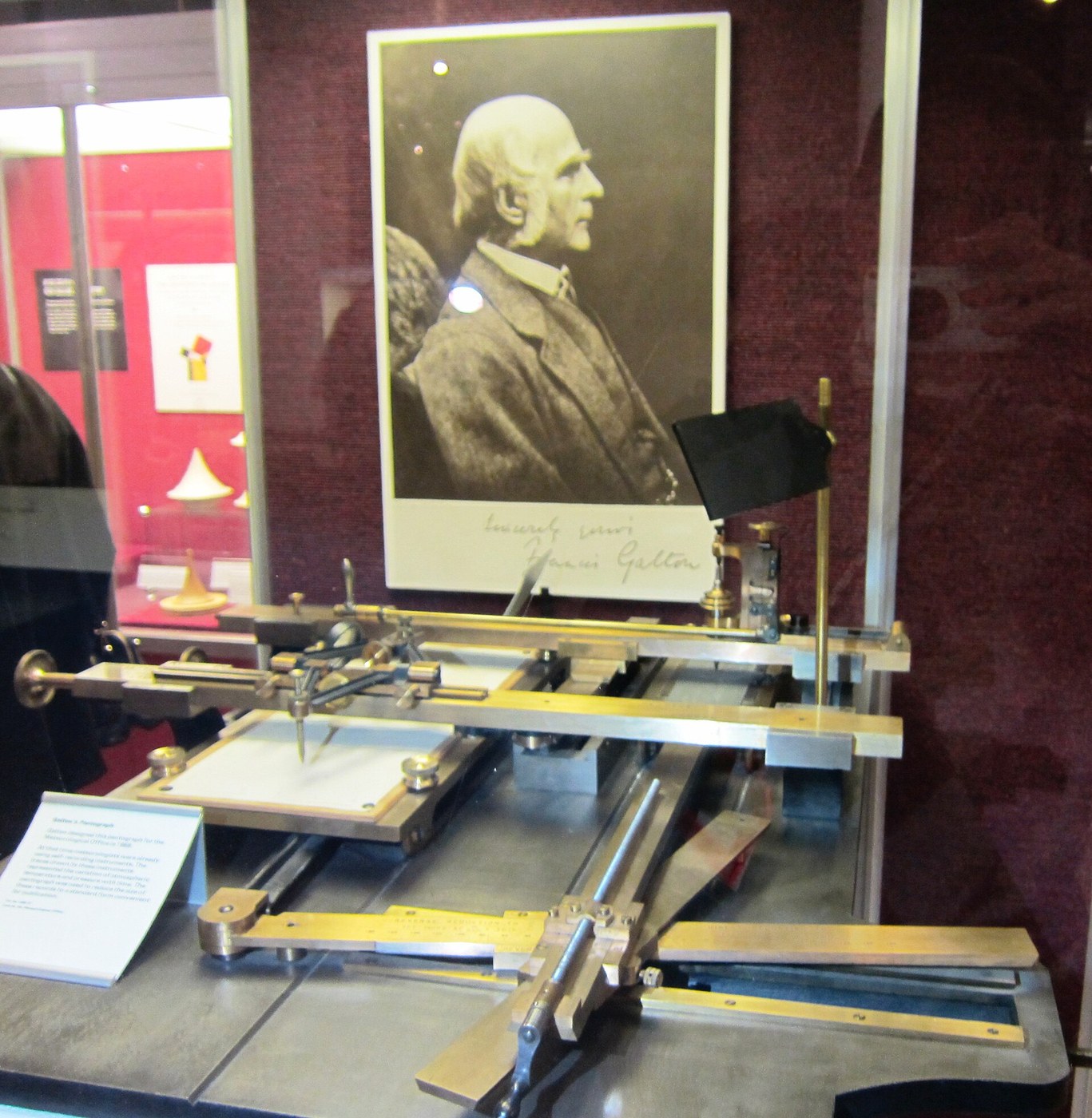


Pantograph
دستورالعملها
Build the parallelogram
Build the parallelogram
Four rods, four pivots, and it must stay a parallelogram as it moves.
- Cut four flat strips — two long, two short — and drill pivot holes.
- Join them so opposite sides are equal in length.
- Flex it and check that opposite sides stay parallel throughout.
مواد مورد نیاز این مرحله:
 تختهٔ کاج1 board
 مهرهٔ ششگوش4 قطعه
Place the three critical points on one line
Place the three critical points on one line
Pivot, tracer and pencil must be collinear — this is the requirement everything depends on.
- Pin one corner to the table as the fixed pivot.
- Put the tracing point at a second location on the linkage.
- Put the pencil so that pivot, tracer and pencil lie on a straight line in every position.
مواد مورد نیاز این مرحله:
 مجموعه مداد گرافیتی1 مجموعه
 خطکش1 قطعه
Set the ratio and test it
Set the ratio and test it
The scale factor is a ratio of distances, and nothing else.
- Measure pivot-to-tracer and pivot-to-pencil.
- Scale factor = pivot-to-pencil ÷ pivot-to-tracer.
- Trace a square of known size and measure the copy.
Find the distortions
Find the distortions
Push it to the edges of its travel and look for error.
- Trace a large grid of squares covering the full working area.
- Examine the copy at the extremes of extension.
- Look for sloppiness at the pivots by wiggling the tracer with the linkage stationary.
History and context
History and context
Christoph Scheiner (1573-1650) was a Jesuit mathematician and astronomer who described the pantograph in 1603 and published on it in 1631. He is better remembered for a long and bitter priority dispute with Galileo over sunspots — and the pantograph was a working tool in that very research, used to copy projected images of the Sun accurately enough to compare from day to day.
The principle predates him in the sense that similar copying linkages were described earlier, but Scheiner's is the version that entered general use and carries the name.
Where it went industrially: engraving pantographs cut dies, moulds and printing plates from oversize masters, which is far easier than engraving small work directly — the operator works big and the machine works small. Sculptors used pointing pantographs to copy statues. A router pantograph copies three-dimensional shapes, and the key-cutting machine in a hardware shop is one.
The name travelled oddly. The sprung frame that presses against overhead wires on an electric train is called a pantograph because early versions were exactly this parallelogram linkage, keeping the contact strip parallel to the wire at any height. Most modern ones are single-arm and no longer a parallelogram, but the name stuck.
What it teaches: constraints can guarantee outcomes. There is no measuring in a pantograph and no way to make an error of scale, because the linkage physically cannot produce anything but a similar figure. Building the guarantee into the mechanism is a better strategy than checking the output — an argument that applies well beyond drawing.
نقشههای مرتبط
این نقشهها دانش مشترکی دارند — تکنیکها، مواد یا اصول
CC0 مالکیت عمومی
این نقشه تحت مجوز CC0 منتشر شده است. شما آزاد هستید آن را کپی، ویرایش، توزیع و برای هر هدفی بدون نیاز به اجازه استفاده کنید.
با خرید محصولات از طریق نقشه از سازنده حمایت کنید و او کمیسیون سازنده تعیین شده توسط فروشندگان، دریافت میکند یا یک نسخه جدید از این نقشه ایجاد کنید و آن را به عنوان اتصال در نقشه خود قرار دهید تا درآمد به اشتراک گذاشته شود.