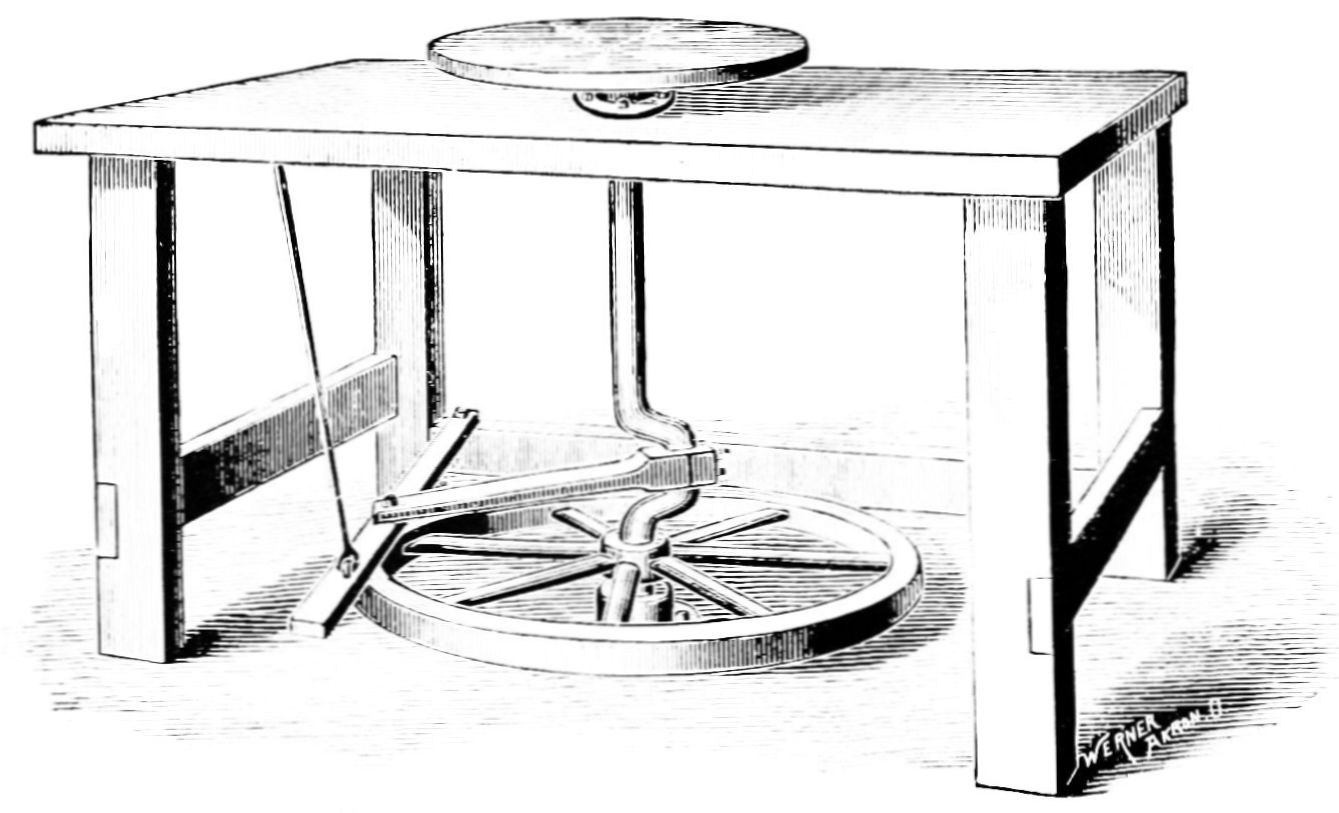


Potter's Kick Wheel
A kick wheel is a machine for storing energy in a spinning mass. A heavy flywheel near the floor is connected by a vertical shaft to a small wheel head at working height. The potter kicks the flywheel now and then; the momentum stored in that rotating mass keeps the head turning for a minute or more — long enough to throw a pot, with both hands free the entire time.
That last point is the whole invention. Earlier turntables had to be turned by hand or by an assistant, which meant one hand always occupied or another person always present. Freeing both hands is what made thin, symmetrical, fast production pottery possible, and the fast wheel appears in the archaeological record in the mid-to-late 3rd millennium BC.
Weight is not a detail here, it is the specification. Too light a flywheel and it simply will not hold speed against the pressure of your hands on the clay, no matter how hard you kick. Build it heavy.
دستورالعملها
Cut the frame timbers
Cut the frame timbers
Cut four legs 750 mm long and eight rails 500 mm long from 70 x 70 mm timber. 750 mm puts the wheel head at a comfortable seated working height for most adults.
مواد مورد نیاز این مرحله:
 چوب نرم ۷۰x۷۰ میلیمتر8 متر
ابزارهای مورد نیاز:
 ارهٔ دستی
Build the frame
Build the frame
Bolt the legs and rails into a rigid box with rails at both the top and the bottom. Bolts, not screws — a kick wheel takes a sideways impact several times a minute for years and screwed joints work loose.
مواد مورد نیاز این مرحله:
 مجموعهٔ پیچ ششگوش M101 مجموعه
ابزارهای مورد نیاز:
 آچار فرانسه
Check the frame is square and dead level
Check the frame is square and dead level
Measure both diagonals of the frame — equal means square. Level it in both directions. A shaft that is not vertical will bind in its bearings and the head will wobble.
ابزارهای مورد نیاز:
 تراز آبی
Cut the flywheel formwork
Cut the flywheel formwork
Build a circular mould 600 mm across and 80 mm deep from plywood, with a 40 mm hole dead centre for the shaft. Centre matters more than anything: an off-centre flywheel shakes the whole frame at speed.
مواد مورد نیاز این مرحله:
 تختهٔ چندلایهٔ توس بالتیک1 قطعه
ابزارهای مورد نیاز:
 ارهٔ مویی
Cast the concrete flywheel
Cast the concrete flywheel
Fill the mould with concrete around the shaft, tamping to drive out air pockets. A 600 mm x 80 mm disc lands around 50 kg. Air voids are both a weakness and a source of imbalance.
مواد مورد نیاز این مرحله:
 مخلوط بتن60 کیلوگرم
Cure the concrete for 7 days
Cure the concrete for 7 days
Keep the disc damp and covered for 7 days. Concrete gains most of its strength in the first week, and a flywheel that cracks in use at speed is genuinely dangerous.
Fit the shaft and bearings
Fit the shaft and bearings
Mount pillow block bearings on the top and bottom rails, exactly in line with each other, and run the steel shaft through both. Any misalignment between the two shows up immediately as drag and noise.
مواد مورد نیاز این مرحله:
 شفت فولادی ۳۰ میلیمتر1 متر
ابزارهای مورد نیاز:
 یاتاقان کفی (KP08)
Set the flywheel height
Set the flywheel height
Fix the flywheel on the shaft 150 mm above the floor — high enough to swing a foot under comfortably, low enough that kicking it is a relaxed motion rather than a lift.
ابزارهای مورد نیاز:
آچار فرانسهFit the wheel head
Fit the wheel head
Fix a 300 mm metal or hardwood disc to the top of the shaft, dead square to it. The head must run true — check by holding a pencil against the rim while it spins; the line should be continuous.
مواد مورد نیاز این مرحله:
 صفحهٔ سر چرخ سفالگری ۳۰۰ میلیمتر1 قطعه
Balance the flywheel
Balance the flywheel
Spin it and let it stop on its own several times. If it always settles with the same point at the bottom, that side is heavy — bolt small weights to the light side until it stops in random positions.
Build the seat and splash pan
Build the seat and splash pan
Fit a seat at the same height as the wheel head or slightly above, on the side you kick from. Fit a shallow pan around the head to catch slip and trimmings.
Test with clay
Test with clay
Kick up to speed and centre a 1 kg ball of clay. A correctly weighted wheel holds throwing speed for a minute or more between kicks. If it dies under hand pressure, the flywheel is too light — add mass.
مواد مورد نیاز این مرحله:
 خاک استونور1 کیلوگرم
History & Context
History & Context
Both hands free. The earliest turntables — slow wheels — were turned by hand or by an assistant, which meant the potter never had two hands on the clay at once. A flywheel stores enough rotational energy to keep the head turning without continuous input, and that is what unlocked thin walls, true symmetry and real production speed. The fast wheel operating on the flywheel principle appears in the mid-to-late 3rd millennium BC.
The physics of why weight wins. Rotational kinetic energy scales with mass and with the square of the radius. That means mass out at the rim is worth far more than mass near the centre, and it is why flywheels are discs rather than solid cones. It also explains the failure mode: an under-weight flywheel simply does not store enough energy to resist the drag of hands on clay, and no amount of harder kicking fixes it. Insufficient flywheel weight makes it difficult to achieve the necessary speed and pressure.
The Iron Age layout is still the layout. A turning platform about a metre above the floor, a long axle, and a heavy flywheel at ground level kicked by the foot — that description of the Iron Age potter's wheel is a description of the wheel in this blueprint. The proportions were solved early and have barely moved, because they are set by the human body and by rotational physics, neither of which has changed.
Concrete, stone, or steel. Historically flywheels were heavy stone or a weighted wooden disc; today they are commonly cast concrete or metal. Modern builders often reach for a barbell weight of around 20 kg as a convenient ready-made mass. All of these are solving the same problem — get enough kilograms out at a large enough radius, distributed evenly.
Why electric wheels did not fully replace it. An electric wheel holds a set speed regardless of what your hands do. A kick wheel slows as you press and speeds as you release, so the machine gives continuous feedback about how much force you are applying. Many potters find that responsiveness worth the kicking, which is why kick wheels are still built and still sold rather than being purely historical objects.
مواد
7- جایگزین
- 1 مجموعهجایگزین
- جایگزین
- 60 کیلوگرمجایگزین
- جایگزین
- جایگزین
- 1 کیلوگرمجایگزین
CC0 مالکیت عمومی
این نقشه تحت مجوز CC0 منتشر شده است. شما آزاد هستید آن را کپی، ویرایش، توزیع و برای هر هدفی بدون نیاز به اجازه استفاده کنید.
با خرید محصولات از طریق نقشه از سازنده حمایت کنید و او کمیسیون سازنده تعیین شده توسط فروشندگان، دریافت میکند یا یک نسخه جدید از این نقشه ایجاد کنید و آن را به عنوان اتصال در نقشه خود قرار دهید تا درآمد به اشتراک گذاشته شود.