
Rubber Tree and Natural Rubber — Traditional Latex Extraction in the Amazon
دستورالعملها
Know the rubber tree (Hevea brasiliensis)
Know the rubber tree (Hevea brasiliensis)
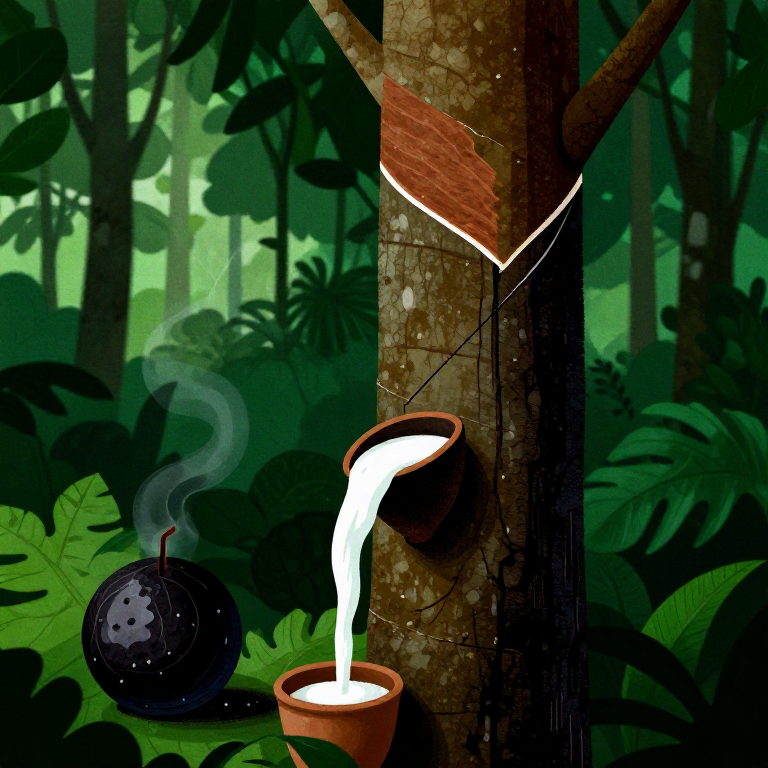
The rubber tree (Hevea brasiliensis) is a tree of the Euphorbiaceae family, native to the Amazon basin. It reaches 25-30 meters in height, with a straight trunk 30-60 cm in diameter and a broad crown. The bark is smooth, grayish, with leaf scar marks. The leaves are compound trifoliate (three leaflets) with smooth margins, arranged alternately. The tree produces capsular fruits with three seeds that explode when ripe, launching seeds several meters — hence the family name (Euphorbiaceae, from the Greek euphorbia). Latex is produced in laticifer vessels located in the inner bark (secondary phloem). Fresh latex is a milky white emulsion containing 30-40% rubber particles (cis-1,4-polyisoprene) suspended in water, along with proteins, sugars, minerals, and lipids.
Understanding the history of the rubber cycle
Understanding the history of the rubber cycle
The first rubber cycle (1879-1912) transformed the Brazilian Amazon. Global demand for rubber for bicycle and automobile tires attracted thousands of rubber tappers, mainly Northeasterners fleeing droughts. Manaus became one of the richest cities in the world — the Amazonas Theatre (1896) was built with materials imported from Europe. Brazil held the worldwide monopoly on rubber until 1876, when Henry Wickham smuggled 70,000 Hevea seeds to the Kew Botanical Garden in England. The seedlings were sent to Ceylon (Sri Lanka) and Malaysia, where organized plantations surpassed Amazonian extractive production. By 1913 Asian plantation rubber already dominated the world market, and the Amazonian cycle collapsed. Today, Thailand and Indonesia are the largest world producers. In Brazil, rubber tappers like Chico Mendes (1944-1988) fought for the creation of Extractive Reserves to preserve the traditional way of life and the forest.
Identifying rubber trees in the forest
Identifying rubber trees in the forest
ابزارهای مورد نیاز:
 قمه
قمهPrepare the tapping knife and equipment
Prepare the tapping knife and equipment
مواد مورد نیاز این مرحله:
 کاسهٔ گردآوری شیرابه20 قطعه
 ناودان فلزی20 قطعه
 مفتول بستن5 متر
ابزارهای مورد نیاز:
 چاقوی شیرهگیری کائوچو
 سنگ تیزکنی
 چراغ پیشانی نفتی
Walk the rubber trail at dawn
Walk the rubber trail at dawn
ابزارهای مورد نیاز:
چراغ پیشانی نفتیچاقوی شیرهگیری کائوچوMake the tapping cut in the bark
Make the tapping cut in the bark
ابزارهای مورد نیاز:
چاقوی شیرهگیری کائوچوInstall the spout and collection cup
Install the spout and collection cup
مواد مورد نیاز این مرحله:
کاسهٔ گردآوری شیرابه1 قطعهناودان فلزی1 قطعهابزارهای مورد نیاز:
 نگهدارندهٔ سیمی لیوان
Collect the latex from the cups
Collect the latex from the cups
ابزارهای مورد نیاز:
 سطل گردآوری شیرابه
Strain the latex
Strain the latex
ابزارهای مورد نیاز:
 صافی فولاد زنگنزن
 پارچهٔ پنبهای
Prepare the fire for smoking
Prepare the fire for smoking
Smoking (traditional smoking) is the historical method used by rubber tappers to coagulate and preserve latex. Build a small fire on the ground or in a clay oven (smoker), using fruits and oleaginous seeds from the forest that produce dense white smoke. Traditionally babassu coconuts (Attalea speciosa), tucumã pits (Astrocaryum aculeatum), or Brazil nut pods (Bertholletia excelsa) are used. These oleaginous seeds produce smoke rich in acetic acid, formaldehyde, and phenolic compounds that coagulate the latex and function as antifungal and antibacterial agents, preserving the rubber. Avoid resinous wood (pine) that gives dark color and undesirable odor. The smoke should be dense and white — clear and hot smoke indicates excessive combustion. The smoker should have a directed upper opening where the rubber tapper positions the stick with the forming rubber ball.
مواد مورد نیاز این مرحله:
 مغز نخل باباسو5 kilogram
ابزارهای مورد نیاز:
 دودخانهٔ گِلی
 وسیلهٔ آتشافروزی
Smoke the latex to form a rubber ball
Smoke the latex to form a rubber ball
مواد مورد نیاز این مرحله:
 شیرابهٔ تازهٔ پالوده5 لیتر
ابزارهای مورد نیاز:
 پاروی چوبی دودی کردن (pau de defumação)
 ملاقهدودخانهٔ گِلی
Remove the ball from the spit and inspect
Remove the ball from the spit and inspect
When the ball reaches the desired size (typically 20-60 kg), cut it along the spit with a sharp knife to remove it. The ball should be uniform in color (dark amber to brown), elastic to the touch, with no pockets of raw latex inside. Cut a thin slice to inspect: the interior should be homogeneous, with no white layers (uncoagulated latex) or air bubbles. Good quality smoked rubber (fine rubber) is translucent when cut into thin slices against the light. Rubber with raw layers or contamination is classified as 'sernambi' — inferior quality. The traditional classification ranges from 'fine' (best) to 'entrefine' and 'sernambi' (worst). Well-smoked fine rubber can be stored for months without degradation thanks to the antifungal properties of smoke.
ابزارهای مورد نیاز:
 چاقو
چاقوCare for the health of rubber trees
Care for the health of rubber trees
Store and transport rubber
Store and transport rubber
Smoked rubber balls must be stored in a dry, covered location with good ventilation, away from direct sunlight. Smoked rubber is hygroscopic — it absorbs moisture in humid environments, which favors fungal growth on the surface. In Amazonian tradition, the balls were transported by canoe through rivers and streams to the rubber tappers' warehouses (patrons), where they were weighed and exchanged for supplies in the aviamento system — a debt system that tied the rubber tapper to the land. The balls were then sent downriver to Belém or Manaus for export. Today, Amazonian natural rubber is valued by programs such as the 'Native Rubber Seal' of the Chico Mendes Extractive Reserve. Native rubber from the Amazon, although representing a small fraction of world production, has invaluable cultural and environmental value — each smoked rubber ball represents the preservation of the standing forest and the ancestral knowledge of rubber tappers.
ابزارهای مورد نیاز:
 ترازو
ترازو محوطهٔ انبار سرپوشیده
مواد
5- 21 قطعهجایگزین
- 21 قطعهجایگزین
- 5 مترجایگزین
- 5 kilogramجایگزین
- 5 لیترجایگزین
ابزارهای لازم
15- جایگزین
- جایگزین
- جایگزین
- جایگزین
- جایگزین
- جایگزین
- جایگزین
- جایگزین
- جایگزین
- جایگزین
- جایگزین
- جایگزین
- جایگزین
- جایگزین
CC0 مالکیت عمومی
این نقشه تحت مجوز CC0 منتشر شده است. شما آزاد هستید آن را کپی، ویرایش، توزیع و برای هر هدفی بدون نیاز به اجازه استفاده کنید.
با خرید محصولات از طریق نقشه از سازنده حمایت کنید و او کمیسیون سازنده تعیین شده توسط فروشندگان، دریافت میکند یا یک نسخه جدید از این نقشه ایجاد کنید و آن را به عنوان اتصال در نقشه خود قرار دهید تا درآمد به اشتراک گذاشته شود.