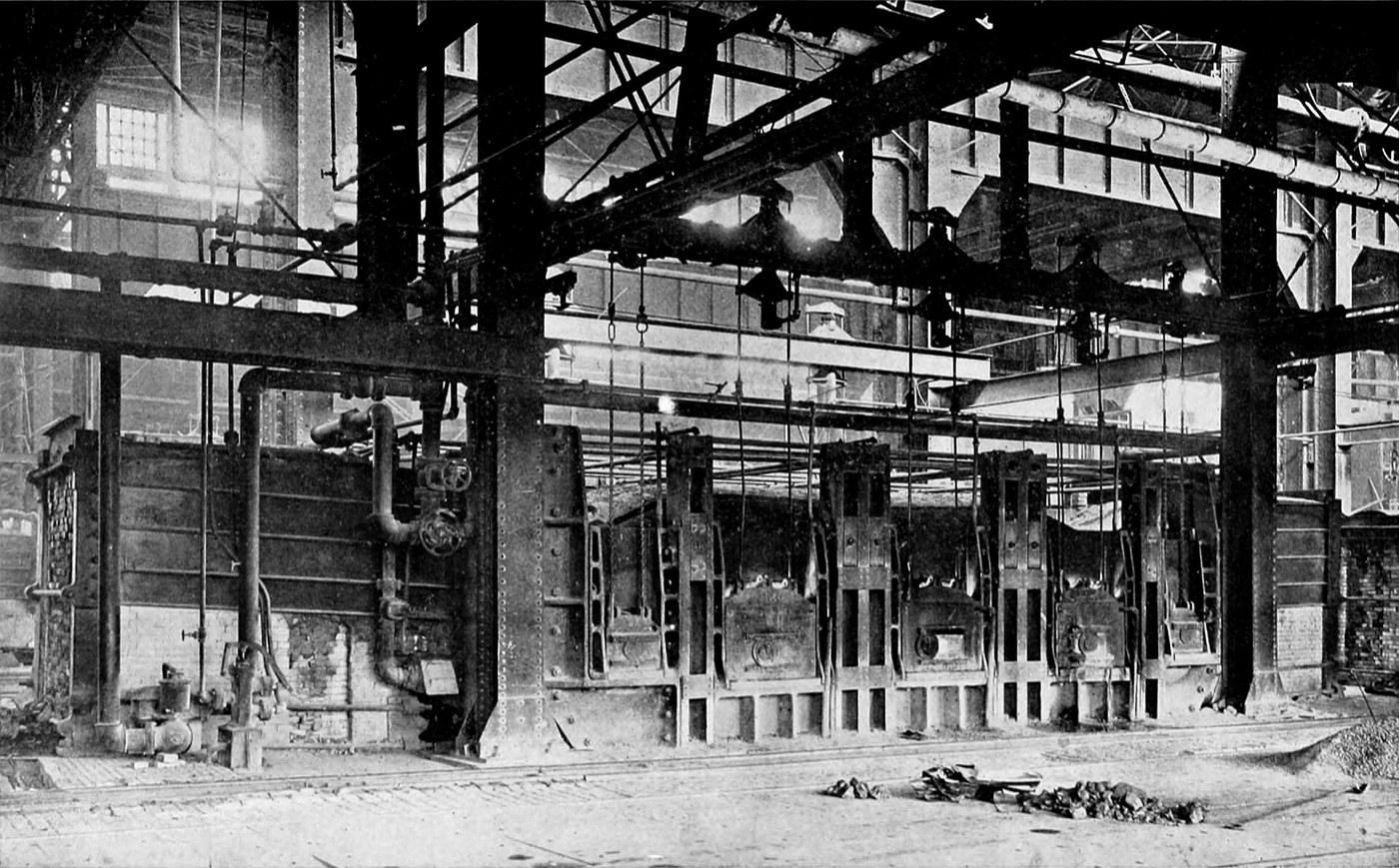


Siemens-Martin Open Hearth
To melt steel you need a flame hotter than steel melts. Ordinary combustion in an ordinary furnace does not get there — most of the heat goes up the chimney.
The Siemens regenerative furnace catches it. Exhaust gas is routed through a chamber packed with brickwork, dumping its heat into the bricks. Then the flow reverses: incoming air and fuel pass through those hot bricks and arrive at the hearth already glowing. Alternate every twenty minutes or so and the furnace climbs far above what the fuel alone could deliver.
This is a documentary blueprint with a bench-scale demonstration, not a home steelmaking guide. An open hearth is an industrial plant. What you can build and measure yourself is the regenerator — and that is the part that mattered.
دستورالعملها
Draw the furnace before building anything
Draw the furnace before building anything
Sketch the plant: a shallow hearth, a burner at each end, and beneath each end a chamber packed with checkerwork brick. Label which way the gases flow in this half of the cycle.
Trace the reversal
Trace the reversal
Now draw the same furnace with every arrow reversed. Exhaust that was heating the right-hand chamber now flows left, and the air that was cold now enters through the chamber the exhaust just heated. The whole invention is in that switch.
Build a regenerator you can measure
Build a regenerator you can measure
Make a small steel or ceramic tube packed loosely with broken firebrick, with an inlet at each end. This is a regenerator at bench scale — the same principle, safe to run.
مواد مورد نیاز این مرحله:
 آجر نسوز4 قطعه
Measure the baseline
Measure the baseline
Blow hot air from a heat gun straight into open air and record the temperature at a fixed distance with a thermocouple. Write it down. This is your control.
ابزارهای مورد نیاز:
 دماسنج آشپزخانه
Charge the brickwork
Charge the brickwork
Run the hot air through the packed tube for several minutes so the brick absorbs heat, and record how the outlet temperature climbs as the bricks warm.
Reverse the flow and measure again
Reverse the flow and measure again
Now blow cold air through the hot brickwork from the other end and measure the outlet. It comes out hot — heat recovered from a stream that would otherwise have been thrown away. That number, against your baseline, is the whole demonstration.
Plot the decay
Plot the decay
Keep measuring as the bricks give up their heat and plot temperature against time. The curve falls away, and where it becomes too cold to be useful is what sets the reversal interval in a real furnace — around twenty minutes at industrial scale.
Change the packing and repeat
Change the packing and repeat
Run it again with the brick broken smaller. More surface area transfers heat faster but chokes the flow. That trade-off is why real regenerator checkerwork is laid in an open lattice rather than dumped in as rubble.
Work out the charge on paper
Work out the charge on paper
An open hearth is charged with molten or solid pig iron plus a large proportion of scrap steel, with lime as flux. Calculate a charge: to lower carbon from pig iron's ~4 % toward steel's ~0.3 %, most of the carbon has to be oxidised away or diluted by low-carbon scrap.
Follow the refining chemistry
Follow the refining chemistry
Write out what leaves and where: carbon burns off as CO and CO₂; silicon, manganese and phosphorus oxidise and are taken up by the lime slag. The slag is not waste in the middle of the process — it is the chemical sink doing the refining.
Time the two processes side by side
Time the two processes side by side
Note the durations: a Bessemer blow is minutes; an open-hearth heat is hours. Then ask which one you could take samples from and adjust. Slowness is the open hearth's advantage, not its weakness.
Account for the scrap
Account for the scrap
Work out what a process that can melt large amounts of scrap does to the economics of an industry that had been treating old steel as a nuisance. Recycling is not a modern addition to steelmaking — it arrived with this furnace.
History & Context
History & Context
Two names, two contributions. Carl Wilhelm Siemens developed the regenerative furnace in the 1850s — the heat-recovery principle. In 1865 Pierre-Émile Martin took a licence from Siemens and applied that furnace to making steel. Hence Siemens-Martin: one man's furnace, another man's process.
Why it beat Bessemer. The Bessemer converter is spectacular and fast — air blown through molten iron, carbon burnt out in minutes. It is also nearly impossible to control, and blowing air through steel leaves nitrogen in it, which makes the metal brittle. The open hearth is slow enough that samples can be taken and the composition corrected before tapping, does not blow air through the melt, and can consume large amounts of scrap. After 1890 it steadily supplanted Bessemer, and by the early twentieth century it was the leading steelmaking process in the world.
The regenerator is the idea worth keeping. Storing waste exhaust heat in a thermal mass and giving it back to the incoming stream is a general principle. It appears today in glass furnaces, in industrial heat exchangers and in the heat-recovery ventilation of well-insulated houses. The plant this blueprint describes is obsolete; the trick inside it is not.
And then it went. Basic oxygen steelmaking, which blows pure oxygen rather than air, does the same job in a fraction of the time without the nitrogen problem, and open hearths were shut down through the later twentieth century. The sequence — Bessemer, open hearth, basic oxygen — is a good example of a technology that wins on control, holds the field for decades, and then loses to something that finally offers speed and control together.
نقشههای مرتبط
این نقشهها دانش مشترکی دارند — تکنیکها، مواد یا اصول

CC0 مالکیت عمومی
این نقشه تحت مجوز CC0 منتشر شده است. شما آزاد هستید آن را کپی، ویرایش، توزیع و برای هر هدفی بدون نیاز به اجازه استفاده کنید.
با خرید محصولات از طریق نقشه از سازنده حمایت کنید و او کمیسیون سازنده تعیین شده توسط فروشندگان، دریافت میکند یا یک نسخه جدید از این نقشه ایجاد کنید و آن را به عنوان اتصال در نقشه خود قرار دهید تا درآمد به اشتراک گذاشته شود.