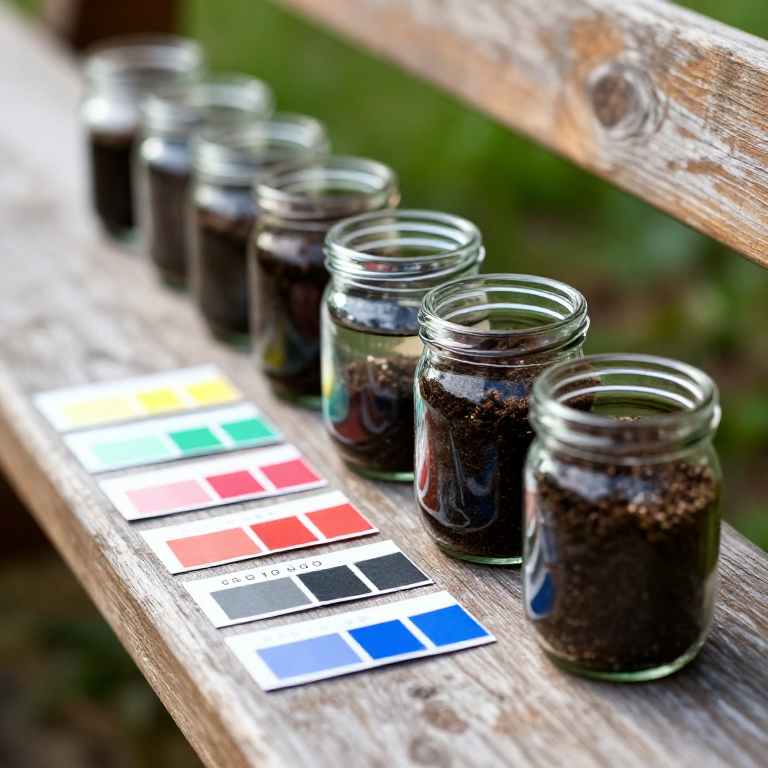


Testing Soil pH and Nutrients
Soil pH decides which nutrients a plant can actually take up. The nutrients are usually present — they are simply locked into forms the roots cannot absorb, and pH is the lock. Iron becomes unavailable in alkaline soil, phosphorus is bound in both strongly acid and strongly alkaline soil, and a plant can starve in ground that is chemically rich.
Which means the commonest gardening intervention — adding fertiliser to a struggling plant — frequently does nothing, because the limitation was never quantity.
Measuring it properly turns on one thing almost everyone gets wrong: the sample. Soil varies enormously over a few metres and over a few centimetres of depth. A single trowelful tells you about that trowelful. A useful measurement is a composite — many small cores from across an area, mixed, dried and sub-sampled — and taken from the root zone, not the surface.
The second thing is that soil pH is measured in a slurry, at a defined soil-to-water ratio, because the reading shifts with dilution. Change the ratio and you change the answer, which is why methods specify it.
Sample properly, measure a whole garden, and map it.
دستورالعملها
Take a composite sample, not a sample
Take a composite sample, not a sample
Divide the area into zones that genuinely differ — bed, lawn, under a tree, near a wall. In each zone take at least ten small cores from root depth, roughly 10-20 cm, along a zig-zag path.
Combine each zone's cores into one bag and label it.
Avoid the first few centimetres and avoid within a metre of paths, walls and compost heaps — mortar leaches lime and will hand you an alkaline result that is about the wall.
ابزارهای مورد نیاز:
 Earth Auger
 All-Weather Field Notebook (3-Pack)
Dry, crush and sieve
Dry, crush and sieve
Spread each composite thinly and air-dry — do not use an oven. Crush lumps, remove stones and roots, and pass through a sieve or a coarse cloth.
Mix thoroughly and take your sub-sample from the mixed whole.
Oven drying changes soil chemistry, particularly for nitrogen and potassium, so a result from oven-dried soil is not comparable with a standard method.
ابزارهای مورد نیاز:
 Fine Cheesecloth
 Digital Scale (0.01g)
Measure pH at a fixed ratio
Measure pH at a fixed ratio
Weigh soil and distilled water at a fixed ratio — 1 part soil to 2.5 parts water by mass is a common standard. Stir, leave 30 minutes with occasional stirring, and read the pH of the settled liquid.
Record the ratio alongside the number.
A pH quoted without its ratio is not a measurement, because dilution shifts the reading — deliberately try 1:1 and 1:5 and watch the number move.
مواد مورد نیاز این مرحله:
 pH Test Strips1 بسته
ابزارهای مورد نیاز:
 Glass Beaker
Test for carbonate with vinegar
Test for carbonate with vinegar
Put a spoonful of dry soil in a dish and add vinegar.
Expect fizzing if free carbonate is present.
Score each zone none / slight / strong.
This is the most useful ten-second test in the whole blueprint. A fizzing soil is buffered alkaline by carbonate, which means acid-loving plants will never thrive there and that adding sulphur to lower the pH is a losing battle against a large chemical reservoir.
مواد مورد نیاز این مرحله:
 Wine Vinegar100 میلیلیتر
Measure texture by settling
Measure texture by settling
Shake a soil sample with water in a tall straight jar and leave it to settle for a day. Sand falls in seconds, silt in minutes, clay over hours.
Measure the depth of each band and compute percentages.
Texture governs how a soil behaves far more than nutrients do — it decides drainage, how much water is available to roots, and how strongly the soil holds onto nutrients in the first place.
ابزارهای مورد نیاز:
 Tape Measure
Map it and act on the map
Map it and act on the map
Draw the plot and write each zone's pH, fizz result and texture on it. Compare with what actually grows well where.
Expect the map to explain problems you had already noticed.
Match the plant to the soil before trying to match the soil to the plant. Changing a soil's pH meaningfully is slow, expensive and, in carbonate soil, largely futile — and the map tells you which battles are worth fighting.
ابزارهای مورد نیاز:
 Graph Paper
Compendium — what pH controls and what a home test cannot tell you
Compendium — what pH controls and what a home test cannot tell you
The availability curve is the whole point. Most plant nutrients are most available in a band roughly between pH 6 and 7.5. Below that, phosphorus binds with iron and aluminium, and aluminium itself becomes soluble enough to be toxic to roots. Above it, iron, manganese and zinc precipitate out of reach — which is what causes the yellow-between-green-veins chlorosis seen on acid-loving shrubs planted in chalky ground. The plant is not short of iron; it is standing in it and cannot get at it.
Buffering is why changing pH is hard. A soil's resistance to pH change depends on its clay and organic matter content and, decisively, on free carbonate. A sandy soil with little organic matter shifts easily; a chalky clay is buffered by a reservoir of calcium carbonate that will neutralise anything you add for years. This is why the vinegar fizz test matters more than the pH number — it tells you not where the soil is but how hard it will fight to stay there.
What a colour test actually measures. Home kits for nitrogen, phosphorus and potassium extract a fraction of what is in the soil with a chemical reagent and compare a colour. Different laboratories use genuinely different extractants — Olsen, Mehlich, Bray — and they give different numbers for the same soil, all correct within their own method. A home NPK result is a rough indication and cannot be compared against a figure from a lab using another extractant. Nitrogen in particular is nearly meaningless to test at home: it moves and transforms so quickly that a reading is out of date within days.
When to use a real laboratory. For anything that matters — a new allotment, a food-growing site on former industrial or urban land, persistent unexplained failure — send a sample. A lab will give you pH, buffer pH, organic matter, cation exchange capacity and a proper nutrient panel for a modest fee. And on any site with an industrial, roadside or demolition history, ask specifically for heavy metals: lead in urban garden soil is a genuine and well-documented risk, especially where children play or root vegetables are grown, and no colour-chart kit will detect it.
Safe practice. Wash hands after handling soil, do not test soil in food containers, and keep samples away from food preparation areas. Do not taste soil to judge texture, an old field method that has no place in a garden of unknown history.
مواد
2- 1 بستهجایگزین
- 100 میلیلیترجایگزین
ابزارهای لازم
7- جایگزین
- جایگزین
- جایگزین
- جایگزین
- جایگزین
- 1 vendor sell this, none ship to you yetجایگزین
- جایگزین
مواد نقشههای متصل

نقشههای مرتبط
این نقشهها دانش مشترکی دارند — تکنیکها، مواد یا اصول
CC0 مالکیت عمومی
این نقشه تحت مجوز CC0 منتشر شده است. شما آزاد هستید آن را کپی، ویرایش، توزیع و برای هر هدفی بدون نیاز به اجازه استفاده کنید.
با خرید محصولات از طریق نقشه از سازنده حمایت کنید و او کمیسیون سازنده تعیین شده توسط فروشندگان، دریافت میکند یا یک نسخه جدید از این نقشه ایجاد کنید و آن را به عنوان اتصال در نقشه خود قرار دهید تا درآمد به اشتراک گذاشته شود.