هنر
زیبایی و سلامت
صنایع دستی
فرهنگ و تاریخ
سرگرمی
محیط زیست
غذا و نوشیدنی
آینده سبز
مهندسی معکوس
علوم
ورزش
فناوری
پوشیدنیها
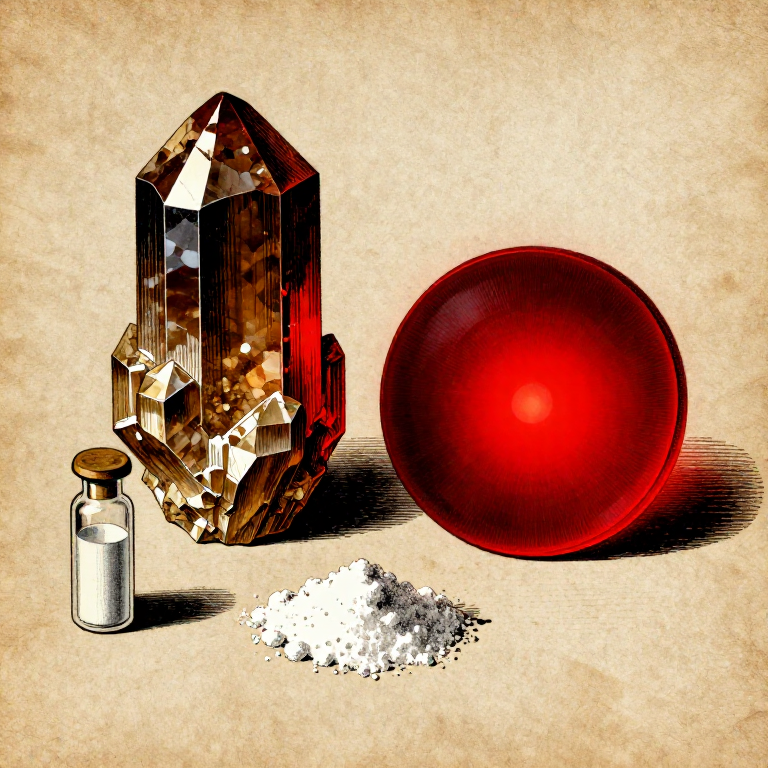
Understanding Yttrium from Xenotime — The Rare Earth That Lights Red Screens
متوسط
دستورالعملها
1
1
Understand Yttrium's Discovery and Naming
Johan Gadolin identified yttrium oxide in 1794 from a black mineral found near the village of Ytterby, Sweden. This single quarry eventually gave names to four elements: yttrium, ytterbium, erbium, and terbium. Yttrium is classified as a rare earth despite being more abundant than lead — it occurs at 33 ppm in Earth's crust. The 'rare' in rare earth refers to the difficulty of separating these chemically similar elements, not their scarcity.
2
2
Identify Xenotime and Monazite
Xenotime (YPO₄) is the primary yttrium mineral, forming brown to yellowish prismatic crystals with a tetragonal crystal system. It concentrates in heavy mineral sands alongside monazite, zircon, and ilmenite. Monazite (CePO₄) also contains 2-5% yttrium substituting for cerium. Both minerals resist weathering, accumulating in beach placers and alluvial deposits in Australia, Brazil, India, and Southeast Asia.
ابزارهای مورد نیاز:
Hand Lens (10x Magnification)
Streak Plate (Unglazed Porcelain)3
3
Test Mineral Properties
Xenotime has Mohs hardness of 4-5 and a white to pale brown streak. Its specific gravity of 4.4-5.1 makes it separable from lighter gangue minerals by gravity methods. Unlike monazite, xenotime is not significantly radioactive because it concentrates heavy rare earths rather than thorium. A key diagnostic test: xenotime dissolves slowly in hot sulfuric acid, while many look-alike minerals resist it.
مواد مورد نیاز این مرحله:
Sulfuric Acid (96% concentrated)ابزارهای مورد نیاز:
Safety Goggles
Chemical-Resistant Gloves
Precision Scale (0.01g)4
4
Understand Rare Earth Separation
Separating yttrium from other rare earths is one of chemistry's greatest challenges — all form +3 ions with nearly identical chemical behavior. Modern separation uses solvent extraction with organophosphorus acids in mixer-settler cascades. Hundreds of stages gradually concentrate individual elements. Yttrium behaves as a 'pseudo-heavy' rare earth despite its low atomic number, eluting between dysprosium and holmium.
5
5
Explore Yttrium in Red Phosphors
Yttrium oxide doped with europium (Y₂O₃:Eu³⁺) is the most important red phosphor in lighting and display technology. The europium atoms emit at 611 nm (vivid red) when excited, while the yttrium oxide host lattice provides the optimal crystal field environment. Every color television from the 1960s to 2000s used this phosphor. Modern white LEDs still use yttrium aluminum garnet (YAG:Ce) as the yellow-emitting phosphor layer.
6
6
Understand YAG Laser Technology
Yttrium aluminum garnet (Y₃Al₅O₁₂) doped with neodymium produces the Nd:YAG laser — the most widely used solid-state laser in the world. Operating at 1064 nm (near-infrared), it cuts metal in manufacturing, removes tattoos in dermatology, ranges targets in military systems, and performs LASIK eye surgery. The YAG crystal's thermal conductivity and optical transparency make it an ideal laser host material.
7
7
Discover Yttrium Barium Copper Oxide Superconductor
In 1987, Paul Chu discovered that YBa₂Cu₃O₇ (YBCO) becomes superconducting at 93 K — above liquid nitrogen's boiling point of 77 K. This was revolutionary: previous superconductors required expensive liquid helium (4 K). YBCO enabled practical demonstrations of magnetic levitation and lossless current flow using cheap liquid nitrogen. The discovery earned the term 'high-temperature superconductor' despite being -180°C.
8
8
Survey Yttrium-Stabilized Zirconia
Adding 3-8 mol% Y₂O₃ to ZrO₂ stabilizes the cubic crystal phase at room temperature, creating yttria-stabilized zirconia (YSZ). This ceramic is extraordinarily tough — it resists crack propagation through a phase transformation mechanism. Applications include thermal barrier coatings on jet engine turbine blades, dental crowns, hip joint replacements, and oxygen sensors in every automobile exhaust system.
9
9
Examine Yttrium Metal Properties
Metallic yttrium is silvery, ductile, and relatively stable in air — it forms a protective oxide layer unlike most rare earths. Adding yttrium to aluminum and magnesium alloys improves high-temperature strength: yttrium-containing magnesium alloys are used in Formula 1 gearboxes where weight and heat resistance both matter. Yttrium metal powder is pyrophoric and must be handled in inert atmosphere.
10
10
Document Findings and Supply Chain
Record yttrium's key data: atomic number 39, silvery metal, melting point 1526°C, density 4.47 g/cm³. China produces over 95% of the world's yttrium, creating significant supply chain risk for LED lighting, laser manufacturing, and ceramic industries. Recycling from spent phosphor powders and electronic waste is growing but challenging because rare earth concentrations in consumer products are low. Annual production is about 8,000 tonnes of yttrium oxide.
مواد
1- جایگزین
ابزارهای لازم
5- جایگزین
مواد نقشههای متصل
CC0 مالکیت عمومی
این نقشه تحت مجوز CC0 منتشر شده است. شما آزاد هستید آن را کپی، ویرایش، توزیع و برای هر هدفی بدون نیاز به اجازه استفاده کنید.
با خرید محصولات از طریق نقشه از سازنده حمایت کنید و او کمیسیون سازنده تعیین شده توسط فروشندگان، دریافت میکند یا یک نسخه جدید از این نقشه ایجاد کنید و آن را به عنوان اتصال در نقشه خود قرار دهید تا درآمد به اشتراک گذاشته شود.