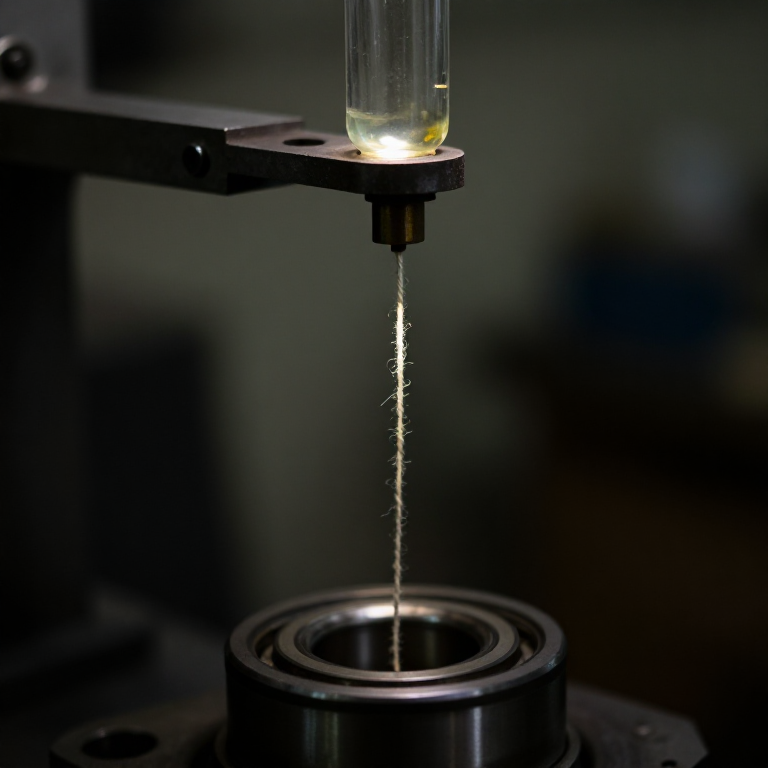


Wick Oiler
دستورالعملها
Build the reservoir and its delivery tube
Build the reservoir and its delivery tube
A small cup above the bearing, with a tube leading down to it.
- Fix a glass jar or a small metal cup to a plywood bracket above the bearing housing.
- Drill the cup's base for a delivery tube of 6 mm aluminium or brass, and seal the joint.
- Run the tube down so its lower end sits just above the shaft.
- Fix the bracket with M5 × 30 socket head cap screws × 2, M5 flat washers × 4 and M5 hex nuts × 2.
Height above the bearing matters less than you would expect. Capillary action lifts oil UP the wick out of the reservoir and gravity does the rest; the feed rate is governed by the wick, not by head. This is why a wick oiler works reliably at almost any reasonable height, unlike a gravity drip which depends on it.
Use a transparent reservoir if you can. Being able to see the oil level is half the value — an empty oiler and a full one look identical from outside an opaque cup, and the bearing finds out first.مواد مورد نیاز این مرحله:
 شیشهٔ نگهداری دردار1 قطعه
 تختهٔ چندلایهٔ توس بالتیک1 ورق
 میلگرد گرد برنجی1 قطعه
 واشر تخت4 قطعه
 مهرهٔ ششگوش2 قطعه
ابزارهای مورد نیاز:
 دریل شارژی
 مجموعه مته
 ارهٔ مویی
 مجموعه آچار آلن
 مجموعه سوهان
 کولیس دیجیتال ۶ اینچی
Make wicks in three thicknesses
Make wicks in three thicknesses
The wick is the metering device, so make several and compare them.
- Cut three lengths of wool yarn: one strand, three strands twisted, and six strands twisted.
- Make each long enough to reach from the reservoir's bottom, up over the rim or through the tube, and down to the delivery point.
- Soak all three fully in oil before use.
- Label them by strand count.
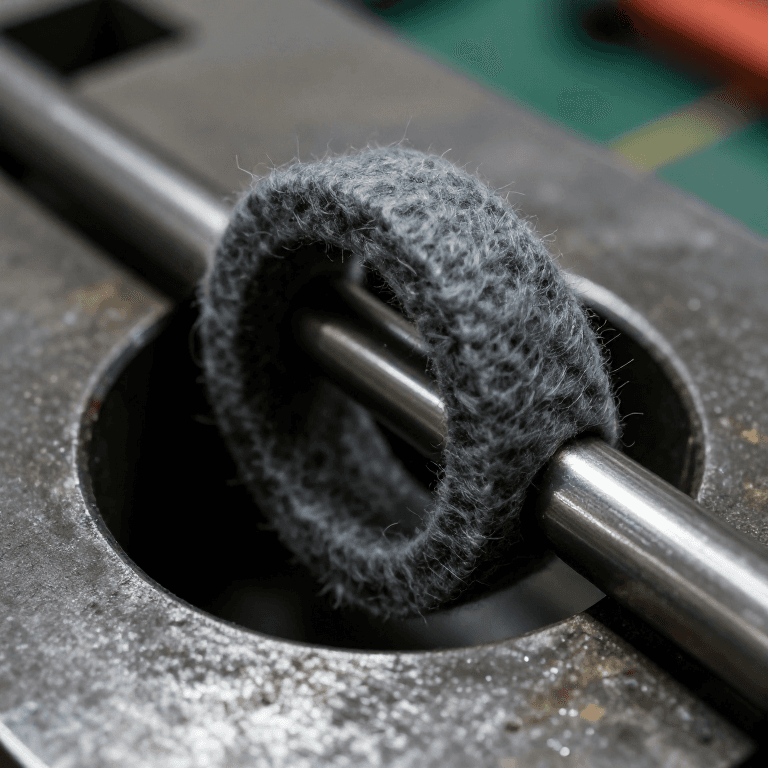
Why wool rather than cotton or synthetic. Wool's scaled fibre surface holds and transports oil better, and it does not rot in oil the way some natural fibres do. The same property makes wool felt the traditional wiper material — one fibre, two applications, both exploiting capillary behaviour.
A wick must be soaked before it will work. A dry wick can take hours to prime by itself, and a bearing started on a dry wick runs unlubricated for exactly as long as priming takes.مواد مورد نیاز این مرحله:
 کلاف نخ پشمی1 کلاف
 روغن بزرک پخته1 بطری
ابزارهای مورد نیاز:
مجموعه سوهانکولیس دیجیتال ۶ اینچیMeasure feed rate against wick thickness
Measure feed rate against wick thickness
Three wicks, one reservoir, a countable result.
- Fit the single-strand wick, fill the reservoir and let it settle.
- Count drips per minute at the delivery end over five minutes.
- Repeat with the three-strand and six-strand wicks.
- Now warm the oil slightly and repeat the three-strand test.
- Tabulate strands, temperature and drips per minute.
ابزارهای مورد نیاز:
 کرونومترکولیس دیجیتال ۶ اینچی
Find the siphon failure — and stop it
Find the siphon failure — and stop it
The classic wick-oiler fault, deliberately provoked.
- Fit the six-strand wick and let it run.
- Lower the delivery end well below the reservoir base and watch.
- If the wick becomes fully saturated end to end, it stops metering and siphons — a continuous flow rather than drips.
- Raise the delivery end, or thin the wick, until dripping resumes.
ابزارهای مورد نیاز:
کرونومترکولیس دیجیتال ۶ اینچیWhere it belongs among the feeders, and history
Where it belongs among the feeders, and history
Wick lubrication is everywhere in nineteenth and early twentieth century machinery — line shafting, locomotive axleboxes, sewing machines, machine tools. Railway axleboxes used a pad of oil-soaked wool waste pressed against the journal, which is the same principle without a reservoir, and generations of railway maintenance amounted to keeping those pads oiled and clean.
The three feeders in this batch differ in who is in control. The wick feeds continuously and automatically, at a rate nobody sets after installation. The sight-feed drip oiler feeds at a rate the operator dials and can watch. The grease nipple feeds nothing at all until somebody chooses to pump it. Automatic and unsupervised, adjustable and visible, or manual and deliberate — that is a choice about trust and attention, not about lubrication.
Its enduring virtue is that it cannot fail energetically. No pump to seize, no pressure to lose, no control to mis-set. It either feeds or it stops, and it stops gently. For machinery that runs unattended for long periods at modest speeds, that is worth more than precision.
Honest limits: it feeds while the machine is stopped as well as running, wasting oil; it cannot deliver enough for a heavily loaded or fast bearing; the rate drifts as oil thickens with age and cold; and the wick itself is a consumable that hardens and must be renewed. Modern equivalents replace it with a pressurised system precisely because those limits matter more as machines get faster.
مواد
7- 1 قطعهجایگزین
- جایگزین
- 1 قطعهجایگزین
- 4 قطعهجایگزین
- 2 قطعهجایگزین
- 1 کلافجایگزین
- 1 بطریجایگزین
نقشههای مرتبط
این نقشهها دانش مشترکی دارند — تکنیکها، مواد یا اصول

CC0 مالکیت عمومی
این نقشه تحت مجوز CC0 منتشر شده است. شما آزاد هستید آن را کپی، ویرایش، توزیع و برای هر هدفی بدون نیاز به اجازه استفاده کنید.
با خرید محصولات از طریق نقشه از سازنده حمایت کنید و او کمیسیون سازنده تعیین شده توسط فروشندگان، دریافت میکند یا یک نسخه جدید از این نقشه ایجاد کنید و آن را به عنوان اتصال در نقشه خود قرار دهید تا درآمد به اشتراک گذاشته شود.