

Panning for Alluvial Gold — Gravity Separation in Stream Sediment
Leiðbeiningar
Identify a Gold-Bearing Stream
Identify a Gold-Bearing Stream
Gold erodes from primary deposits in quartz veins and is transported by water into streams, where it accumulates in specific locations. Look for gold in the inside bends of rivers (where current slows and heavy material settles), behind large boulders, in bedrock crevices, and at the junction of tributary streams. Alluvial gold deposits form where the stream's carrying capacity decreases — wherever the current slows, heavier particles drop first. The best gravel is found at bedrock level, beneath several layers of sand and cobbles. Ancient Egyptian gold panning operations on the Nile tributaries used these same principles.
Fill and Submerge the Pan
Fill and Submerge the Pan
Fill the pan approximately three-quarters full with gravel and sediment from a promising location. Submerge the pan in the stream and break up any clay lumps by hand — gold particles trapped in clay will not separate until the clay is fully disaggregated. Remove any large stones by hand after checking them for attached gold (gold occasionally adheres to quartz pebbles). The pan should now contain fine gravel, sand, and water. Historically, the sheepskin was used in place of a pan — gold particles trapped in the wool fibers, which is likely the origin of the Greek myth of the Golden Fleece.
Agitate and Wash Away Light Material
Agitate and Wash Away Light Material
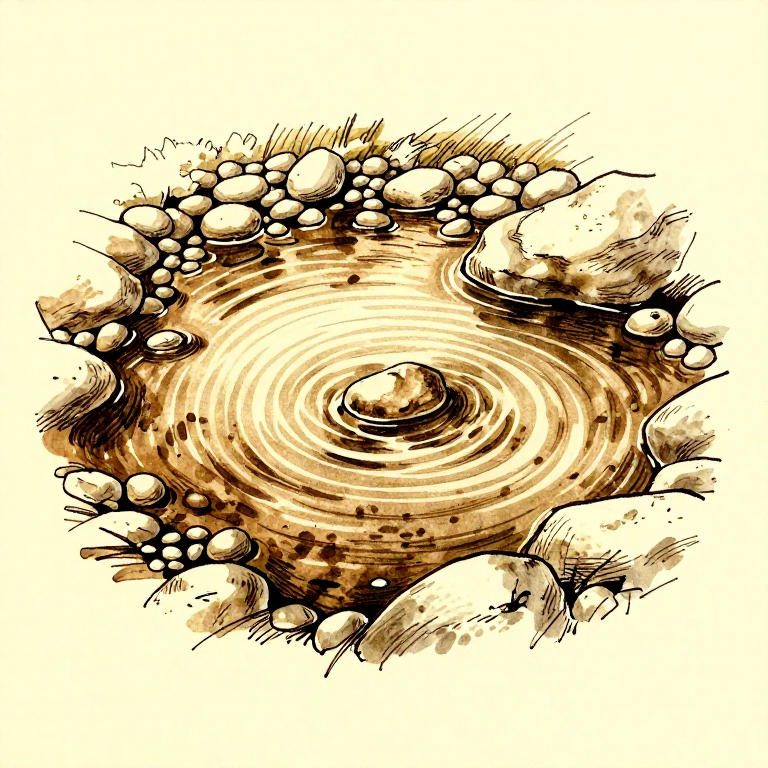
With the pan submerged, shake it vigorously side to side for 15-20 seconds. This agitation causes the denser particles (gold, black sand, and heavy minerals) to sink to the bottom while lighter sand and gravel rise to the top. Tilt the pan slightly away from you and gently swirl water across the surface, washing the lighter top layer of material over the rim. Between each washing pass, shake the pan flat again to re-settle the heavies. Work slowly and methodically — rushing causes gold to wash over the rim with the light material. The process takes 3-5 minutes per panful.
Efni fyrir þetta skref:
 Ílát1, approximately 30-40 cm diameter cm
 Mölmany panfuls stykki
Nauðsynleg verkfæri:
 Graftól (steinn, horn eða prik)
 Glerhettuglas (lítið, fyrir sýni)
Concentrate the Heavies
Concentrate the Heavies
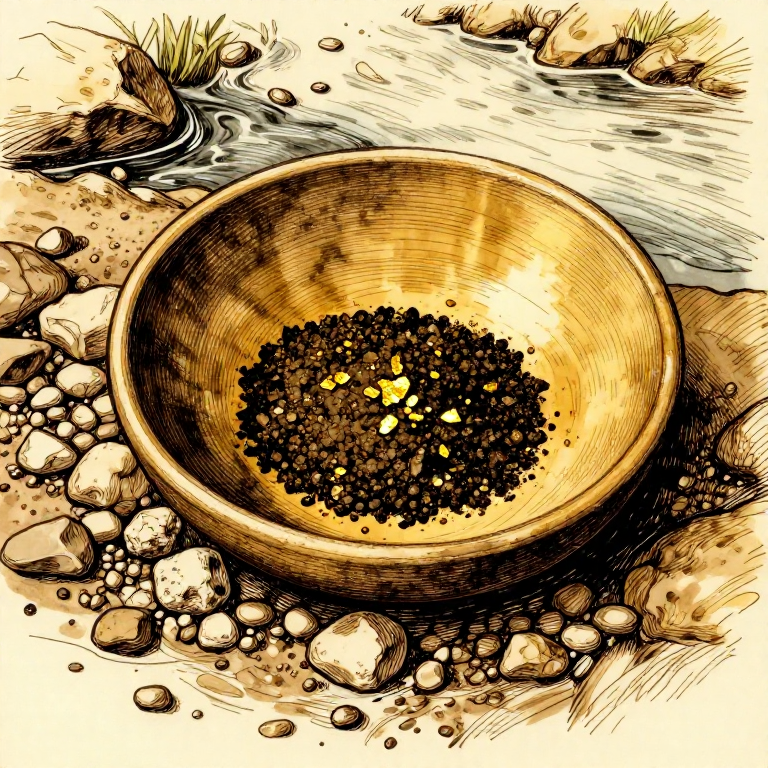
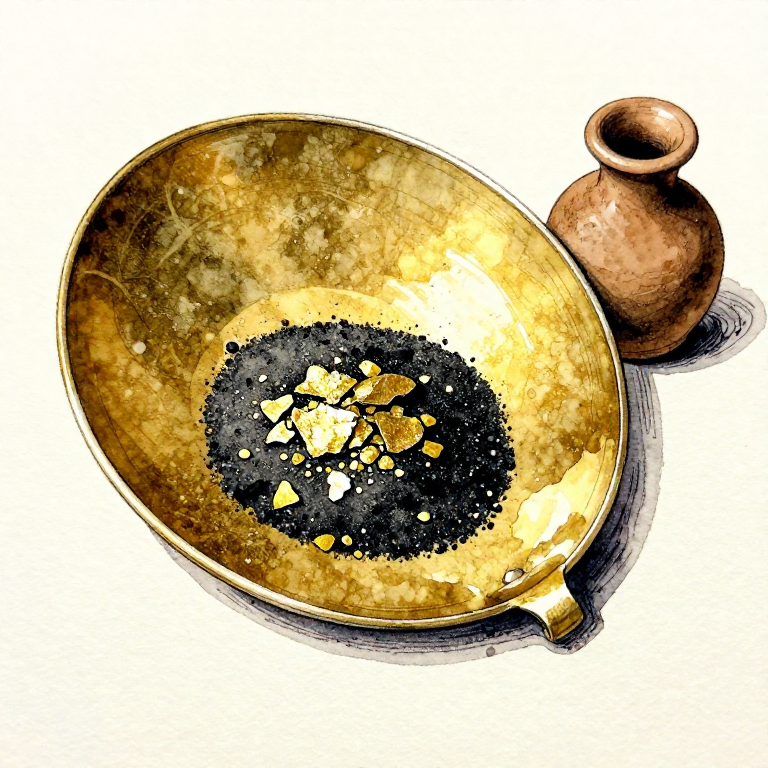
Continue the shake-tilt-wash cycle until only a tablespoon or two of heavy concentrate remains in the bottom of the pan. This concentrate consists primarily of black sand (magnetite and ilmenite, density 5-5.2 g/cm3) and any gold present. The gold — if present — appears as bright yellow flakes or tiny nuggets among the dark mineral grains. Even a small amount of gold is conspicuous because of its distinctive colour and metallic lustre. Add a small amount of water to the concentrate and swirl it gently in a slow circular motion — the gold, being densest, will trail behind the black sand and collect at the lowest point of the pan.
Collect and Store the Gold
Collect and Store the Gold
Pick out visible gold flakes and nuggets with a moistened fingertip or a thin twig and transfer them to a small vial or container with water. For very fine flour gold (particles smaller than 0.5 mm), the ancient method was to pass the concentrate over a sheepskin or woollen cloth — the gold particles lodge in the fibers while the sand washes through. The cloth is then dried and shaken over a container to release the gold, or burned to recover it. Panning is labour-intensive but highly effective for small-scale recovery. Ancient sources report that skilled panners in gold-rich rivers could recover 1-5 grams of gold per day — enough to be economically significant in the ancient world where a gram of gold could purchase a sheep.
Efni
3- 1, approximately 30-40 cm diameter cmStaðgengill
- many panfuls stykkiStaðgengill
- 1, approximately 30-40 cm diameter stykkiStaðgengill
Nauðsynleg verkfæri
2- Staðgengill
- Staðgengill
Þessi teikning býr til

CC0 opinbert ríki
Þessi teikning er gefin út undir CC0. Þér er frjálst að afrita, breyta, dreifa og nota þetta verk í hvaða tilgangi sem er, án þess að biðja um leyfi.
Studdu smiðinn með því að kaupa vörur í gegnum teikningu hans þar sem hann fær þóknun smiða sem seljendur ákvarða, eða búðu til nýja endurskoðun á þessari teikningu og tengdu hana sem tengingu í þinni eigin teikningu til að deila tekjum.