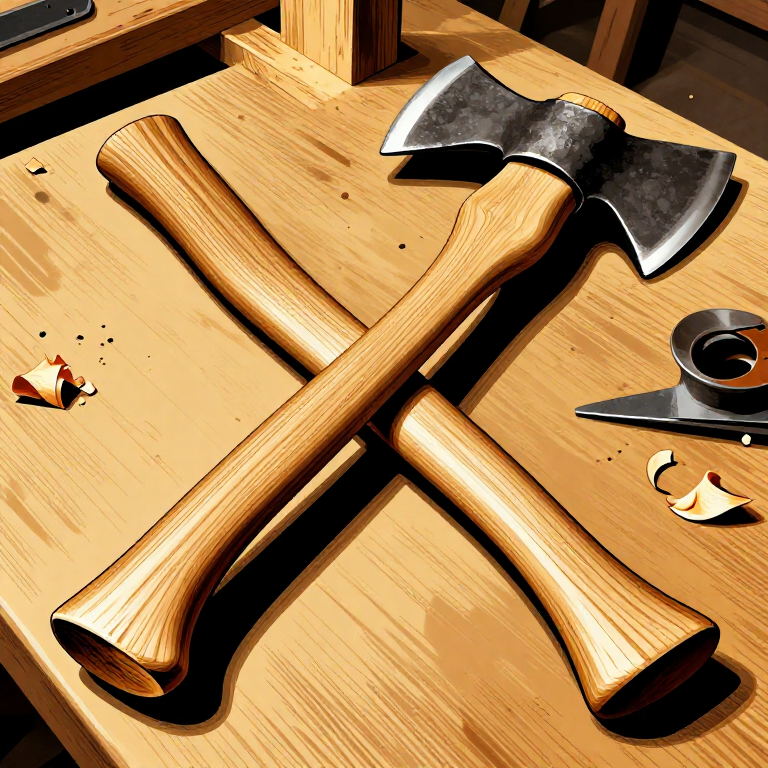


Shaping an Ash Tool Handle — The Perfect Shock-Absorbing Wood
Leiðbeiningar
Select and Split the Ash Billet
Select and Split the Ash Billet
Ash (Fraxinus excelsior in Europe, F. americana in North America) is the premier handle wood for one reason: its long, interlocking fibers absorb impact vibration instead of transmitting it to your hands. This is why virtually every axe, hammer, pick, and hoe in history has an ash handle.
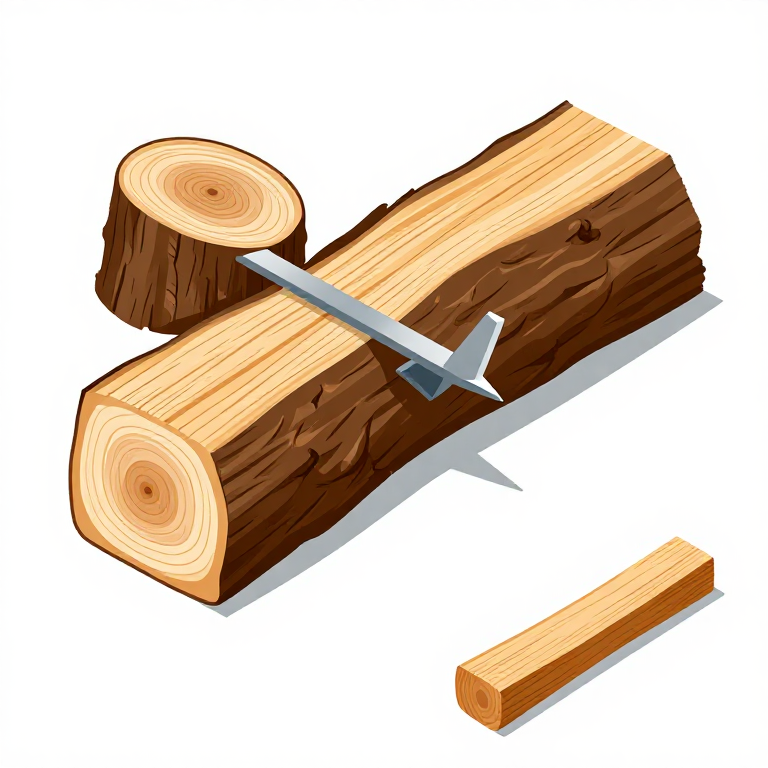
Select a straight-grained log section at least 40cm long and 10-15cm diameter. The grain must run straight — any spiral, knot, or cross-grain creates a weak point that will eventually snap under impact.
Split the log in half with wedges, then split again into quarters. Choose the best quarter — the one with the straightest, most consistent grain. Splitting along the grain (rather than sawing) ensures the fibers run continuously from end to end, which is critical for strength.
Efni fyrir þetta skref:
 Askbútur
Rough-Shape with Hatchet
Rough-Shape with Hatchet
Using a hatchet or side axe, rough out the handle shape from your split billet. Work with the grain, removing wood in controlled chips. The basic handle cross-section is an oval (not round) — this gives you directional control and prevents the tool from rotating in your hand.
Leave the handle slightly oversize at this stage — you will refine with finer tools. For an axe handle, typical rough dimensions are: 3-4cm × 2.5-3cm at the grip, swelling to 4-5cm at the head end (the "eye").
The head end must be shaped to fit the specific tool — an axe eye is typically an elongated oval. Measure your tool head carefully and shape the top of the handle to match, leaving it slightly oversize for a tight wedged fit.
Nauðsynleg verkfæri:
 Handöxi
Refine with Drawknife and Spokeshave
Refine with Drawknife and Spokeshave
Clamp the rough handle in a shaving horse or vise. Using a drawknife (pulling toward you with both hands), remove wood in long, thin shavings to approach the final shape. Follow the grain — if the knife digs in, reverse direction.
Switch to a spokeshave for the final shaping. A spokeshave gives more control for curves, especially the swell at the grip end and the transition to the head. The handle should feel comfortable in your hand — wrap your fingers around it and adjust any uncomfortable high spots.
Slight palm swell at the bottom of the handle (the "knob") prevents the tool from slipping out of your hand during a powerful swing. This is a critical safety feature on every striking tool handle.
Nauðsynleg verkfæri:
 Bandhefill
 Bugtarhefill
 Telgibekkur
Sand and Fit to the Tool Head
Sand and Fit to the Tool Head
Finish the surface with a rasp, then progressively finer sanding. A smooth handle reduces blisters during extended use. Do not over-sand to a polished surface — a slight tooth helps grip.
Fit the handle to the tool head by test-inserting the top end into the eye. Mark high spots, remove them with rasp or knife, and retest. The fit should be snug but not forced.
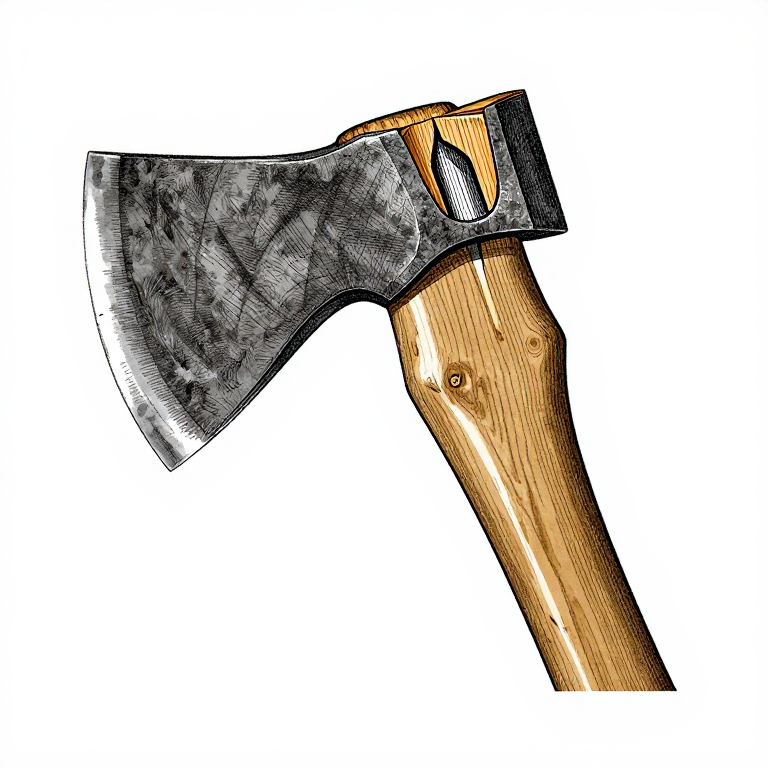
Once the fit is right, drive the handle home. In the top end, cut a slot and drive in a thin wooden wedge (perpendicular to the eye's long axis). This expands the wood inside the eye, locking the head permanently. For extra security, cross-wedge with a second wedge at 90° to the first.
Nauðsynleg verkfæri:
 Rasp
Rasp Sandpappír
Oil and Season the Handle
Oil and Season the Handle
Apply raw linseed oil (not boiled — which contains chemical driers) to the entire handle surface. Rub it in with a cloth, let it soak for 10 minutes, then wipe off excess. Repeat 2-3 times over consecutive days.
Linseed oil penetrates the wood fibers and polymerizes over weeks, creating a water-resistant finish that nourishes the wood. The handle will darken slightly and develop a warm, golden tone that deepens with age and use.
The Vikings preferred ash for axe handles, but also used it for spear shafts, cart axles, and oars. The Old Norse word for ash — "askr" — is also the name of the first man in Norse mythology (Ask and Embla), reflecting the profound importance of this tree in Norse culture.
A well-made ash handle, oiled annually, will outlast multiple tool heads. Many vintage tools still carry handles that are 50+ years old.
Efni fyrir þetta skref:
 Hrá hörfræolía
Nauðsynleg verkfæri
6- Staðgengill
- Staðgengill
- Staðgengill
- Staðgengill
- Staðgengill
- Staðgengill
Þessi teikning býr til

CC0 opinbert ríki
Þessi teikning er gefin út undir CC0. Þér er frjálst að afrita, breyta, dreifa og nota þetta verk í hvaða tilgangi sem er, án þess að biðja um leyfi.
Studdu smiðinn með því að kaupa vörur í gegnum teikningu hans þar sem hann fær þóknun smiða sem seljendur ákvarða, eða búðu til nýja endurskoðun á þessari teikningu og tengdu hana sem tengingu í þinni eigin teikningu til að deila tekjum.