

Cellophane
Jacques Brandenberger watched wine spilled on a restaurant tablecloth and set out to make a cloth that liquid could not soak into. He sprayed fabric with viscose, and the coating peeled off in a clear flexible sheet. The coated cloth was useless; the sheet that fell off was the invention.
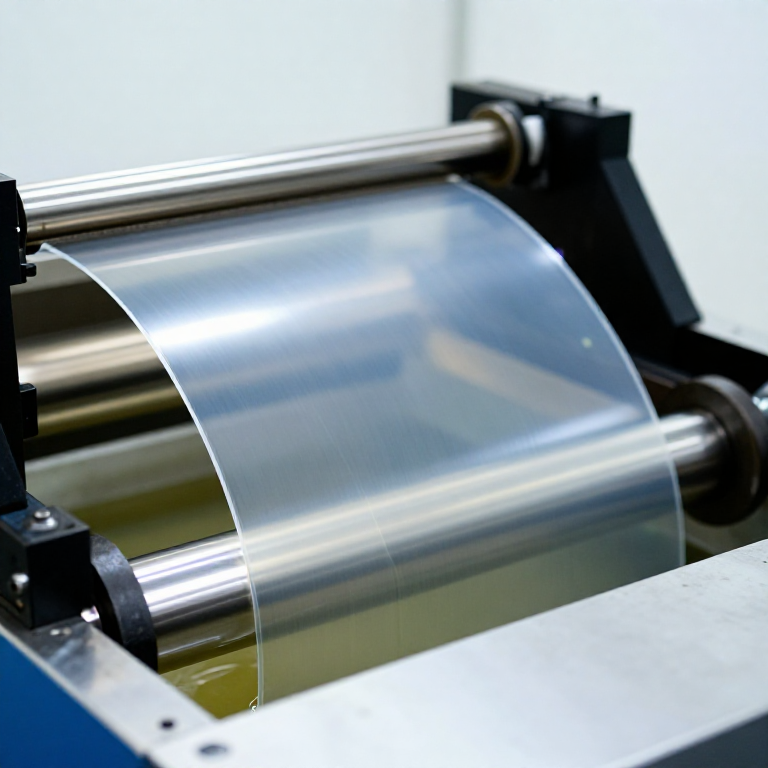
The chemistry is regeneration, not synthesis. Cellulose is dissolved as a xanthate to make viscose, extruded through a slit into an acid bath, and turned back into cellulose — the same molecule it started as, now in a continuous transparent film instead of plant fibre. Nothing new is created; it is dissolved and reshaped.
The patent never uses the trade name. It is titled "Process for the continuous manufacture of cellulose films" — US Patent 981,368, granted to Brandenberger on 10 January 1911.
Leiðbeiningar
Read the process, do not run the viscose chemistry
Read the process, do not run the viscose chemistry
Industrial viscose uses carbon disulfide, which is genuinely toxic and highly flammable, and caustic soda. This blueprint studies the process and demonstrates regeneration with a safe substitute — do not attempt the xanthate route.
Read US 981,368 and note the word 'continuous'
Read US 981,368 and note the word 'continuous'
Brandenberger claims CONTINUOUS manufacture: solution in, film out, without stopping. Making a sheet was known; making it endlessly is the patent.
Understand why cellulose cannot simply be melted
Understand why cellulose cannot simply be melted
Cellulose decomposes before it melts, so it cannot be cast or extruded like a thermoplastic. It has to be dissolved into a derivative and then turned back — that constraint shapes the whole process.
Demonstrate regeneration safely with a gel film
Demonstrate regeneration safely with a gel film
Dissolve sodium alginate in water, extrude it into a calcium chloride bath, and watch a clear film form on contact. Different chemistry, identical PRINCIPLE: soluble form in, insoluble solid out.
Efni fyrir þetta skref:
 Natríumalgínat50 g
 Kalsíumklóríð100 g
Extrude through a SLIT, not a hole
Extrude through a SLIT, not a hole
Make a narrow slot die rather than a round orifice. A hole gives you fibre — which is rayon. The only difference between rayon and cellophane is the shape of the die.
Efni fyrir þetta skref:
 Messingplata 260, þykkt 241 plata
Nauðsynleg verkfæri:
 Málmþjöl
Keep the slit gap even along its length
Keep the slit gap even along its length
Any variation in the gap prints as a permanent thickness band down the whole length of the film. Die accuracy is film quality.
Nauðsynleg verkfæri:
 Reglustika
Coagulate immediately on leaving the die
Coagulate immediately on leaving the die
Run the extrudate straight into the bath. Any unsupported travel and the film necks, thins unevenly or breaks under its own weight.
Draw the film continuously through a train of baths
Draw the film continuously through a train of baths
Pull it through coagulation, then wash, then treatment, on driven rollers. This bath train is what the patent means by continuous manufacture.
Match the roller speeds carefully
Match the roller speeds carefully
Each roller must run slightly faster than the last to keep tension, but not enough to stretch the film. Too much and it thins; too little and it wrinkles.
Wash thoroughly before drying
Wash thoroughly before drying
Residual bath chemicals left in the film make it brittle and cloudy. Washing is not a finishing step; it is part of forming the material.
Add a plasticiser and compare
Add a plasticiser and compare
Treat one strip with glycerol and leave another untreated. Dry both. The untreated one is brittle and cracks; regenerated cellulose needs a plasticiser to stay flexible.
Efni fyrir þetta skref:
 Glýseról100 ml
Test it against water
Test it against water
Wet a sample. Plain cellophane is NOT waterproof — it is cellulose, and it absorbs water and softens. The original wine-proof tablecloth idea failed for exactly this reason.
Lacquer one side and test again
Lacquer one side and test again
Coat a sample with a nitrocellulose lacquer and repeat. Now it resists moisture. DuPont's Hale Church solved this in 1927, and only then did cellophane become food packaging.
Bury a strip and check it in a month
Bury a strip and check it in a month
Uncoated regenerated cellulose is biodegradable — it is a plant polymer and soil organisms digest it. The lacquer that made it useful is what makes it persist.
Compendium — the same molecule, a new shape
Compendium — the same molecule, a new shape
The patent. US 981,368, "Process for the continuous manufacture of cellulose films", granted 10 January 1911 to Jacques Edwin Brandenberger, a Swiss textile engineer. The patent does not use the word cellophane; that is a trade name he coined from cellulose and the Greek diaphanes, transparent. The origin story of the wine-stained restaurant tablecloth is well attested — and instructive, because the product he was trying to make was a failure and the by-product was the invention.
Regeneration, not synthesis. Cellulose decomposes before it melts, so it cannot be processed like a thermoplastic. The viscose route dissolves it by treating alkali cellulose with carbon disulfide to form cellulose xanthate, which is soluble; extruding that solution into an acid bath reverses the reaction and precipitates cellulose again. The molecule leaving the process is chemically the same as the wood pulp entering it — only its physical form has changed, from fibres to a continuous film. Cellophane is therefore not a synthetic plastic; it is reshaped plant material, which is also why it biodegrades.
Fibre or film is decided by the die. Push viscose through round holes into the same acid bath and you get filaments — viscose rayon, patented by Cross, Bevan and Beadle in 1892 and in production before Brandenberger's work. Push it through a slit and you get sheet. Two enormous industries separated by the shape of an orifice, and it is worth noticing how often a process is shared and the geometry is the product.
The failure that had to be fixed. Plain regenerated cellulose is transparent, strong and completely permeable to water vapour — the opposite of what packaging needs, and the reason the original stain-proof cloth never worked. DuPont bought the American rights and set William Hale Church to the problem; his nitrocellulose lacquer coating, introduced in 1927, produced moisture-proof cellophane and sales rose sharply within three years. That is the whole arc: an invention arrived at by accident, useless for its intended purpose, commercially transformed sixteen years later by a coating that solved the property its inventor had originally been chasing.
Efni
4- 50 gStaðgengill
- 100 gStaðgengill
- 1 plataStaðgengill
- 100 mlStaðgengill
Tengd Blueprint
Þessi blueprint deila þekkingu — tækni, efni eða meginreglur


CC0 opinbert ríki
Þessi teikning er gefin út undir CC0. Þér er frjálst að afrita, breyta, dreifa og nota þetta verk í hvaða tilgangi sem er, án þess að biðja um leyfi.
Studdu smiðinn með því að kaupa vörur í gegnum teikningu hans þar sem hann fær þóknun smiða sem seljendur ákvarða, eða búðu til nýja endurskoðun á þessari teikningu og tengdu hana sem tengingu í þinni eigin teikningu til að deila tekjum.