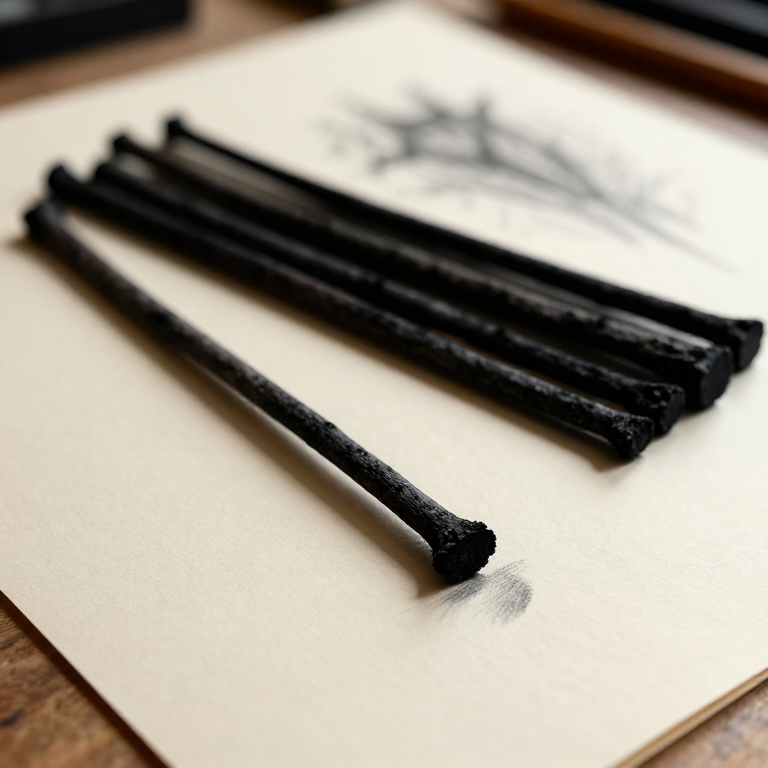


Making Charcoal Drawing Sticks from Willow — The Renaissance Artist's First Mark
Charcoal is the oldest drawing medium — cave painters at Lascaux and Altamira used burnt sticks 17,000 years ago. But the deliberate manufacture of consistent, high-quality charcoal drawing sticks became an art in itself during the Renaissance, when Italian masters like Leonardo da Vinci and Michelangelo used charcoal for preliminary sketches, composition studies, and full-scale cartoons (preparatory drawings transferred to walls for fresco painting).
The best drawing charcoal is made from willow (Salix) or vine (Vitis) twigs, burned slowly in a restricted-air environment. Willow produces a smooth, consistent grey that erases cleanly — ideal for sketching and revision. Vine charcoal is slightly harder and darker. The quality depends entirely on the burning process: too much air produces ash; too little heat produces half-burned wood that crumbles. The goal is complete carbonization — driving off all volatile compounds while preserving the wood's cellular structure intact.
A single session of charcoal-making produces enough drawing sticks for months of work. The process connects directly to the same pyrolysis chemistry used in charcoal fuel production, glassmaking flux, and gunpowder manufacturing — the same transformation of wood into pure carbon, but optimized for a pencil-thin stick rather than a kiln-filling lump.
Leiðbeiningar
Harvest willow twigs
Harvest willow twigs
Cut straight willow twigs in late winter or early spring when the sap is down and the wood is dormant. Select shoots that are 1-2 years old, approximately 5-8 mm in diameter, and at least 30 cm long. The wood should be straight with no side branches — knotty or branched twigs produce uneven charcoal that breaks during drawing.
Willow (Salix alba or Salix viminalis) is preferred because its wood is uniformly porous with a fine, even grain. It carbonizes consistently and produces a smooth drawing mark. If willow is unavailable, grapevine (Vitis) prunings are an excellent alternative — vine charcoal is slightly harder and produces a darker, more intense mark. Cut approximately 30-50 twigs per batch.
Nauðsynleg verkfæri:
 Hnífur
Peel and dry the twigs
Peel and dry the twigs
Strip the bark from each twig by pulling it through a clenched fist or scraping with a knife blade. The bark contains more moisture and different chemical compounds than the heartwood — leaving it on produces charcoal with an uneven surface that crumbles at the edges. Peeled twigs carbonize more uniformly and produce a smoother drawing stroke.
Cut the peeled twigs to approximately 15-20 cm lengths — the standard size for drawing charcoal sticks. Bundle them loosely and allow to dry in a warm, ventilated area for at least 1 week. The twigs must be thoroughly dry before carbonization — any residual moisture produces steam during burning that can crack the charcoal internally, causing it to snap during use.
Pack the twigs in a sealed container
Pack the twigs in a sealed container
The key to making drawing charcoal (rather than ash) is restricting oxygen during the burn. Pack the dried twigs tightly into a metal tin or clay pot with a tight-fitting lid. An old biscuit tin, a clay flower pot sealed with a saucer and clay, or a foil-wrapped bundle all work. The container must be sealed well enough to prevent air from reaching the twigs, but not airtight — gases must be able to escape through small gaps or a single vent hole to prevent pressure buildup.
Arrange the twigs parallel to each other, packed snugly but not crushed. Fill all empty space with dry sand to prevent the twigs from shifting and to provide even heat distribution. A small vent hole (2-3 mm) in the lid allows volatile gases to escape — when the escaping gas can be ignited with a match and burns with a blue flame, carbonization is underway.
Carbonize in a fire or kiln
Carbonize in a fire or kiln
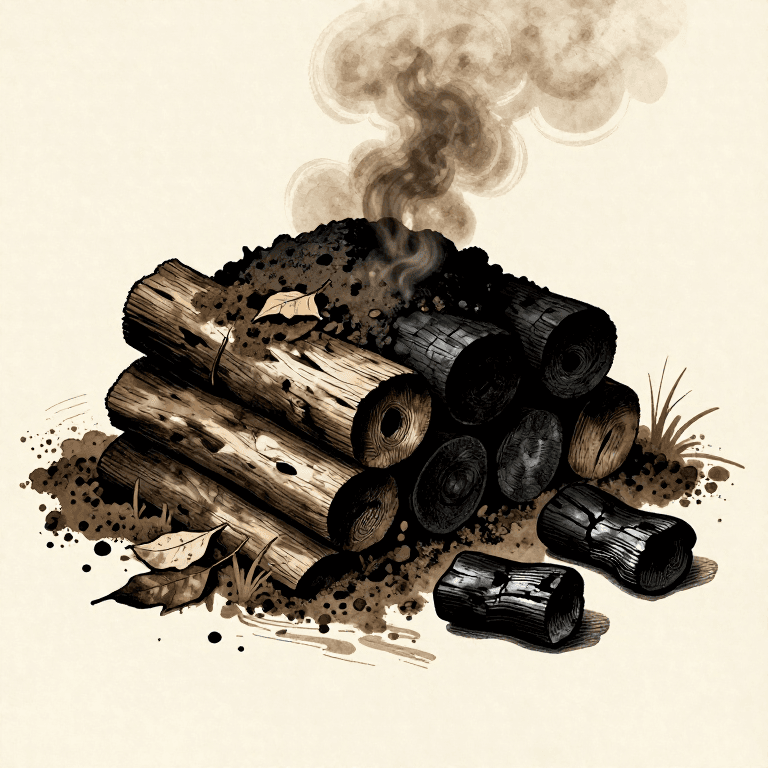
Place the sealed container in the centre of a campfire, wood stove, or kiln and maintain a steady fire around it for 2-3 hours. The heat must be sufficient to raise the interior of the container above 300°C (the point at which pyrolysis — the thermal decomposition of cellulose — begins) but need not exceed 500°C for drawing-quality charcoal. Higher temperatures produce harder, denser charcoal suitable for fuel but too brittle for drawing.
Watch the vent hole: initially, steam escapes (white vapour). Then volatile organic compounds escape (yellow-brown smoke with a distinctive sweet/acrid smell). Finally, the escaping gas becomes clear and burns with a blue flame if ignited — this indicates that the volatiles are exhausted and the wood has converted to nearly pure carbon. When the blue flame dies out, carbonization is complete.
Efni fyrir þetta skref:
 Viðarkol3 kg
Nauðsynleg verkfæri:
 Hlífðargleraugu gegn efnaslettum
Cool and inspect the charcoal sticks
Cool and inspect the charcoal sticks
Remove the container from the fire and allow it to cool completely — at least 12 hours, or overnight. Do not open the container while hot — oxygen rushing in will ignite the still-glowing charcoal and reduce it to ash in seconds. The sealed container must cool below 100°C before opening.
Open the container and carefully remove the charcoal sticks. Well-made drawing charcoal retains the exact shape and dimensions of the original twig — it should look like a thin black stick that has preserved every detail of the wood grain. It should be light in weight (charcoal is approximately 25% the weight of the original wood), uniformly black throughout, and produce a smooth grey line when drawn across paper. Test each stick: it should make a mark that is easily smudged with a finger and erased with a kneaded eraser.
Grade and store the drawing charcoal
Grade and store the drawing charcoal
Sort the finished sticks by hardness: softer sticks (those that crumble slightly and leave a dark, thick mark) are used for broad shading and bold expressive work. Harder sticks (those that feel smooth and leave a lighter, finer mark) are used for detailed line work and preliminary sketching. The hardness is controlled by carbonization temperature — sticks from the center of the container (hottest) are harder than those from the edges (cooler).
Wrap finished charcoal sticks in cloth or tissue paper and store in a dry container. Charcoal is fragile and absorbs moisture from the air, which causes it to drag and skip during drawing. Well-stored charcoal keeps indefinitely — the 17,000-year-old charcoal marks at Lascaux are proof that pure carbon, once formed, is essentially permanent. An afternoon's work produces enough drawing charcoal for a year of sketching.
Efni úr tengdum teikningum

Þessi teikning býr til
Tengd Blueprint
Þessi blueprint deila þekkingu — tækni, efni eða meginreglur

CC0 opinbert ríki
Þessi teikning er gefin út undir CC0. Þér er frjálst að afrita, breyta, dreifa og nota þetta verk í hvaða tilgangi sem er, án þess að biðja um leyfi.
Studdu smiðinn með því að kaupa vörur í gegnum teikningu hans þar sem hann fær þóknun smiða sem seljendur ákvarða, eða búðu til nýja endurskoðun á þessari teikningu og tengdu hana sem tengingu í þinni eigin teikningu til að deila tekjum.