LIST
FEGURÐ OG VELLÍÐAN
HANDVERK
MENNING OG SAGA
SKEMMTUN
UMHVERFI
MATUR OG DRYKKUR
ÖFUGVERKFRÆÐI
VÍSINDI
ÍÞRÓTTIR
TÆKNI
KLÆÐANLEG TÆKNI
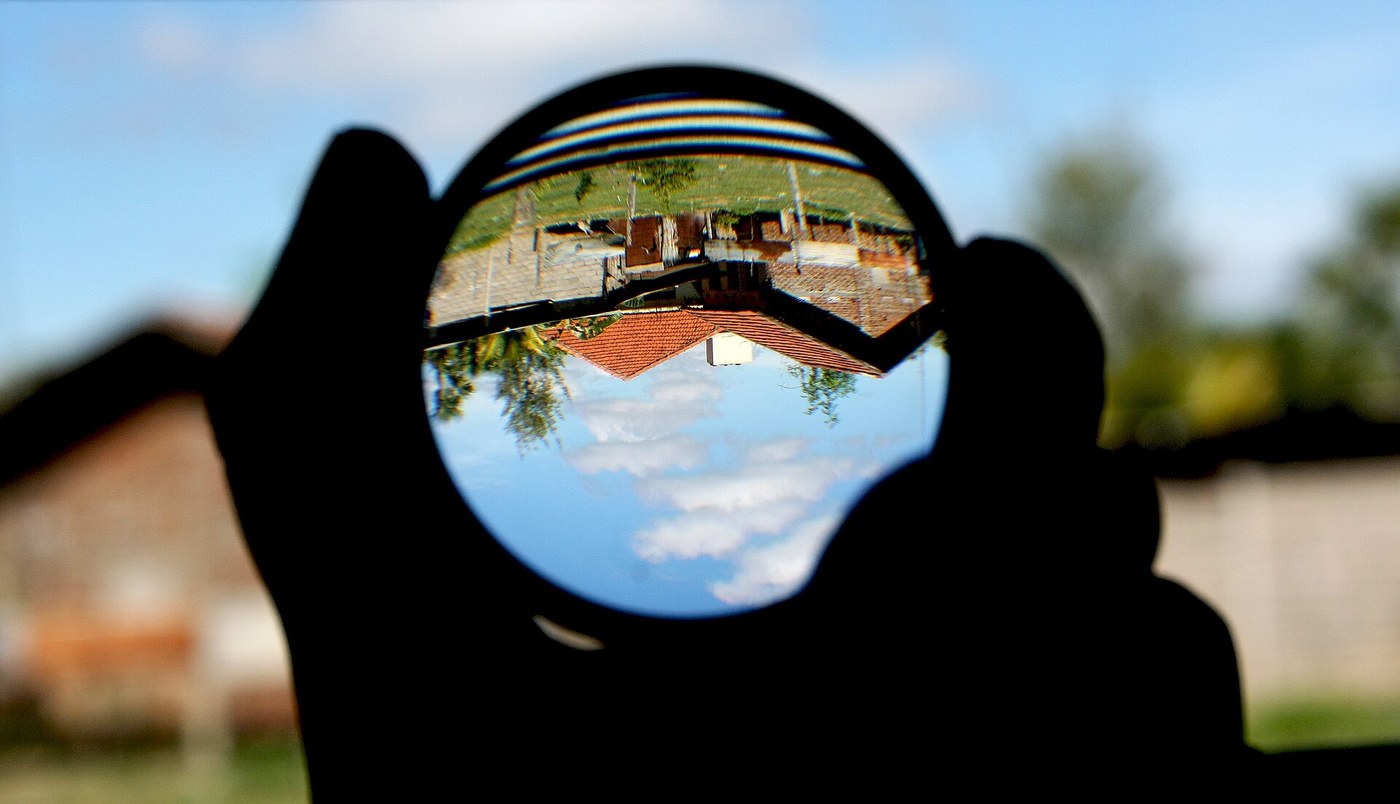


Convex and Concave Lenses Ground as a Pair
Rub one glass disc over another with wet grit and both change shape: the one on top goes hollow, the one beneath goes domed, and they stay a perfect fit. Grind both faces of a pair this way and the bottom disc becomes a double-convex lens, the top one a double-concave lens of the same curve. Longer work gives deeper curves and shorter focal lengths.
The picture: a double-convex lens held at arm's length shows the scene small and upside down.
Lengra kominn
Several days per pair
Leiðbeiningar
1
1
Cut two discs
Cut two discs
Score two equal circles on the glass sheet, snap them out and nibble the edges round with grozing pliers. Fix a short wooden handle to the back of each with warm pitch.
Efni fyrir þetta skref:
 Glerplata1 stykki
 Furubiklím20 g
 Harðviðarlisti1 stykki
Nauðsynleg verkfæri:
 Glerskeri
 Glerbítartöng
 Öryggisgleraugu
2
2
Rough grind the first faces
Rough grind the first faces
Lay one disc face up on a firm table, wet it and sprinkle coarse grit. Push the other disc over it, face down, in short strokes, turning both a little all the time. The top one becomes concave, the bottom convex. Rinse and recharge as the grit wears.
Efni fyrir þetta skref:
 Vatn2 lítrar
Nauðsynleg verkfæri:
 Reglustika
 Kísilkarbíðkorn
3
3
Check the curve
Check the curve
Lay a ruler across the hollow disc and measure the depth at the centre with the caliper. Keep the top disc on top to deepen the curve; swap them to flatten it.
Nauðsynleg verkfæri:
Reglustika Stafrænn skífmælir 6 tommur
4
4
Fine grind and polish
Fine grind and polish
Go through finer grits, washing everything clean between grits. Polish each face on a pitch lap pressed to the other disc's curve, with tin oxide (putty powder) and water, until clear.
Efni fyrir þetta skref:
 Tinoxíð (tin(IV)oxíð)30 gFurubiklím100 g
Nauðsynleg verkfæri:
Kísilkarbíðkorn5
5
Turn them over, do the second faces
Turn them over, do the second faces
Move the handles to the finished faces and grind the other sides the same way, the same disc on top, to the same depth. The bottom disc is now a double-convex lens, the top one double-concave.
Efni fyrir þetta skref:
Tinoxíð (tin(IV)oxíð)20 gNauðsynleg verkfæri:
Stafrænn skífmælir 6 tommurKísilkarbíðkorn6
6
Find the focal length
Find the focal length
Hold the convex lens in sunlight over paper and move it until the spot is smallest; that distance is its focal length. Grind more pairs to different depths for a set of focal lengths.
Nauðsynleg verkfæri:
Reglustika7
7
Focal length from the curve
Focal length from the curve
Hleð Jupyter-vinnubók…
8
8
Limits
Limits
Which disc goes hollow is the mirror makers' rule (Sky & Telescope, Stellafane); the lens formula is from Wikipedia. Window glass is not optical glass: expect some colour fringes and bubbles.
Efni
5- 1 stykkiStaðgengill
- 120 gStaðgengill
- 1 stykkiStaðgengill
- 2 lítrarStaðgengill
- Staðgengill
Þessi teikning býr til



Tengd Blueprint
Þessi blueprint deila þekkingu — tækni, efni eða meginreglur

CC0 opinbert ríki
Þessi teikning er gefin út undir CC0. Þér er frjálst að afrita, breyta, dreifa og nota þetta verk í hvaða tilgangi sem er, án þess að biðja um leyfi.
Studdu smiðinn með því að kaupa vörur í gegnum teikningu hans þar sem hann fær þóknun smiða sem seljendur ákvarða, eða búðu til nýja endurskoðun á þessari teikningu og tengdu hana sem tengingu í þinni eigin teikningu til að deila tekjum.