

Diesel Engine
A petrol engine needs a spark because its fuel-air mixture will not light on its own at the pressures it runs. Rudolf Diesel's insight was to raise the pressure until the air is hot enough to ignite fuel by itself — and then inject the fuel into that air.
Compress air hard enough and it becomes an ignition source. Squeeze it to a twentieth of its volume and it reaches five or six hundred degrees, well above the ignition point of the fuel. No spark plug, no ignition timing, no distributor. The engine ignites when fuel arrives, so injection timing IS ignition timing.
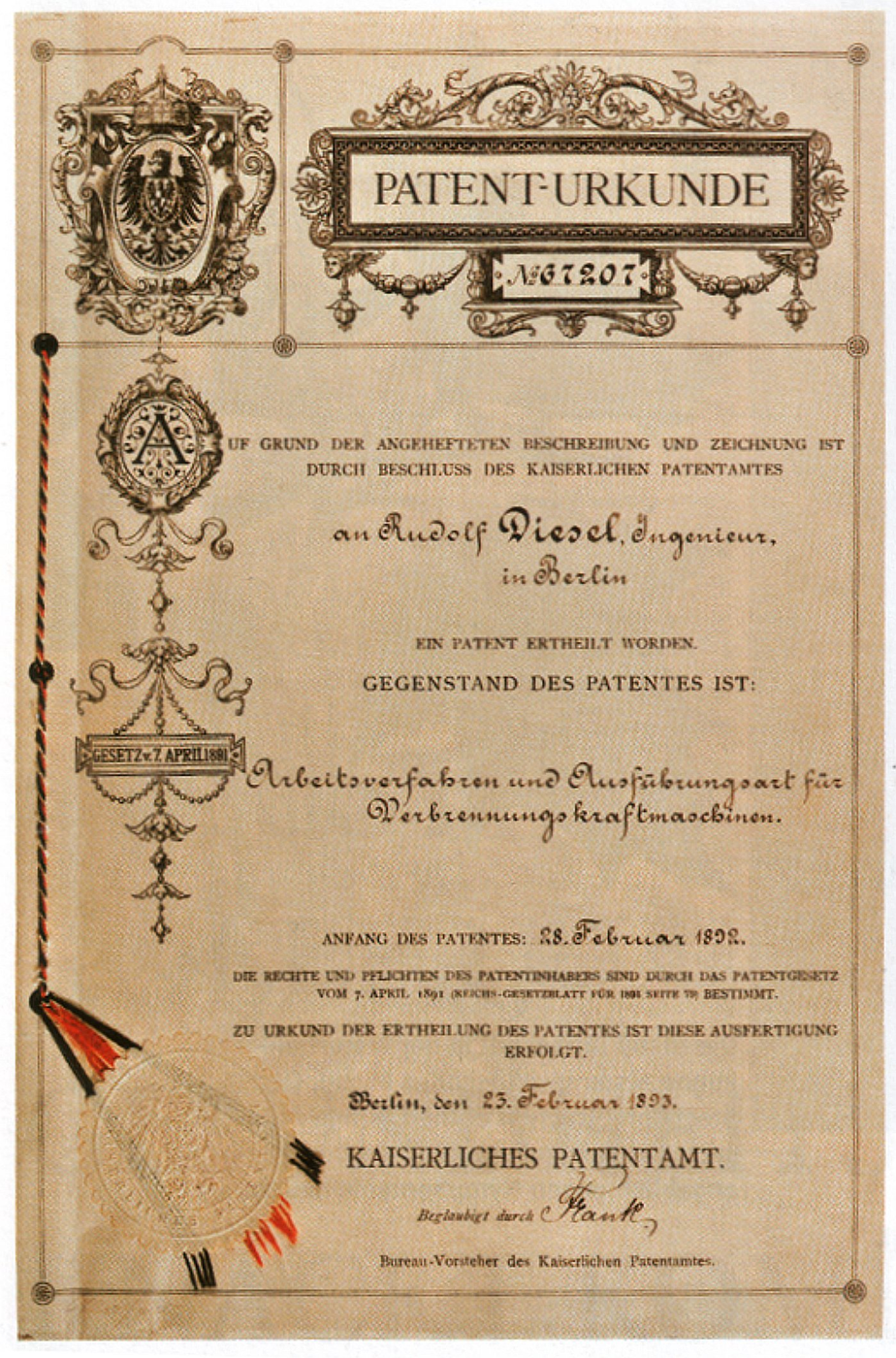
Diesel was pursuing efficiency, not convenience — he wanted an engine approaching the Carnot ideal, and higher compression is the route. US Patent 608,845, "Internal-Combustion Engine", granted to Rudolf Diesel of Berlin on 9 August 1898.
Leiðbeiningar
Diesel's first engine exploded and nearly killed him
Diesel's first engine exploded and nearly killed him
The 1893 prototype blew apart on its first firing. Build only the demonstration apparatus described here at low pressure, behind a shield, and never pressurise a vessel you have not proof-tested.
Read US 608,845 and note what regulates power
Read US 608,845 and note what regulates power
Diesel claims gradual introduction of fuel into air already compressed to ignition temperature. Power is set by how much fuel is injected — there is no throttle on the air.
Build a fire syringe and prove the principle
Build a fire syringe and prove the principle
Make a thick-walled clear tube with a close-fitting plunger, drop in a wisp of tinder, and strike the plunger down sharply. It ignites with no flame and no spark. That is the entire Diesel cycle in one stroke.
Efni fyrir þetta skref:
 Akrýlstöng1 stykki
Work out the temperature you just produced
Work out the temperature you just produced
For adiabatic compression T₂/T₁ = (V₁/V₂)^(γ−1), with γ ≈ 1.4 for air. A 20:1 squeeze from 300 K gives roughly 1000 K — hot enough to light fuel unaided.
Compare with a petrol engine's compression ratio
Compare with a petrol engine's compression ratio
Petrol runs around 10:1 because higher ratios make the mixture detonate before the spark. A diesel compresses AIR ALONE, so there is nothing to pre-ignite.
Machine a cylinder and a well-fitted piston
Machine a cylinder and a well-fitted piston
Bore a cylinder and fit a piston with rings. Blow-by past the piston is fatal here — you cannot reach ignition temperature if the charge leaks.
Efni fyrir þetta skref:
 Kringlótt stöng úr deigu stáli1 stykki
Nauðsynleg verkfæri:
 Málmþjöl
Design the combustion chamber for swirl
Design the combustion chamber for swirl
Shape the piston crown to spin the air as it is compressed. Fuel is injected as a spray and must find oxygen fast — mixing time is the limit on how quickly a diesel can burn.
Build an injector that atomises, not squirts
Build an injector that atomises, not squirts
Force fuel through a fine orifice at high pressure so it leaves as a mist. A stream of liquid fuel will not burn fast enough — surface area is everything.
Efni fyrir þetta skref:
 Messingtengi2 stykki
Time injection to just before top dead centre
Time injection to just before top dead centre
Inject as the piston nears the top. There is a short ignition delay while the spray heats and vaporises, so injection must lead the intended burn.
Understand why diesels knock
Understand why diesels knock
If the delay is long, a lot of fuel accumulates and lights at once — a pressure spike you hear as the characteristic clatter. Shortening the delay is most of diesel refinement.
Note that there is no throttle butterfly
Note that there is no throttle butterfly
The engine always draws a full charge of air. Power is set purely by fuel quantity, which is why diesels run very lean at light load and lose no energy pumping against a closed throttle.
Fit a governor, because it will not self-limit
Fit a governor, because it will not self-limit
Unloaded and over-fuelled, a diesel accelerates until it destroys itself. A mechanical governor limiting fuel is not an accessory — it is a safety-critical part.
Measure the efficiency argument
Measure the efficiency argument
Thermal efficiency rises with compression ratio. That is why Diesel chased high compression at all, and why his engines beat the steam plants of the day by a wide margin.
Try a different fuel in the fire syringe
Try a different fuel in the fire syringe
Compression ignition is indifferent to fuel chemistry in a way a spark engine is not. Diesel ran demonstrations on peanut oil — the cycle cares about ignition temperature, not petroleum.
Compendium — heat from squeezing
Compendium — heat from squeezing
The patent. US 608,845, "Internal-Combustion Engine", granted 9 August 1898 to Rudolf Diesel of Berlin, following his German patent of 1892 and his 1893 treatise Theory and Construction of a Rational Heat Engine. Diesel was a refrigeration engineer by trade and a thermodynamicist by inclination; his stated goal was an engine approaching the Carnot efficiency limit, and compression ignition was the means, not the end. The first working engine ran in 1897 at about 26 % efficiency — roughly double the best steam engines of the time.
The physics in one line. Compress a gas quickly and no heat escapes, so the work done on it goes into internal energy and the temperature rises: T₂/T₁ = (V₁/V₂)^(γ−1). With γ ≈ 1.4 and a compression ratio around 20, air at 300 K reaches roughly 1000 K, comfortably above the autoignition temperature of diesel fuel. A fire syringe demonstrates the whole principle for the cost of a tube and a plunger, and it is the same effect that makes a bicycle pump warm.
Why compressing air alone changes everything. A petrol engine compresses a fuel-air mixture, so raising compression risks the mixture detonating spontaneously before the spark — knock — which caps the ratio near 10:1 and therefore caps efficiency. A diesel compresses pure air, where there is nothing to pre-ignite, so the ratio can go to 20:1 or beyond. Fuel is then injected into air already above ignition temperature, and combustion begins on arrival. This also means ignition timing and fuelling are the same control, that there is no throttle and hence no pumping loss at part load, and that a runaway is possible if fuelling is not governed.
Diesel's own intentions, and his end. He demonstrated the engine on peanut oil at the 1900 Paris Exposition and argued that agricultural oils could give farmers independence from petroleum — compression ignition genuinely does not care much what the fuel is, which is why biodiesel needs no engine redesign. Diesel disappeared overboard from a Channel steamer in September 1913 in circumstances never established. Within a decade the engine bearing his name dominated shipping, and it went on to take rail, heavy road transport and stationary power, on the strength of the efficiency he set out to find.
Efni
3- 1 stykkiStaðgengill
- 1 stykkiStaðgengill
- 2 stykkiStaðgengill
Tengd Blueprint
Þessi blueprint deila þekkingu — tækni, efni eða meginreglur

CC0 opinbert ríki
Þessi teikning er gefin út undir CC0. Þér er frjálst að afrita, breyta, dreifa og nota þetta verk í hvaða tilgangi sem er, án þess að biðja um leyfi.
Studdu smiðinn með því að kaupa vörur í gegnum teikningu hans þar sem hann fær þóknun smiða sem seljendur ákvarða, eða búðu til nýja endurskoðun á þessari teikningu og tengdu hana sem tengingu í þinni eigin teikningu til að deila tekjum.