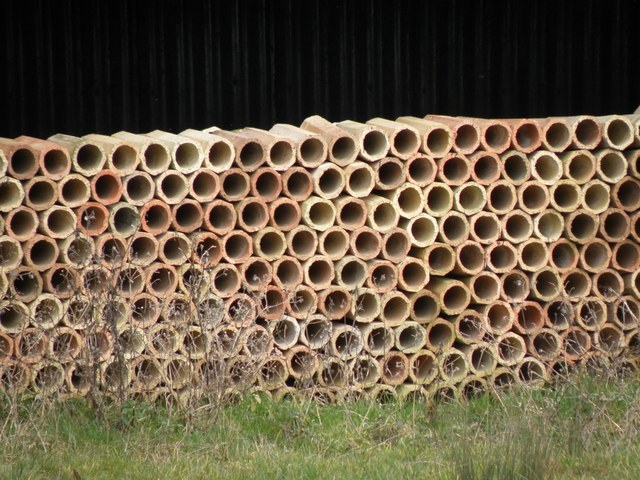


Drainage Tile
Leiðbeiningar
Show that waterlogged soil has no air
Show that waterlogged soil has no air
Demonstrate the actual problem rather than asserting it.
- Fill two clear containers with the same soil.
- Saturate one completely; keep the other damp but draining.
- Push a stick into each and compare; leave both a few days and compare smell.
Efni fyrir þetta skref:
 Bikarglas úr bórsílíkati2 stykki
Make and lay the tile
Make and lay the tile
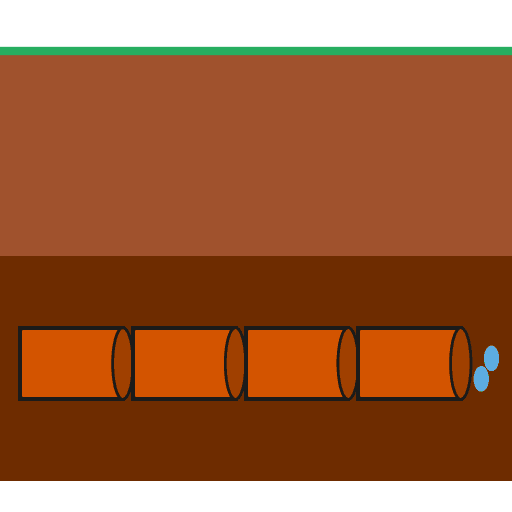
Short lengths of pipe, butted end to end — not sealed.
- Form short clay pipe sections and fire them, or use terracotta pieces.
- Lay them end to end in a trench with small gaps at the joints.
- Do NOT seal the joints.
Efni fyrir þetta skref:
 Mulin terrakotta2 kg
Set the depth and the fall
Set the depth and the fall
Two numbers decide whether a drain works for a century or silts up in a year.
- Bury below the root and cultivation zone — typically 0.8 to 1.2 m in farmland.
- Give a steady fall, commonly around 1 in 200 to 1 in 400.
- Check the fall along the whole run, not just end to end.
Efni fyrir þetta skref:
 Gráðubogi1 stykki
Nauðsynleg verkfæri:
 Reglustika
Measure the drawdown between drains
Measure the drawdown between drains
Spacing is the design decision, and the soil sets it.
- In a tank of soil with a tile at one side, saturate and then let it drain.
- Measure the water table depth at several distances from the drain.
- Repeat with sand and with clay.
History and context
History and context
Buried drains are old — the Romans used stone-filled trenches, and bush drains packed with brushwood were common in medieval and early modern farming. What changed in the nineteenth century was cheap pipe. Extrusion machines from the 1840s, notably associated with John Reade and with the Marquess of Tweeddale's press, dropped the cost enormously, and the British Public Money Drainage Acts from 1846 lent government money for the work.
The scale is easy to underestimate. Millions of acres were tiled across Britain and Ireland in a few decades, and the American Midwest — the Black Swamp of Ohio and Indiana, much of Illinois — was converted from wetland to some of the most productive farmland on Earth by tile drainage. Much of that nineteenth-century clay tile is still functioning.
The environmental account is genuinely mixed, and belongs here. Drainage destroyed wetlands on an enormous scale, with the loss of habitat and flood storage that implies, and tile drains deliver nitrate and phosphorus straight to watercourses far faster than overland flow would — they are a major documented contributor to nutrient loading and the Gulf of Mexico dead zone. Drained peat soils oxidise and release carbon and subside as they do. The same pipes that made the land farmable are now a target for controlled-drainage structures and constructed wetlands that hold water back deliberately.
What replaced the tile: corrugated perforated plastic pipe laid by a machine that ploughs it in continuously with laser or GPS grade control. The pipe changed; the depth, the fall and the spacing calculation did not.
Efni
3- 2 stykkiStaðgengill
- 2 kgStaðgengill
- 1 stykkiStaðgengill
Nauðsynleg verkfæri
1- Staðgengill
Þessi teikning býr til
Tengd Blueprint
Þessi blueprint deila þekkingu — tækni, efni eða meginreglur
CC0 opinbert ríki
Þessi teikning er gefin út undir CC0. Þér er frjálst að afrita, breyta, dreifa og nota þetta verk í hvaða tilgangi sem er, án þess að biðja um leyfi.
Studdu smiðinn með því að kaupa vörur í gegnum teikningu hans þar sem hann fær þóknun smiða sem seljendur ákvarða, eða búðu til nýja endurskoðun á þessari teikningu og tengdu hana sem tengingu í þinni eigin teikningu til að deila tekjum.