Samvinna
LIST
FEGURÐ OG VELLÍÐAN
HANDVERK
MENNING OG SAGA
SKEMMTUN
UMHVERFI
MATUR OG DRYKKUR
ÖFUGVERKFRÆÐI
VÍSINDI
ÍÞRÓTTIR
TÆKNI
KLÆÐANLEG TÆKNI
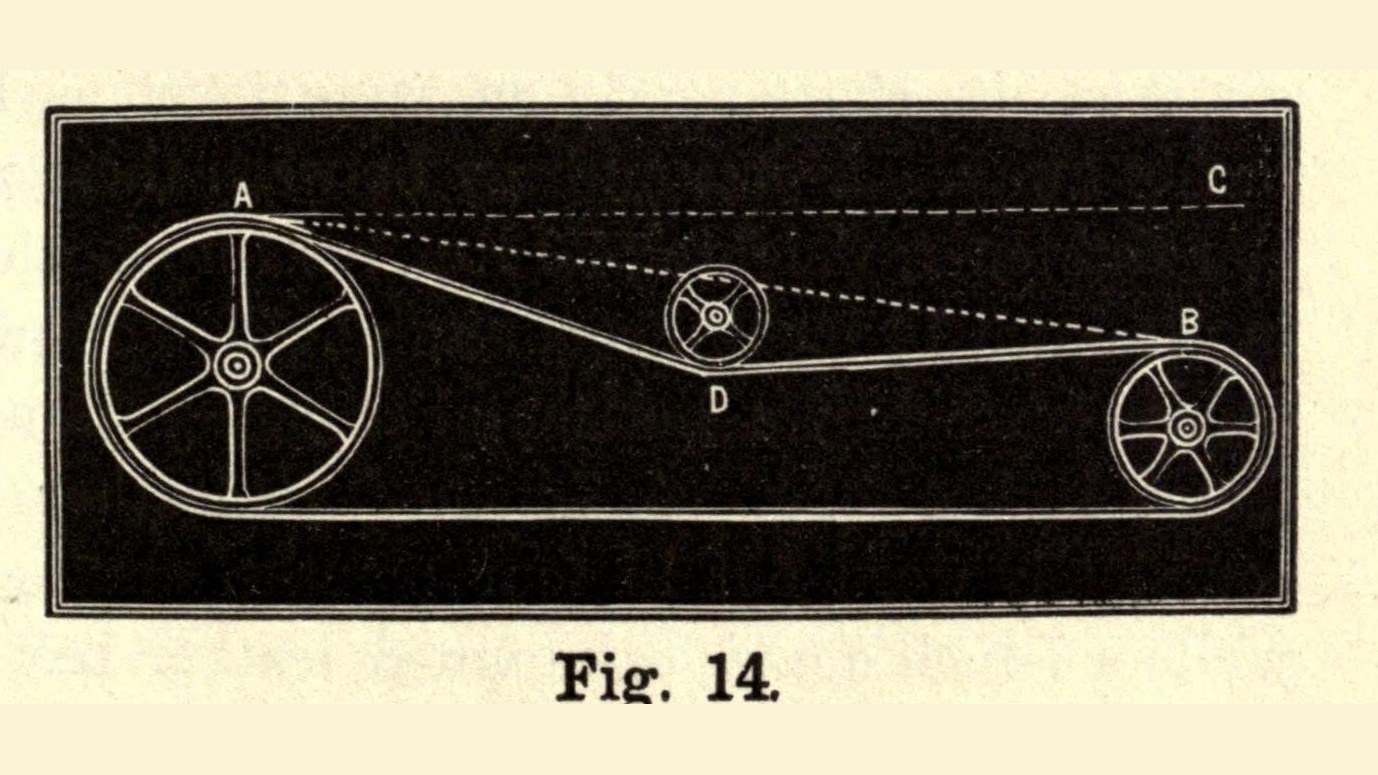


Drive Belt: a Flat Leather Belt of Oak-Tanned Butts, Spliced, Cemented and Sewn (Cooper, 1888)
Before rubber and V-belts, machines were driven by flat leather belts running on crowned pulleys. J. H. Cooper's Treatise on the Use of Belting (1888) quotes how the best English belts were made: only the butt of an oak-bark tanned ox-hide, stretched by machinery and dried stretched, cut in strips joined by feather-edged splices that are cemented and then sewn with strong waxed hemp. Single belts are 3/16 to 1/4 inch thick; heavy double belts, two layers cemented and sewn their whole length, 5/16 to 7/16 inch.
The cement, the width, the splice length and the stitching are not given; those are unknown here.
Source: J. H. Cooper, A Treatise on the Use of Belting (1888), pp. 82, 116-117. Picture: his Fig. 14, a belt with a tension roller.
Miðlungs
A day for a short belt
Leiðbeiningar
1
1
Read Cooper
Read Cooper
"For light work, belts of single substance are sufficient, the strips of leather being joined together by feather-edged splices, first cemented and then sewn."
2
2
Choose the butts
Choose the butts
Use only the butt, the prime part of an oak-bark tanned ox-hide; cut the shoulders off, because they stretch in a different direction from the butt and make a belt run crooked. Stretch the butts hard and let them dry while held extended: good strap butts can be lengthened for good by 4 to 5 inches. The stretching machinery is not described (unknown).
Efni fyrir þetta skref:
 Jurtasútað leður1 butts
Nauðsynleg verkfæri:
 Þynningarhnífur
 Óþekktur efniviður
3
3
Cut and splice the strips
Cut and splice the strips
Cut the butts into strips of the belt's width, cutting the ends square. Thin the ends to a feather edge so they overlap without a step, and cement the splices. The cement, the width and the length of the splice are not given (unknown).
Efni fyrir þetta skref:
Óþekktur efniviður1 cementNauðsynleg verkfæri:
Þynningarhnífur Óþekkt mál
4
4
Sew the splices
Sew the splices
Sew each cemented splice with strong, well-waxed hemp: wax the hemp cord with beeswax, pierce the stitch holes with an awl and sew through. A single belt is 3/16 to 1/4 inch thick. For heavy work, lay two (or three) thicknesses together, cement them and sew them through their whole length: a double belt is 5/16 to 7/16 inch thick.
Efni fyrir þetta skref:
 Hampsnæri1 as required
 Býflugnavax1 to wax the hemp
Nauðsynleg verkfæri:
 Sýll
5
5
History and honest limits
History and honest limits
Cooper's treatise gathers makers' and engineers' practice on belting; his sources sewed with waxed hemp or with thin alum-dressed hide, and some riveted double belts with copper or iron rivets by machine. He advises running belts on pulleys crowned slightly in the middle and keeping them supple with a dressing of neat's-foot oil, tallow and rosin.
The cement, belt width, splice length and stitch spacing are not given; vegetable-tanned leather stands for oak-bark tanned butts and beeswaxed hemp cord for waxed hemp.
Efni
4- 1 buttsStaðgengill
- 1 cementStaðgengill
- 1 as requiredStaðgengill
- 1 to wax the hempStaðgengill
Nauðsynleg verkfæri
4- Staðgengill
- Staðgengill
- Staðgengill
- Staðgengill
Þessi teikning býr til
CC0 opinbert ríki
Þessi teikning er gefin út undir CC0. Þér er frjálst að afrita, breyta, dreifa og nota þetta verk í hvaða tilgangi sem er, án þess að biðja um leyfi.
Studdu smiðinn með því að kaupa vörur í gegnum teikningu hans þar sem hann fær þóknun smiða sem seljendur ákvarða, eða búðu til nýja endurskoðun á þessari teikningu og tengdu hana sem tengingu í þinni eigin teikningu til að deila tekjum.