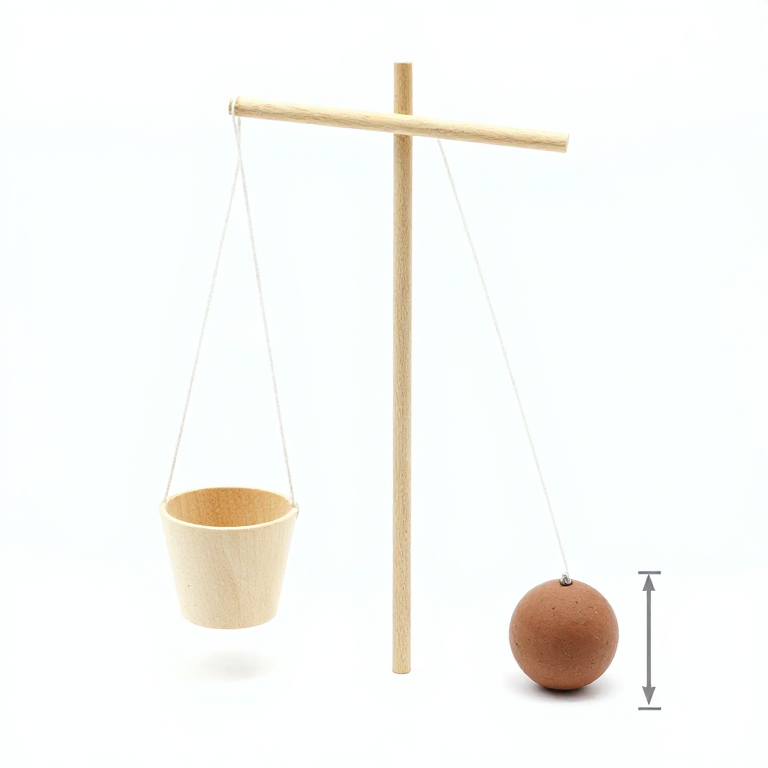


Egyptian Shaduf Model — Building a Scale Model Shaduf
Leiðbeiningar
Build the Upright Support
Build the Upright Support
Drill a hole in the center of the base board and glue the upright dowel vertically into it. The upright should stand approximately 20-25 cm tall. Ensure it is perfectly vertical by checking against a square or by eye from two perpendicular directions. If the support leans, the beam will naturally swing to one side rather than operating in a balanced plane. For extra stability, add small diagonal braces from the base of the upright to the base board. At the top of the upright, drill a horizontal hole approximately 6-8 mm in diameter to serve as the pivot point for the beam. This hole must be clean and smooth so the beam can rotate freely without binding.
Efni fyrir þetta skref:
 Ílát1 stykki
Mount the Beam and Set the Fulcrum
Mount the Beam and Set the Fulcrum
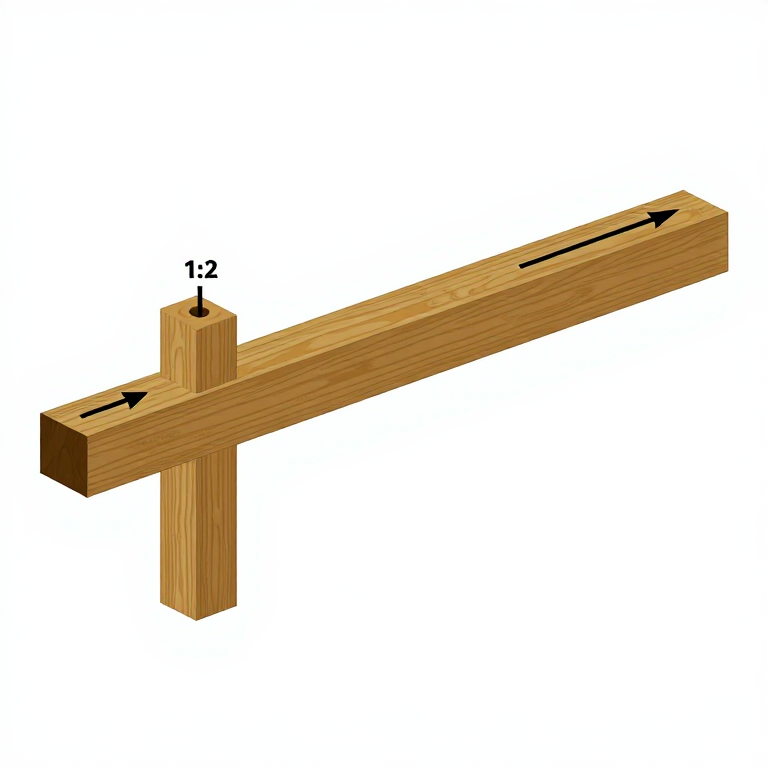
Insert the longer beam dowel through the pivot hole in the upright. Position it so approximately one-third of its length extends on the counterweight side and two-thirds on the bucket side. This 1:2 ratio is the key to the shaduf's mechanical advantage — the counterweight on the short arm can balance a load on the long arm that weighs twice as much as the counterweight, because torque equals force multiplied by the distance from the fulcrum. The beam should rotate freely on the pivot without excessive looseness. If the pivot hole is too large, wrap a small piece of tape around the beam at the pivot point to take up the slack.
Attach the Bucket and Counterweight
Attach the Bucket and Counterweight
Tie a string to the long end of the beam and attach a small cup or container as the bucket. The string should be long enough that the bucket can swing down below the base board level (simulating dipping into water). On the short end of the beam, attach a lump of modeling clay or a bag of small stones as the counterweight. Start with a weight that is slightly heavier than the empty bucket so the beam naturally tips toward the counterweight side, raising the bucket. Then add water to the bucket and observe how the balance shifts — the counterweight should be slightly lighter than the filled bucket, so the operator provides only a small force to lower the bucket.
Calibrate the Balance
Calibrate the Balance
Fine-tune the counterweight by adding or removing clay until the system operates smoothly. When the bucket is empty, the beam should slowly tilt toward the counterweight (raising the bucket). When the bucket is filled with water, a light push on the bucket end should lower it easily. The ideal balance is when the counterweight almost — but not quite — balances the full bucket, so the operator needs to apply only a small additional force to raise the water. This demonstrates the principle of mechanical advantage: the shaduf does not eliminate the work of lifting water, but it reduces the peak force required by spreading the effort over a longer motion arc on the counterweight side.
Test and Demonstrate the Model
Test and Demonstrate the Model
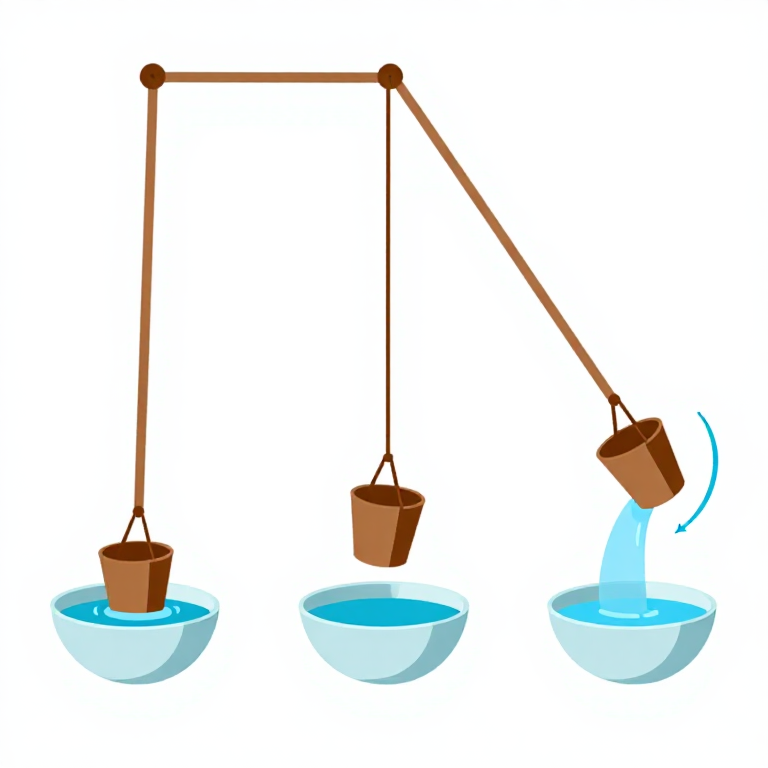
Place a small bowl of water at the base of the model. Push the bucket end down to dip the cup into the water, filling it. Release the downward force and the counterweight lifts the filled bucket. Swing the beam to tip the water into a second container at a higher level. This demonstrates the three phases of shaduf operation: lowering, lifting, and pouring. Measure the force needed to lift the bucket with and without the counterweight to quantify the mechanical advantage. For your 1:2 beam ratio, the counterweight should reduce the lifting force by roughly half. The full-scale Egyptian shaduf could lift 6,000-10,000 liters per hour, and this model demonstrates the exact same physics at a smaller scale. Multiple models could be arranged in series to show how cascaded shadufs lifted water to progressively higher levels.
Efni
7- 1 stykkiStaðgengill
- 1 stykkiStaðgengill
- 1 stykkiStaðgengill
- 1 piece, approx 15x15 cm stykkiStaðgengill
- 30-40 cm stykkiStaðgengill
- 50-100 g stykkiStaðgengill
- Staðgengill
CC0 opinbert ríki
Þessi teikning er gefin út undir CC0. Þér er frjálst að afrita, breyta, dreifa og nota þetta verk í hvaða tilgangi sem er, án þess að biðja um leyfi.
Studdu smiðinn með því að kaupa vörur í gegnum teikningu hans þar sem hann fær þóknun smiða sem seljendur ákvarða, eða búðu til nýja endurskoðun á þessari teikningu og tengdu hana sem tengingu í þinni eigin teikningu til að deila tekjum.