

Folding Wheelchair
A wheelchair made of wood and wicker with a rigid frame weighs a great deal, will not fit through a domestic doorway, and cannot go into a car. So a wheelchair user could move around a room and nowhere else — the chair defined the size of their world, and it was about the size of a house.
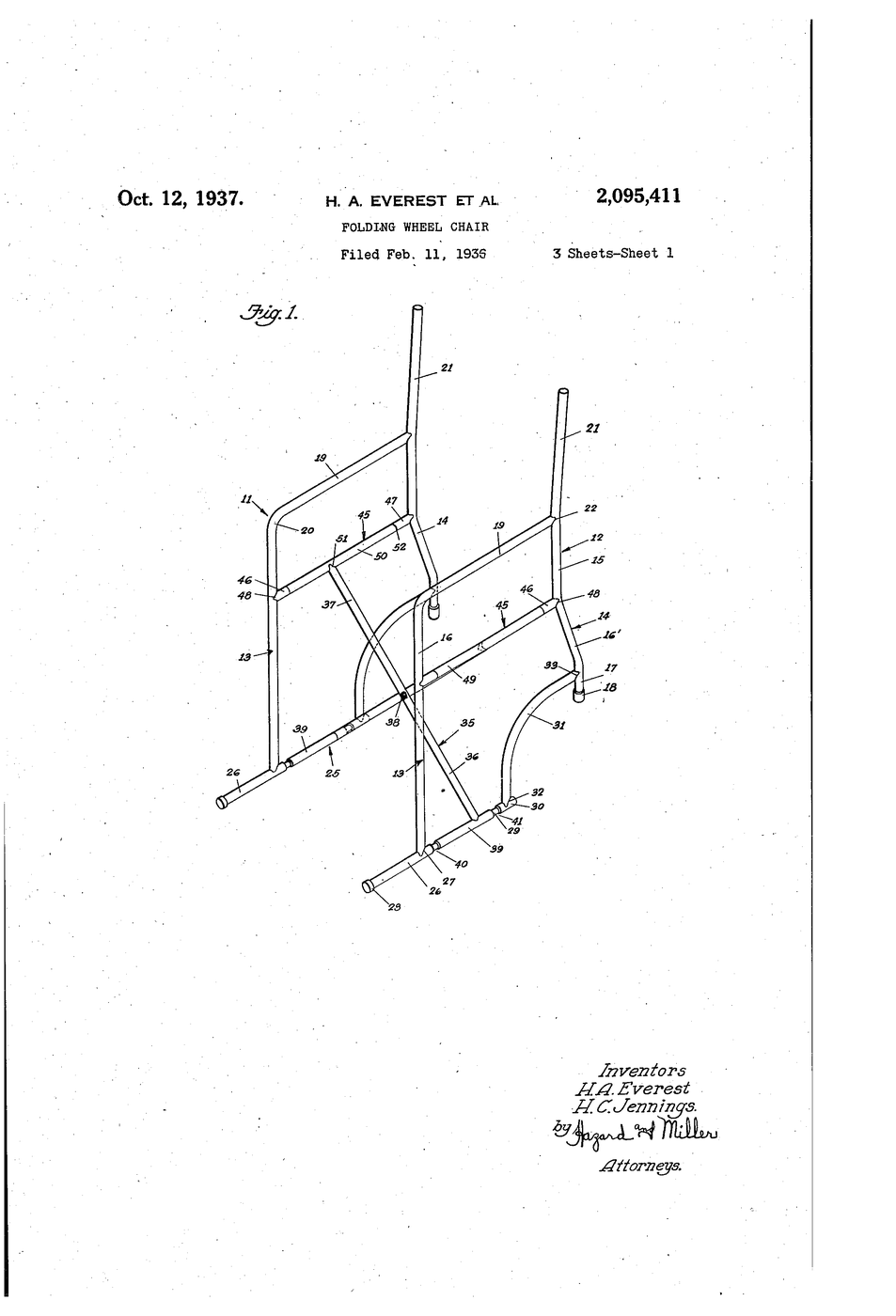
The chair has to fold, and a rigid frame cannot. The answer is to build the two sides as separate frames and join them with a pair of crossed diagonal braces, pivoted where they meet. Push the sides together and the X collapses flat; pull them apart and it locks the chair square.
That only works if the seat gives way too — which is why the seat and back are fabric slung between sliding members rather than boards. A rigid seat would fight the fold; a sling simply goes slack.
US Patent 2,095,411, "Folding wheel chair", filed 11 February 1936 and granted 12 October 1937 to Herbert A. Everest and Harry C. Jennings. Everest was himself a wheelchair user.
Leiðbeiningar
Build this at model scale, not to sit in
Build this at model scale, not to sit in
A wheelchair carries a person's whole weight over uneven ground; a frame failure causes serious injury. Build a bench model to understand the mechanism — do not build one to use.
Read US 2,095,411 and find the twist
Read US 2,095,411 and find the twist
Beyond the folding X, Everest and Jennings claim rotating sleeves on the bottom rods permitting slight frame twisting so all four wheels stay on uneven ground. Note that — it is the least obvious claim.
Build a rigid box-frame chair first
Build a rigid box-frame chair first
Make a simple rigid four-wheel frame with a fixed seat. Measure its width and try to pass it through a scaled doorway.
Efni fyrir þetta skref:
 Krossviðarplata1 plata
Set it on an uneven surface
Set it on an uneven surface
Put the rigid chair on a warped board. One wheel lifts. Push it and note the rocking — a rigid four-point frame cannot keep four contacts on a twisted surface.
Make two separate side frames
Make two separate side frames
Build each side as its own frame with a front and rear leg. From here the two sides are never rigidly joined to each other.
Efni fyrir þetta skref:
 Kringlótt stöng úr deigu stáli2 stykki
Nauðsynleg verkfæri:
 Flatkjaftatöng
Fit the crossed diagonal braces
Fit the crossed diagonal braces
Join the sides with two diagonals pivoted at their crossing point, each running from the bottom of one side to the top of the other. This is the X-brace.
Fold and unfold it empty
Fold and unfold it empty
Push the sides together. The X flattens and the chair becomes narrow. Measure the folded width against step 3.
Fit a rigid board seat and try to fold
Fit a rigid board seat and try to fold
Screw a solid seat across the frame and attempt the fold. It jams. A rigid seat and a folding frame are incompatible — remove it before continuing.
Sling a fabric seat instead
Sling a fabric seat instead
Loop fabric between the two side members so it hangs as a sling. Fold again — the fabric simply goes slack and the chair closes.
Efni fyrir þetta skref:
 Jurtasútað leður1 stykki
Load the seat and check it goes taut
Load the seat and check it goes taut
Put a weight on the sling. It tightens and pulls the two sides together, so the occupant's weight helps hold the frame square rather than spreading it.
Add rotating sleeves to the bottom rods
Add rotating sleeves to the bottom rods
Let the lower cross rods turn slightly in their mounts, so one side can rise relative to the other without racking the whole frame.
Repeat the uneven surface test
Repeat the uneven surface test
Put the finished chair on the warped board. All four wheels stay down — the frame twists a little instead of lifting a wheel. Compare with step 4.
Fit small front casters and large rear wheels
Fit small front casters and large rear wheels
Use small swivelling wheels at the front and large ones at the rear. Small front wheels let the chair pull up close to a table — a detail claimed in the patent.
Efni fyrir þetta skref:
 Kúlulegur4 stykki
Make the back removable
Make the back removable
Fit the fabric back so it can be detached. Everest and Jennings claim this specifically to allow transfer to and from a bed from the rear — a use case only a wheelchair user thinks of.
History & Context — designed by someone who needed it
History & Context — designed by someone who needed it
The patent. US 2,095,411, "Folding wheel chair", filed 11 February 1936 and granted 12 October 1937 to Herbert A. Everest and Harry C. Jennings — two inventors, and the pair went on to found Everest & Jennings.
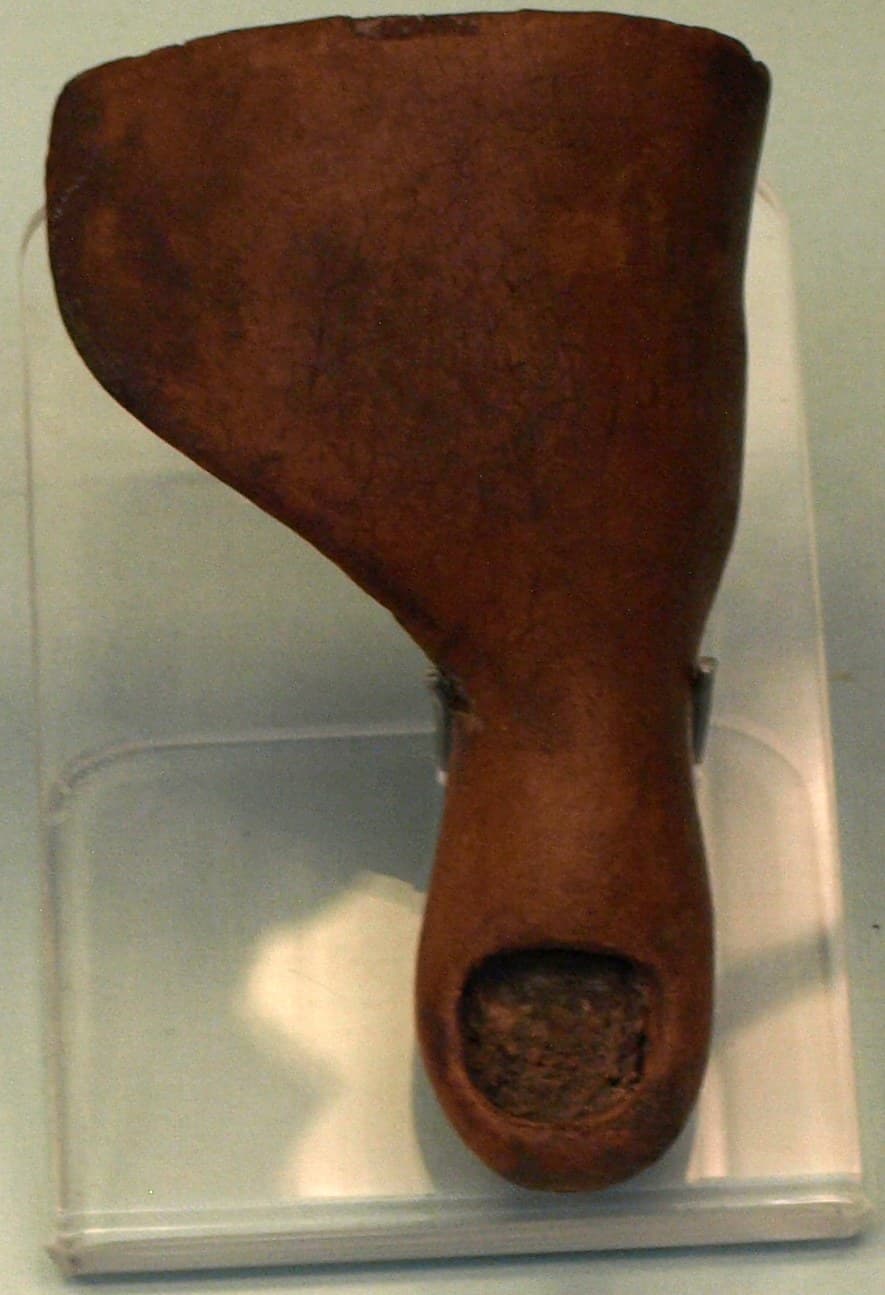
📌 Everest was a wheelchair user. A mining engineer disabled by a back injury, he wanted a chair he could take in a car, and worked with Jennings, a mechanical engineer, to build one. The same authorship model appears in James Hanger's artificial leg elsewhere in this batch: the person who needs the device designs it, and consequently notices things nobody else does. Step 14 is the clearest example — a removable back for transferring from a bed is not a feature that occurs to an engineer designing a chair from the outside, and neither is step 13's small front wheels for pulling up to a table.
The X-brace and the sling are one idea, not two. A folding frame is only useful if everything attached to it also folds, and the seat is the largest attached thing. Making it fabric is what allows the whole design to work — and, as step 10 shows, the sling then does structural work of its own, because a loaded sling pulls the sides together and helps hold the X in its open position. The occupant's weight stabilises the frame instead of stressing it. Nearly every manual wheelchair since uses this arrangement.
The twist tolerance is the claim people miss. A rigid four-wheeled frame on a twisted surface lifts a wheel, which on a wheelchair means losing drive on one side, or tipping. Allowing the frame a few degrees of deliberate wind, via rotating sleeves, keeps all four wheels loaded on cambered pavements, thresholds and rough ground. It is the same reasoning that puts a three-point mount under a machine tool, arrived at for a much less forgiving application.
What it changed, and the uncomfortable epilogue. A chair that folds into a car boot changes what a wheelchair user's day can contain — work, travel, other people's houses. Everest & Jennings became overwhelmingly dominant in the American market for decades, and that dominance eventually drew antitrust action over pricing and competition. The design was genuinely liberating; the company built on it did not always behave as though it were. Both belong in the account.
Efni
4- 1 plataStaðgengill
- 2 stykkiStaðgengill
- 1 stykkiStaðgengill
- 4 stykkiStaðgengill
Nauðsynleg verkfæri
1- Staðgengill
Tengd Blueprint
Þessi blueprint deila þekkingu — tækni, efni eða meginreglur

CC0 opinbert ríki
Þessi teikning er gefin út undir CC0. Þér er frjálst að afrita, breyta, dreifa og nota þetta verk í hvaða tilgangi sem er, án þess að biðja um leyfi.
Studdu smiðinn með því að kaupa vörur í gegnum teikningu hans þar sem hann fær þóknun smiða sem seljendur ákvarða, eða búðu til nýja endurskoðun á þessari teikningu og tengdu hana sem tengingu í þinni eigin teikningu til að deila tekjum.