

Prestressed Concrete
Reinforced concrete has a dirty secret: it works by letting the concrete crack. Steel only takes up the tension once the concrete around it has already split, so a working reinforced beam is quietly full of tiny cracks. That is fine for a building, but the cracks let water and salt reach the steel, and they limit how far and how thin concrete can span.
Freyssinet's idea is to squeeze the concrete so hard, in advance, that it never goes into tension at all. Stretch high-strength steel wires tight, cast the concrete around them, and when it has set, release the wires. As they try to spring back, they clamp the whole beam in permanent compression. Now when a load tries to stretch the bottom of the beam, it first has to overcome that built-in squeeze — so the concrete stays compressed and simply does not crack.
A pre-squeezed beam can be far thinner, span far further, and carry far more than a reinforced one — crack-free and slender.
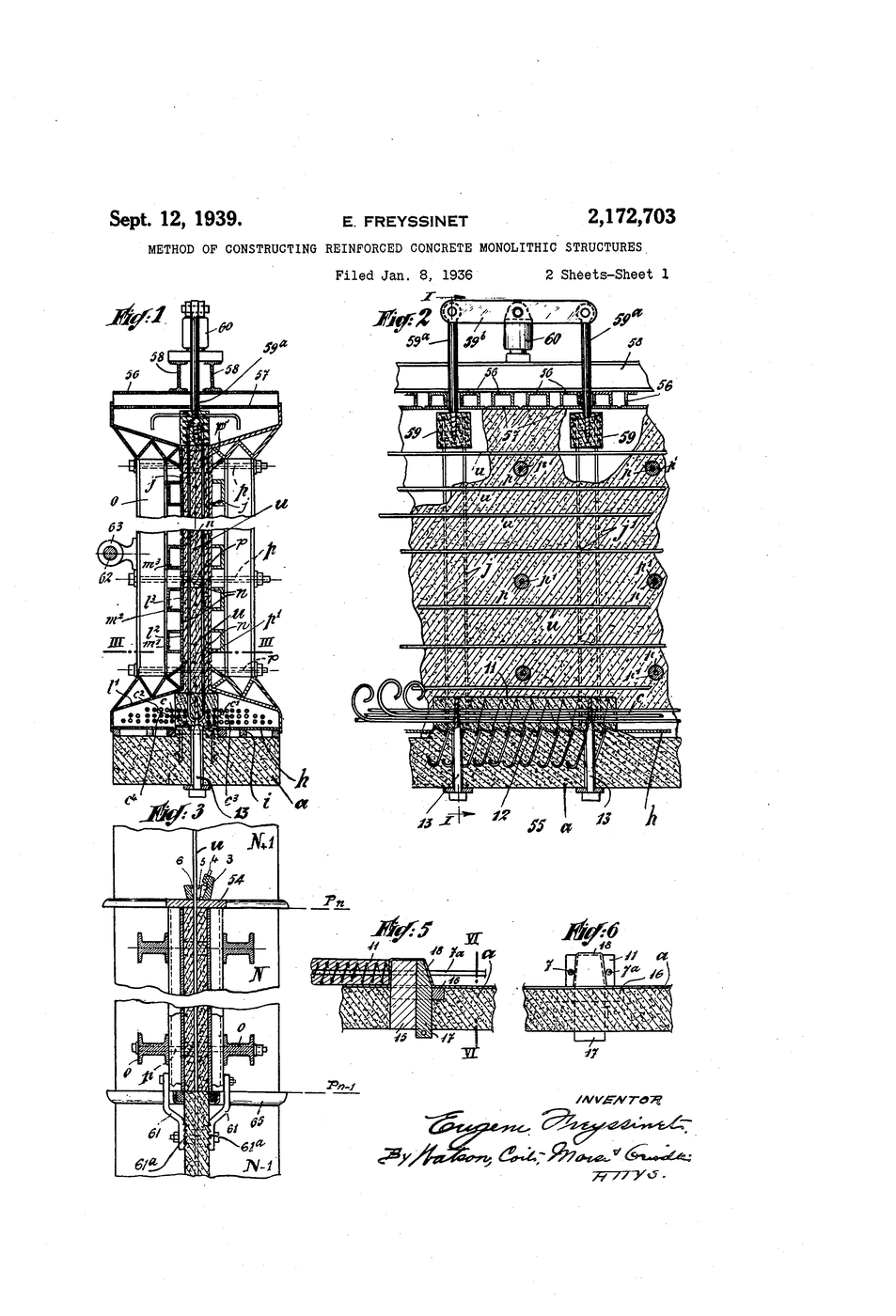
US Patent 2,172,703, granted 12 September 1939 to Eugène Freyssinet of France (who patented the first prestressing method in 1928).
Leiðbeiningar
Read the claim: pre-squeeze the concrete
Read the claim: pre-squeeze the concrete
Freyssinet claims steel "subjected to preliminary tensions" so high they stay tensioned, putting permanent compression into the concrete. Note the order: tension the steel FIRST.
Model it with a row of blocks and a hand
Model it with a row of blocks and a hand
Stand a row of small blocks in a line and squeeze the ends together with your hands. Now you can lift the whole row as one beam — the squeeze holds them together. Let go and they fall apart. That squeeze is prestress.
Efni fyrir þetta skref:
 Múrsteinn1 stykki
Cast a plain plaster beam and crack it
Cast a plain plaster beam and crack it
Cast a thin plaster beam (standing in for concrete), set it, and bend it. It cracks on the tension face at a small load. Record that load — the crack point to beat.
Efni fyrir þetta skref:
 Gifs (Parísargifs)500 g
Nauðsynleg verkfæri:
 Kraftmælir (gormvog)
Build a tensioning jig
Build a tensioning jig
Make a stiff wooden frame with anchor points at each end. A wire will be stretched between them, through the beam mould. This is your prestressing bed.
Efni fyrir þetta skref:
 Krossviðarplata1 plata
Nauðsynleg verkfæri:
 Járnsög
Stretch a steel wire tight through the mould
Stretch a steel wire tight through the mould
Run a strong steel wire along the bottom of the beam mould and tension it hard against the jig anchors — as tight as you safely can. Wear glasses; a snapping wire whips.
Efni fyrir þetta skref:
 Sinkhúðaður stálvír1 metri
Nauðsynleg verkfæri:
 Tær öryggisgleraugu
Cast the plaster around the tensioned wire
Cast the plaster around the tensioned wire
Pour plaster into the mould around the stretched wire and let it set hard, keeping the wire under tension the whole time.
Release the wire and watch the beam camber
Release the wire and watch the beam camber
Once set, cut the wire free of the jig. The wire tries to shorten and squeezes the beam, which bows slightly UPWARD (cambers). You have just put the concrete into permanent compression.
Load the prestressed beam and find its crack point
Load the prestressed beam and find its crack point
Bend the prestressed beam as in step 3. It carries much more before it cracks — the load first has to cancel the built-in squeeze. Compare the two crack loads.
Compare against a simply-reinforced beam
Compare against a simply-reinforced beam
Cast a beam with a slack (un-tensioned) wire in it — ordinary reinforcement. It cracks early, then the steel holds the crack. The prestressed beam never cracked at that load at all. That is the difference.
Push a prestressed beam far thinner
Push a prestressed beam far thinner
Make a very slim prestressed beam and span a wide gap. It holds where a plain plaster beam that thin would snap under its own weight. Prestress buys slenderness and span.
Over-load until it finally cracks
Over-load until it finally cracks
Keep loading the prestressed beam until it does crack — and note that when you unload, the crack closes up again, squeezed shut by the prestress. Crack-free in service is the whole point.
Note why high-strength steel is essential
Note why high-strength steel is essential
The steel must stay stretched for years as the concrete slowly shrinks and creeps. Only high-strength wire, stretched a long way, keeps enough tension left over after those losses. Ordinary mild steel would go slack. Write down why.
History & Context — the beam that is squeezed before it is used
History & Context — the beam that is squeezed before it is used
The patent. US 2,172,703, granted 12 September 1939 to Eugène Freyssinet of France (US filing 1938, French priority 1935). This is one of a family of Freyssinet patents; his first prestressing patent was French, in 1928, which is the true birth of the technique. This particular patent extends prestressing to large monolithic, cast-in-place structures, built with light, transportable equipment.
Prestressing is the answer to reinforced concrete's flaw. A reinforced beam only mobilises its steel once the concrete has cracked — so in service it is permanently micro-cracked, which admits water and rusts the steel and limits how slender it can be. Freyssinet's insight was to put the concrete into compression before it ever carries a load: stretch the steel, cast around it, and release, so the recoiling steel clamps the concrete tight (steps 5-7). When a load then tries to stretch the beam's underside, it must first use up that built-in compression, so the concrete never actually goes into tension and never cracks (steps 8-9). Step 2's row of blocks squeezed by hand is the whole idea — compression turns loose pieces into a beam.
The hard part, and why it took a genius to make it work, is the losses. Concrete shrinks as it dries and creeps (slowly deforms) under sustained load for years, and every bit of that shortening lets the steel relax. Early experimenters used ordinary steel, stretched only a little, and their prestress simply leaked away as the concrete moved. Freyssinet's crucial realisation was that you must use very high-strength steel stretched a very long way, so that even after all the shrinkage and creep, plenty of tension — and therefore plenty of compression on the concrete — remains (step 12). He also developed the anchorages and jacks to do it reliably. It is a beautiful case of an idea that is obvious in principle and brutally subtle in practice.
What it built. Prestressed concrete is why concrete can now be slender and span far: it is in long-span bridges, flat floor slabs with few columns, railway sleepers, pressure pipes, storage tanks, stadium roofs and the containment of some structures. Together with Ransome's bond and Portland cement it completes the concrete story — cement makes it, reinforcement lets it take tension after cracking, and prestressing lets it never crack at all. The wires you tensioned in step 5 are, in a real bridge, stressed to tens of tonnes; the principle is identical, and it is squeezing that bridge tight right now.
Efni
4- 1 stykkiStaðgengill
- 500 gStaðgengill
- 1 plataStaðgengill
- 1 metriStaðgengill
Nauðsynleg verkfæri
3- Staðgengill
- Staðgengill
- Staðgengill
Tengd Blueprint
Þessi blueprint deila þekkingu — tækni, efni eða meginreglur



CC0 opinbert ríki
Þessi teikning er gefin út undir CC0. Þér er frjálst að afrita, breyta, dreifa og nota þetta verk í hvaða tilgangi sem er, án þess að biðja um leyfi.
Studdu smiðinn með því að kaupa vörur í gegnum teikningu hans þar sem hann fær þóknun smiða sem seljendur ákvarða, eða búðu til nýja endurskoðun á þessari teikningu og tengdu hana sem tengingu í þinni eigin teikningu til að deila tekjum.