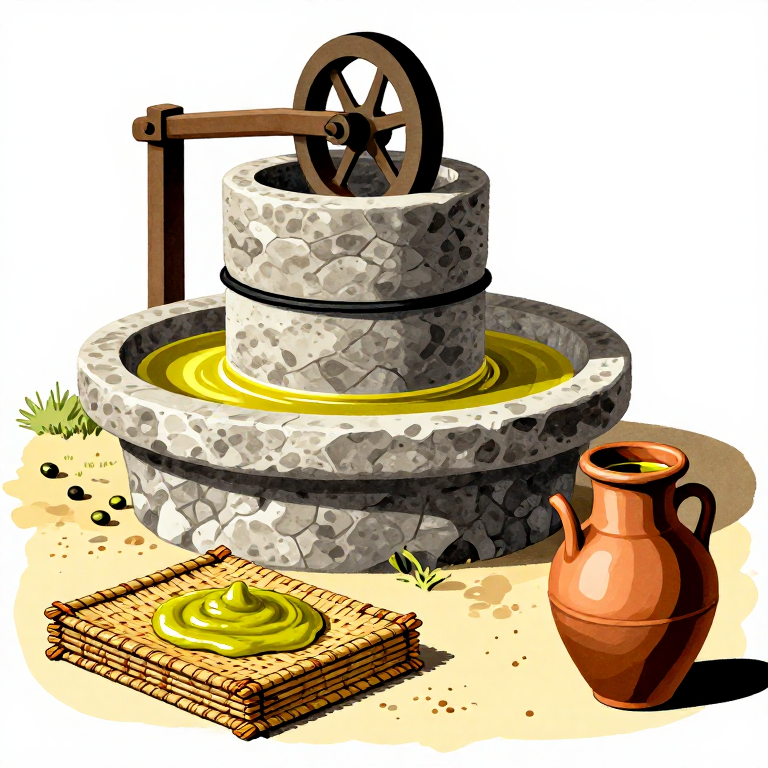


Greek Olive Oil — Pressing Olive Oil with a Trapetum Mill
Leiðbeiningar
Harvest and Wash the Olives
Harvest and Wash the Olives
Select ripe olives that have turned from green to purple-black, indicating full oil content. In ancient Greece, olives were harvested by hand-picking, beating the branches with poles, or shaking the tree and collecting fruit on spread cloths below. Wash the olives thoroughly in clean water to remove leaves, twigs, dirt, and any surface debris. Sort out damaged or rotten fruit, which produces inferior oil with off-flavors. The olive harvest (trygetos) typically occurred from November through January in the Greek climate. Olive oil quality was classified by the Greeks: the first pressing of sound, ripe olives produced the finest grade oil (comparable to modern extra-virgin), while subsequent pressings and oil from damaged fruit were used for lamps and industrial purposes.
Efni fyrir þetta skref:
 Þroskaðar ólífur (ferskar)5-10 kg kg
 Vatnfor washing and separation stykki
 Klútur (til síunar)4-6 pieces stykki
Nauðsynleg verkfæri:
 Steinn
 Pressa
 Söfnunarílát úr gleri
 Botnfellingarkrukkur (gler)
Crush the Olives to a Paste
Crush the Olives to a Paste
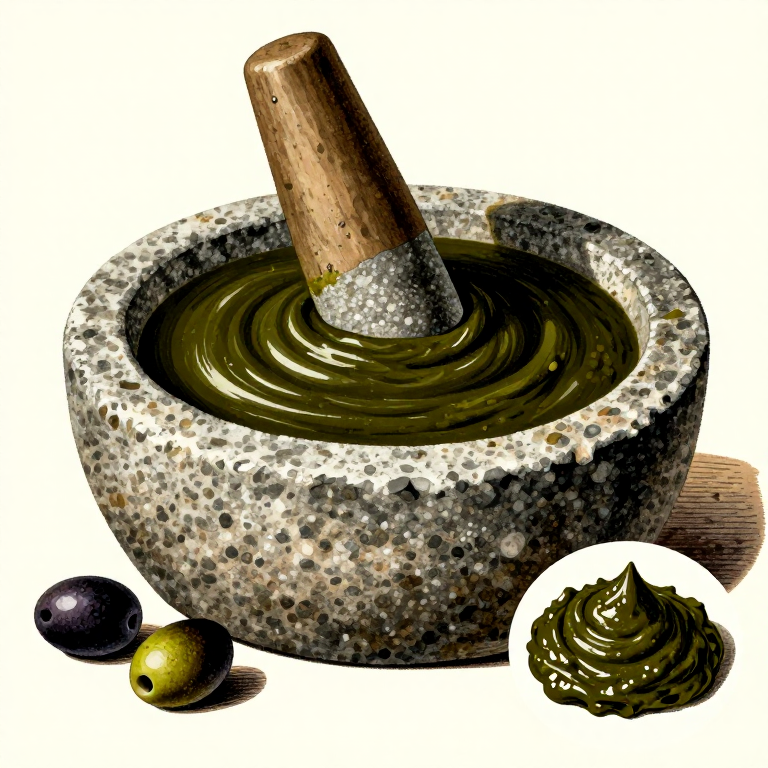
Place the washed olives in a large stone mortar or crushing basin and crush them using a heavy stone or wooden pestle. The goal is to break the olive flesh into a fine paste while cracking but not pulverizing the pits — crushed pit fragments actually aid oil extraction by creating channels for oil to flow through the paste during pressing. The Greek trapetum mill, described by Cato and depicted in archaeological remains, used two hemispherical stones rotating inside a stone basin. The stones were set with a gap that crushed the flesh while leaving the pits partially intact. Crush until the paste is uniform with no whole olives remaining. The paste should be oily and fragrant.
Stack and Press the Olive Paste
Stack and Press the Olive Paste
Spread the crushed olive paste onto round woven fiber mats or into cloth bags, creating layers approximately 2-3 cm thick. Stack several loaded mats on the press bed with a solid disc between each layer to distribute pressure evenly. Greek olive presses were typically large lever presses — a long wooden beam (up to 10 m) anchored at one end, with heavy stone weights hung from the free end to create enormous downward pressure on the stack of olive mats. As pressure increases, a mixture of oil and vegetable water (amurca) drains from the paste through the woven mats and is collected in a basin below. The first pressing yields the highest quality oil; the paste can be remixed with warm water and pressed again for lower grades.
Separate the Oil from Vegetable Water
Separate the Oil from Vegetable Water
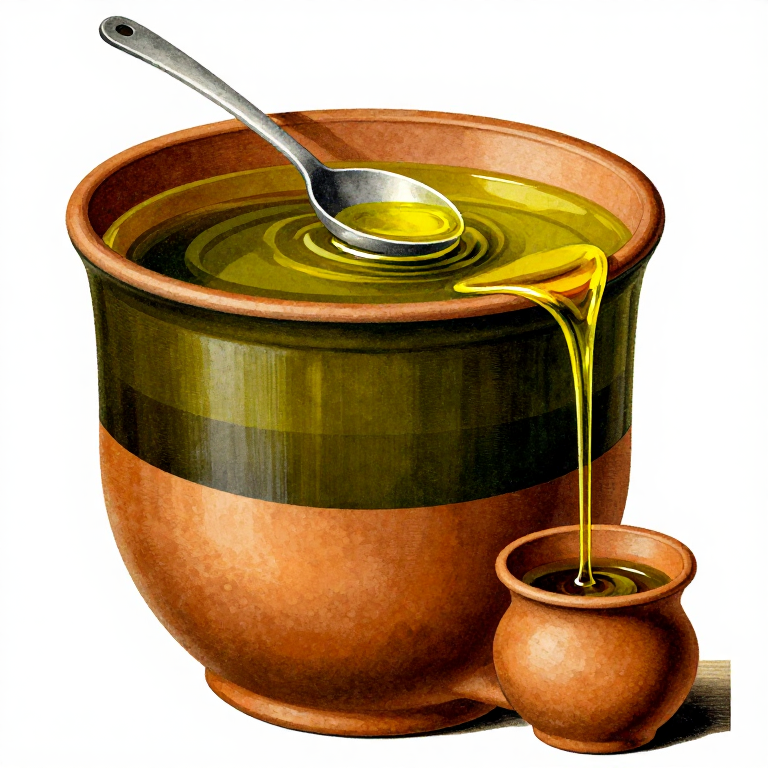
The liquid collected from pressing is a mixture of olive oil and aqueous vegetable water (amurca). Because oil is less dense than water (olive oil density approximately 0.91 g/cm3), it naturally floats to the surface when the mixture is left to stand undisturbed. Pour the press liquid into tall, narrow settling vessels and allow it to separate for several hours. Carefully skim or ladle the floating oil layer from the surface, taking care not to disturb the water layer below. This skimming process was typically repeated through a series of settling tanks, each one producing progressively cleaner oil. The separated vegetable water (amurca) was not discarded — the Greeks used it as a fertilizer, wood preservative, and insect repellent.
Store the Finished Oil
Store the Finished Oil
Transfer the clarified oil into clean, dry ceramic storage vessels — traditionally amphorae or large pithoi (storage jars). Seal the vessels tightly to minimize exposure to air and light, both of which cause olive oil to oxidize and become rancid. Store in a cool, dark location. Well-made olive oil stored in sealed ceramic vessels can last 1-2 years without significant degradation. Olive oil was one of the most important trade commodities in the ancient Greek economy — Athens alone consumed millions of liters annually. The sacred olive trees of Athena in the Athenian Agora were protected by law, and olive oil from these trees was awarded in decorated Panathenaic amphorae as prizes at the Great Panathenaic Games, making them among the most valuable athletic prizes in the Greek world.
Efni
3- for washing and separation stykkiStaðgengill
- 4-6 pieces stykkiStaðgengill
- 5-10 kg stykkiStaðgengill
Nauðsynleg verkfæri
7- Stone mortar or crushing basin
- Staðgengill
- Staðgengill
- Staðgengill
- Staðgengill
- Staðgengill
- Staðgengill
Þessi teikning býr til

CC0 opinbert ríki
Þessi teikning er gefin út undir CC0. Þér er frjálst að afrita, breyta, dreifa og nota þetta verk í hvaða tilgangi sem er, án þess að biðja um leyfi.
Studdu smiðinn með því að kaupa vörur í gegnum teikningu hans þar sem hann fær þóknun smiða sem seljendur ákvarða, eða búðu til nýja endurskoðun á þessari teikningu og tengdu hana sem tengingu í þinni eigin teikningu til að deila tekjum.