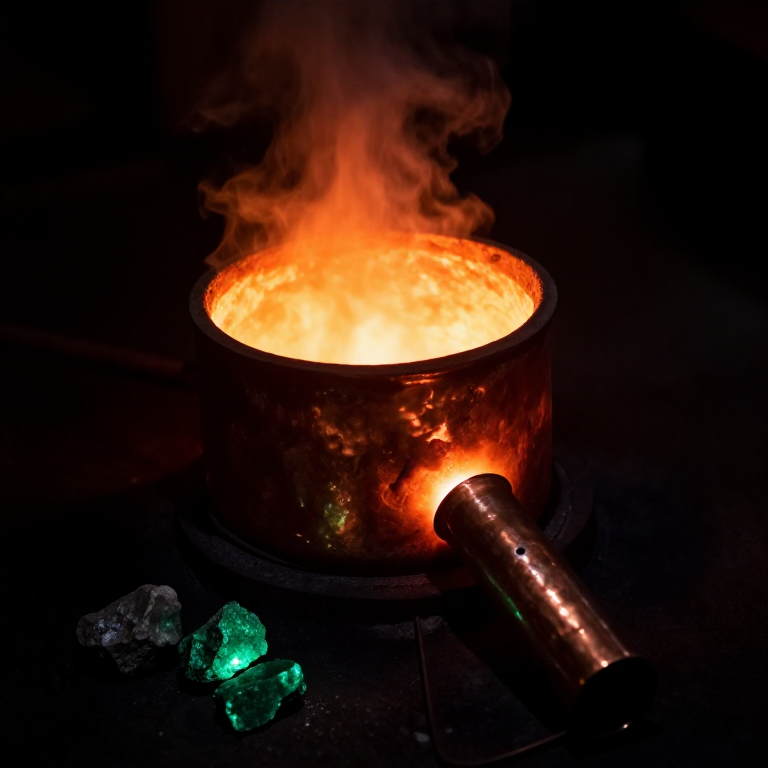
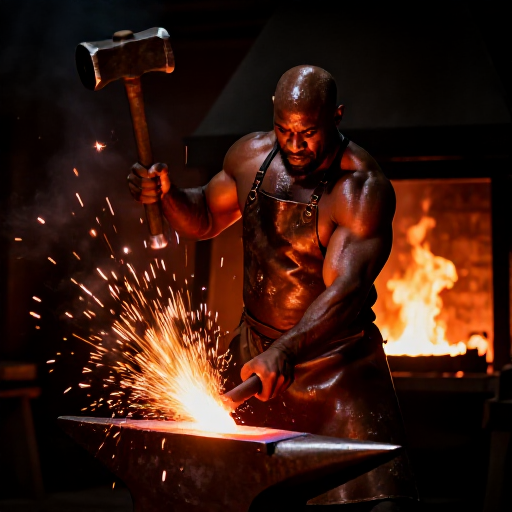

Smelting Copper from Malachite — The Birth of Metallurgy
Leiðbeiningar
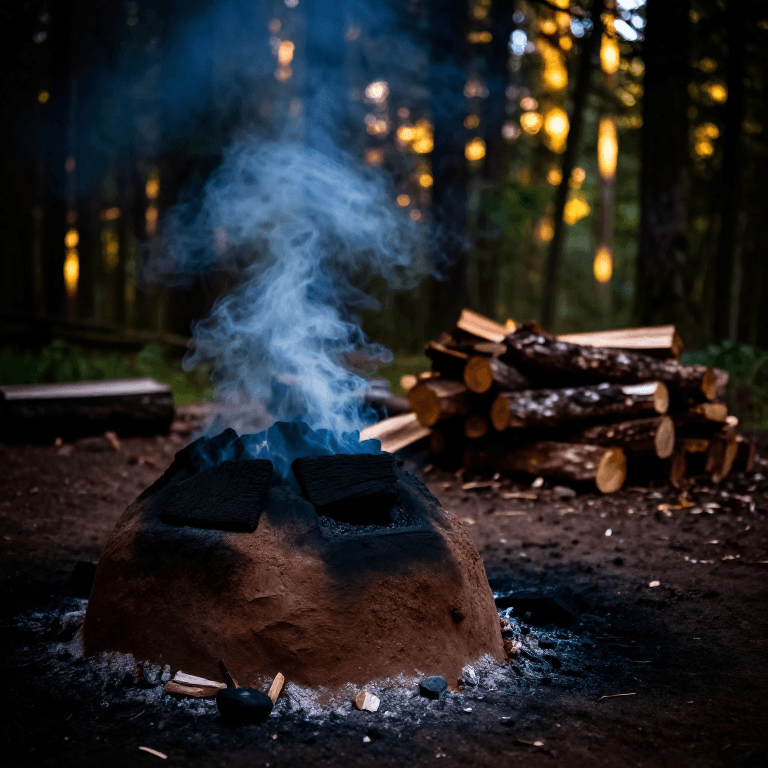
Prerequisite: Making Charcoal
Prerequisite: Making Charcoal
You need 15kg of quality charcoal. Attempting copper smelting with wood fire will fail — copper melts at 1085°C, beyond what wood alone achieves.
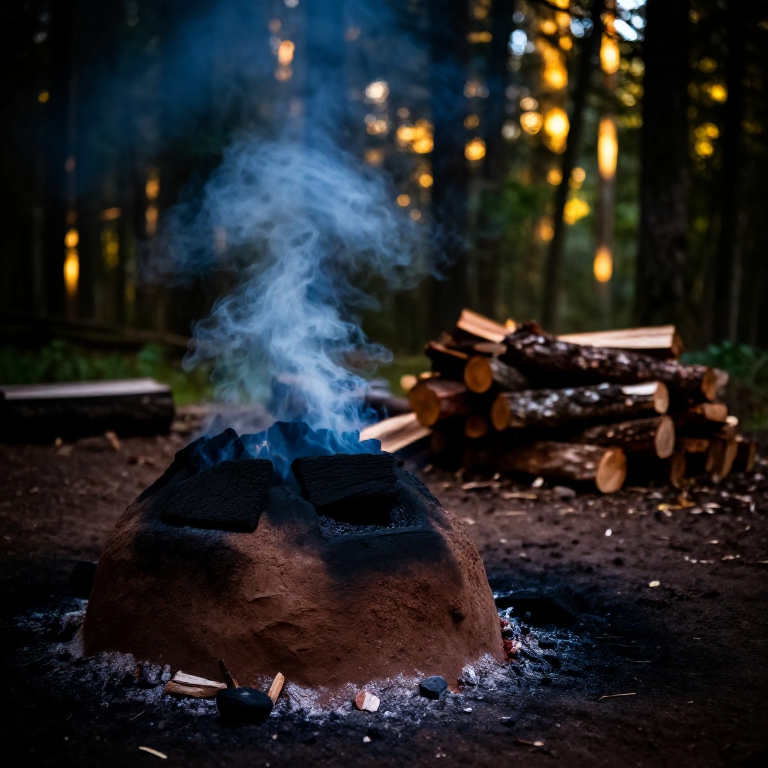
Forsenduteikning
Making Charcoal — The First Chemical Process
Efni fyrir þetta skref:
 Virkt kolduft15 kg
Nauðsynleg verkfæri:
 Brennsluofn
 Smiðjubelgur
 Deiglutöng
 Steypusteinn (flatur, sléttur)
 Steinhamar (grjótmulning)
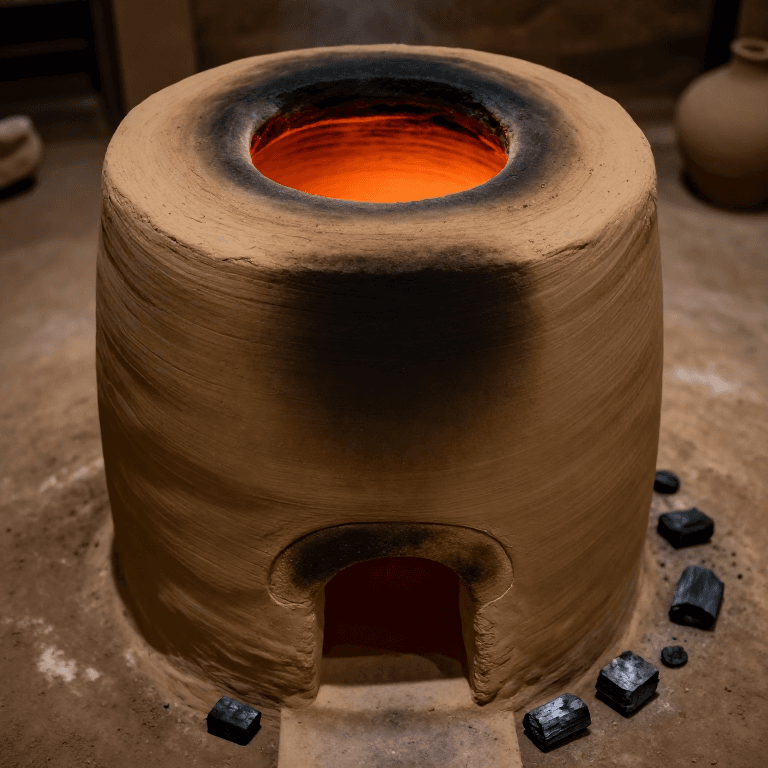
Prerequisite: Building a Clay Kiln
Prerequisite: Building a Clay Kiln
You need a kiln capable of reaching 1100°C for copper smelting.
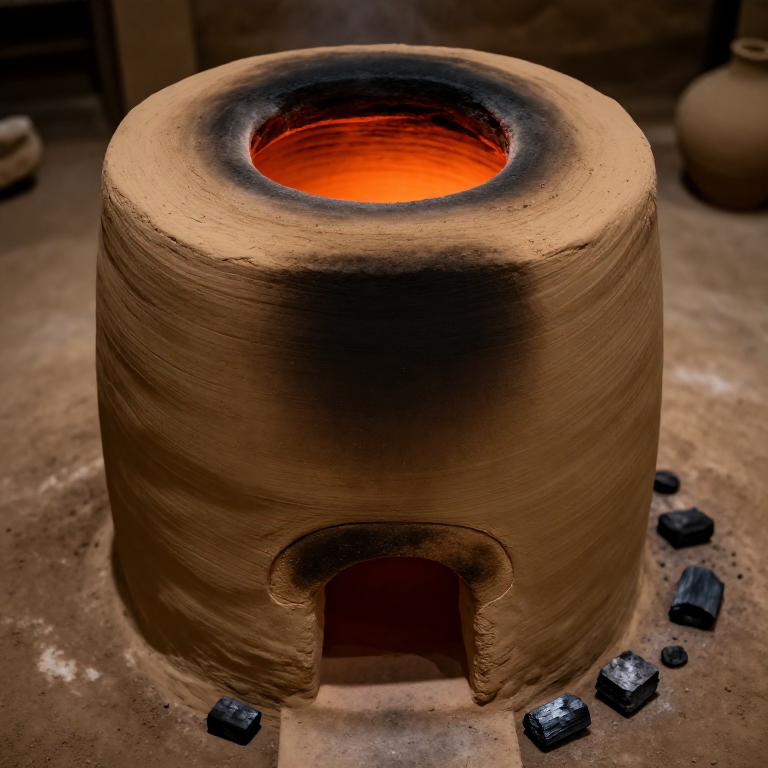
Forsenduteikning
Building a Clay Kiln — The First Furnace
Efni fyrir þetta skref:
 Deigla1 pc
The Chemistry of Copper Smelting
The Chemistry of Copper Smelting
The Reduction Reaction
Smelting is a chemical reduction. Carbon (from charcoal) strips oxygen from the copper ore:
Cu₂CO₃(OH)₂  →  2CuO + CO₂ + H₂O    (at ~300°C, decomposition)
2CuO + C     →  2Cu + CO₂             (at ~800°C, reduction)
In plain English: heat breaks malachite into copper oxide + gas. Then carbon steals the oxygen from the copper oxide, leaving pure copper metal + carbon dioxide gas.
Why Charcoal, Not Wood?
Two reasons:
- Temperature: The reduction reaction requires ~800°C sustained. Wood fires don't reliably reach this.
- Carbon monoxide: Charcoal produces CO gas, which is a more efficient reducing agent than solid carbon. CO penetrates the ore and reduces it from the inside out.
Ore Preparation
- Crush the malachite to pea-sized pieces (5-10mm). Smaller = faster reduction, but powder clogs airflow.
- Sort — remove any non-green rock (gangue). Pure green malachite smelts best.
- Roast (optional): Heat crushed ore in an open fire for 1 hour. This drives off moisture and CO₂, converting malachite to black CuO (tenorite). Pre-roasted ore reduces faster.
Efni fyrir þetta skref:
Virkt kolduft15 kg Malakítgrýti (Cu2CO3(OH)2)2 kg
The Smelt
The Smelt
Loading the Kiln
- Fill the kiln ⅓ full with charcoal. Light it and bring to full temperature (orange-hot interior, ~1000°C) using bellows.
- Place the crucible in the center of the charcoal bed. Pre-heat it for 10 minutes before loading ore.
- Add crushed malachite to the crucible — don't fill more than ⅔ (it will bubble as CO₂ escapes).
- If using flux (borax or wood ash), add a thin layer on top of the ore.
- Cover the ore with a layer of charcoal pieces inside the crucible.
- Pack more charcoal around and above the crucible inside the kiln.
Maintaining Temperature
- Continuous bellows: Pump steadily — one full pump every 2-3 seconds. Temperature drops fast without forced air.
- Add charcoal from the top every 15-20 minutes as it burns down. The crucible must stay buried in hot charcoal.
- Duration: 2-4 hours for a full smelt. Don't rush.
Signs of Success
- Green flames: Copper compounds produce distinctive green-tinted flames. Good sign.
- Bubbling in crucible: CO₂ escaping from the reduction reaction.
- Slag forming on top: A glassy, dark layer of impurities floating above the copper. This is normal and desirable — it protects the copper from re-oxidation.
Efni fyrir þetta skref:
Virkt kolduft15 kgDeigla1 pcMalakítgrýti (Cu2CO3(OH)2)2 kg Uppstoppunarbórax0.5 kg
Pouring and Recovery
Pouring and Recovery
The Pour
- When the slag looks glassy and the crucible contents are liquid, it's time to pour.
- Pre-heat your casting stone by placing it near the kiln opening. Cold stone + molten copper = dangerous spatter.
- Using crucible tongs, carefully lift the crucible from the charcoal bed.
- Pour in a steady stream into the depression in the casting stone. Pour the slag separately.
- Allow to cool naturally. DO NOT quench with water (causes brittleness and can cause steam explosion).
What You Should See
A copper button — a rough, reddish-orange disc of metal. It may have slag inclusions and a rough surface. This is normal for primitive smelting.
Yield
Expect 50-70% copper recovery from good malachite. Some copper remains trapped in slag. Ancient smiths re-smelted slag to recover more.
The Innovation Moment
You've just performed the most transformative chemical process in human history. From green rock, you extracted a metal that can be hammered into tools, ornaments, and weapons. But pure copper is soft. To make it truly useful, you need to alloy it — see Blueprint 07: Alloying Bronze.
First, though, you should learn to shape this copper — see Blueprint 05: Casting Copper Tools.
Efni fyrir þetta skref:
Virkt kolduft15 kgDeigla1 pcEfni
5- Staðgengill
- 15 kgStaðgengill
- 1 stykkiStaðgengill
- 0.5 kgStaðgengill
- 15 kgStaðgengill
Nauðsynleg verkfæri
5- Staðgengill
- Staðgengill
- Staðgengill
- Staðgengill
- Staðgengill
Efni úr tengdum teikningum

CC0 opinbert ríki
Þessi teikning er gefin út undir CC0. Þér er frjálst að afrita, breyta, dreifa og nota þetta verk í hvaða tilgangi sem er, án þess að biðja um leyfi.
Studdu smiðinn með því að kaupa vörur í gegnum teikningu hans þar sem hann fær þóknun smiða sem seljendur ákvarða, eða búðu til nýja endurskoðun á þessari teikningu og tengdu hana sem tengingu í þinni eigin teikningu til að deila tekjum.