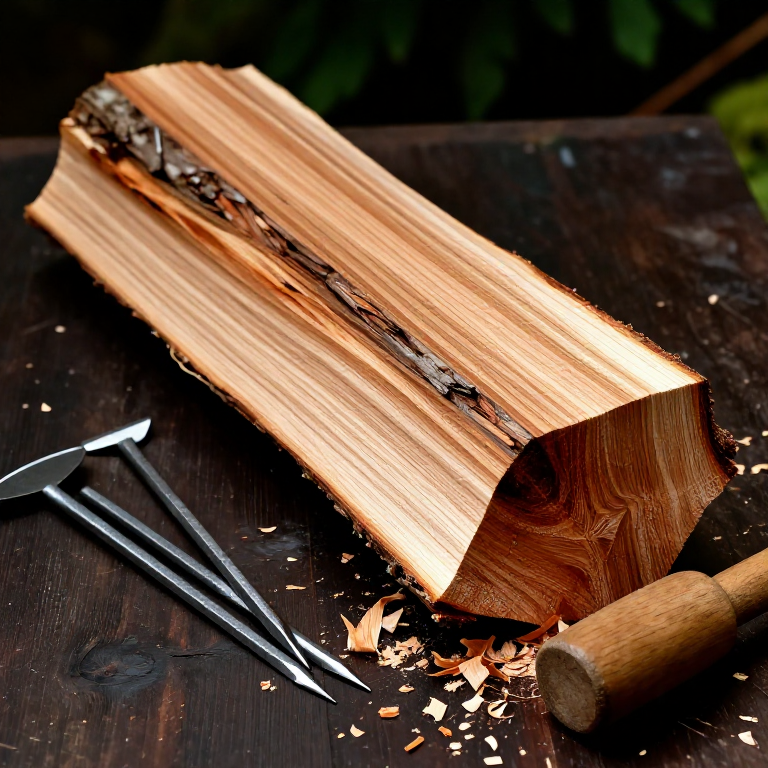


Riving Planks from a Log — Splitting Timber Along the Grain with Wedges
Before sawmills, every plank was riven — split from a log using wedges and mallets. Riving exploits the natural grain of the wood: a wedge driven into the end grain propagates a crack that follows the fibres, producing a plank that is stronger than any sawn board because no fibres are cut across. Every Viking longship, every medieval roof, and every Iron Age door was built from riven timber.
The technique is simple but requires reading the wood. A straight-grained log splits cleanly into halves, quarters, and eighths. Each successive split reduces the section until planks of the desired thickness are reached. Crooked grain, knots, or spiral growth cause the split to run off-line, ruining the plank. Selecting the right log is half the skill.
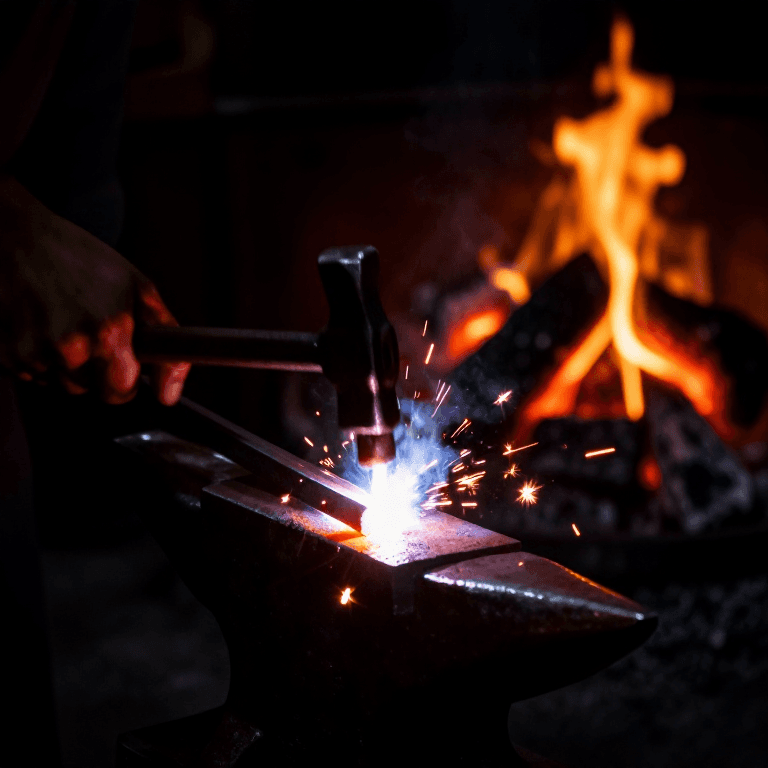
Iron wedges transformed riving from a slow stone-age process into an efficient production method. A smith's iron wedge driven by a wooden maul splits a log in minutes. Combined with an iron drawknife for smoothing, riving produces finished planks faster than pit-sawing and with superior strength.
Leiðbeiningar
Select a straight-grained log
Select a straight-grained log
Efni fyrir þetta skref:
 Eikarborð (rautt)1 stykki
Split the log in half
Split the log in half
Nauðsynleg verkfæri:
 Smíðahamar
 Stálfleygasett
 Sleggja
Quarter each half
Quarter each half
Rive planks from the quarters
Rive planks from the quarters
Nauðsynleg verkfæri:
 Klofningsjárn (froe)
 Trésleggja
Correct wandering splits
Correct wandering splits
Smooth the riven surface
Smooth the riven surface
Nauðsynleg verkfæri:
 Bandhefill
 Telgibekkur
 Skarexi
Efni
1- 1 stykkiStaðgengill
Nauðsynleg verkfæri
8- Staðgengill
- Staðgengill
- Staðgengill
- Staðgengill
- Staðgengill
- Staðgengill
- Staðgengill
- Staðgengill
Efni úr tengdum teikningum
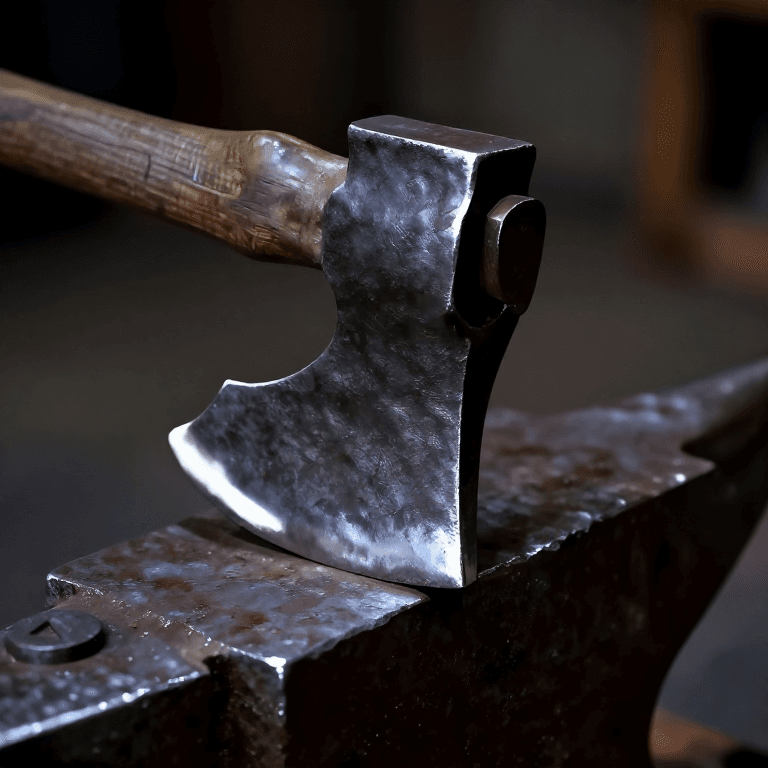
Þessi teikning býr til

Tengd Blueprint
Þessi blueprint deila þekkingu — tækni, efni eða meginreglur
CC0 opinbert ríki
Þessi teikning er gefin út undir CC0. Þér er frjálst að afrita, breyta, dreifa og nota þetta verk í hvaða tilgangi sem er, án þess að biðja um leyfi.
Studdu smiðinn með því að kaupa vörur í gegnum teikningu hans þar sem hann fær þóknun smiða sem seljendur ákvarða, eða búðu til nýja endurskoðun á þessari teikningu og tengdu hana sem tengingu í þinni eigin teikningu til að deila tekjum.