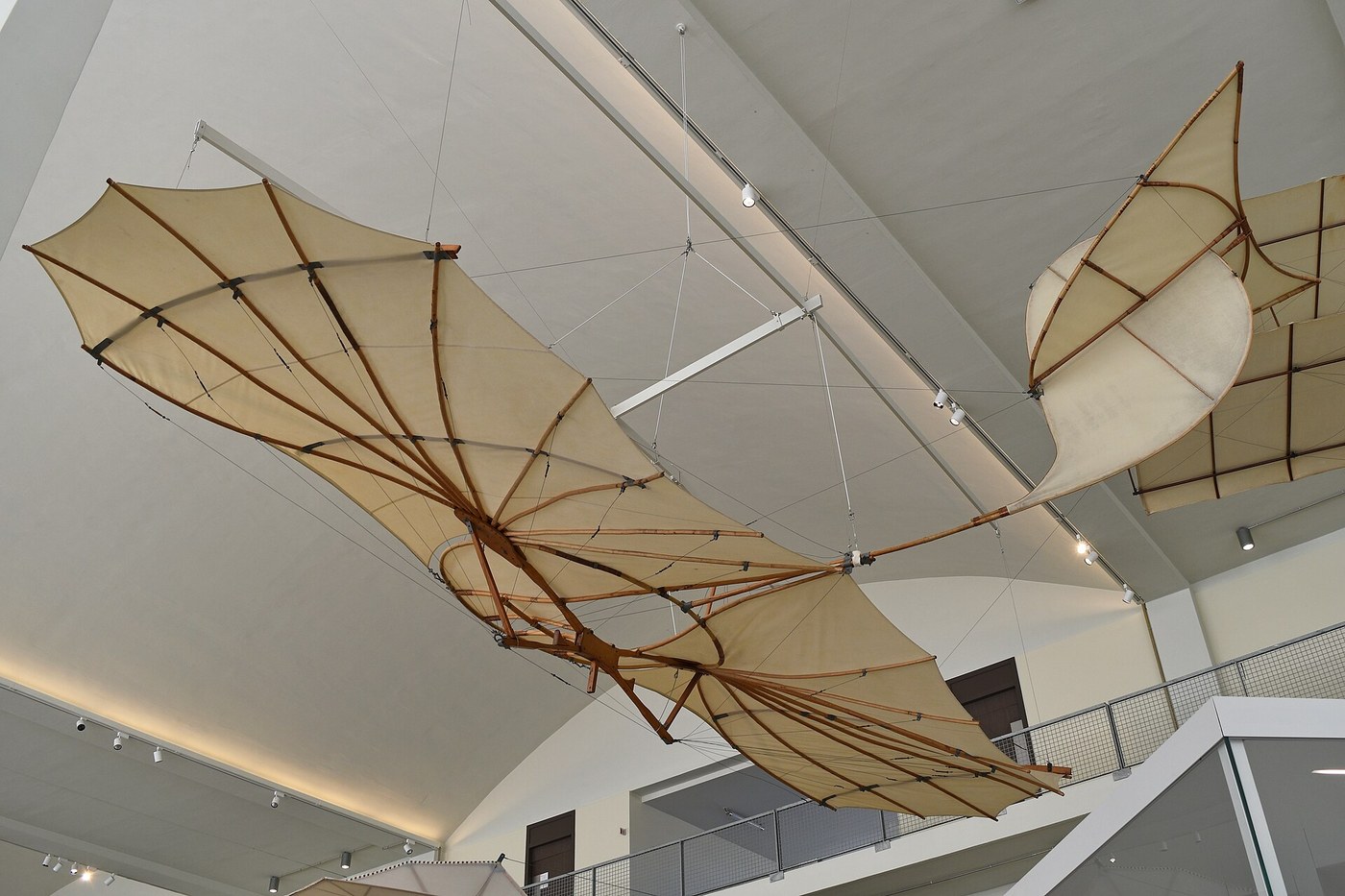


Lilienthal Glider
Leiðbeiningar
Build a model at a scale you can throw
Build a model at a scale you can throw
Build the glider small first. Every mistake is then a broken stick rather than a broken person.
- Make a bat-like monoplane wing of roughly 600 mm span from balsa sticks and sheet, with a shallow camber matching the best section from the whirling-arm tests.
- Fit a fixed cruciform tail — a horizontal surface for pitch, a vertical one for yaw.
- Hang a weight beneath the wing on a short pylon so the centre of gravity sits at about 30 percent of the chord.
- Launch it gently, level, into still air. Adjust ballast until it glides straight rather than diving or stalling.
The trimming is the lesson: a glider is a balance between where the weight is and where the lift acts, and a few millimetres of ballast decides whether it flies or drops. Lilienthal did this trimming with his own body, in flight, which is why his control authority was limited by how far he could lean.
Measure the glide ratio while you are here: launch from a known height, measure the distance travelled, and divide. A ratio of 6:1 means six metres forward per metre down. Lilienthal’s best machines managed roughly that.Efni fyrir þetta skref:
 Balsaviðarplata2 plötur
 Balsaviðarlistar1 búnt
 Trélím1 flaska
 Mótunarleir sem kjölfesta1 pakki
Nauðsynleg verkfæri:
 Föndurhnífur með varablöðum
 Stafrænn skífmælir 6 tommur
 Gráðubogi
 Beltislípivél
 Stafræn vog
 Tær öryggisgleraugu
Cover the frame, and learn why the covering is structural
Cover the frame, and learn why the covering is structural
A wing is a frame plus a skin, and the skin is not just there to keep the air out.
- Build a wing frame of ribs and spars with no covering, and try to twist it by hand. Note how easily it distorts.
- Cover it tightly with cotton fabric or modelling tissue, glued or doped to the frame on both surfaces.
- Try to twist it again.
The covered frame is dramatically stiffer in torsion than the bare one. A taut skin turns an open lattice into something approaching a closed box, and it carries shear that the sticks alone cannot. Lilienthal used cotton shirting over willow; the Wrights used cotton doped tight; the principle is identical and it is why an uncovered model feels alarmingly floppy and a covered one feels solid.
Doping shrinks the fabric as it dries and pulls the surface drum-tight. Overdo it on a light frame and the shrinkage will bow the spars — a real failure mode, and the reason dope is applied in several thin coats rather than one heavy one.Efni fyrir þetta skref:
 Bómullarefni (létt)1 m
 Módelsilkipappír1 sett
 Módelstrekkilakk1 settBalsaviðarlistar1 búnt
Nauðsynleg verkfæri:
Föndurhnífur með varablöðum C-þvingaBeltislípivélTær öryggisgleraugu
Fly it off a slope in small increments
Fly it off a slope in small increments
Lilienthal’s method matters more than his machine, and it is the part worth copying exactly.
- Choose a smooth grassy slope with a steady breeze blowing up it, and clear ground beyond.
- Start at the very bottom, with hops measured in metres, not from the top.
- Change ONE thing at a time — ballast position, tail angle, launch speed — and repeat the same short hop.
- Record every run: what you changed, what it did.
Incremental testing on a shallow slope is what made Lilienthal survive long enough to learn anything. The alternative — build the whole machine, launch from height, hope — killed a great many of his contemporaries and eventually killed him too, in 1896, when a gust stalled him from about fifteen metres.
Do this with models, not with yourself. A person-carrying glider is genuinely dangerous, needs a suitable site, and is not what this blueprint is for. Everything worth learning here is learnable at 600 mm span, and the trimming logbook you build is the real deliverable.Efni fyrir þetta skref:
 Rúðustrikaður pappír1 pad
Nauðsynleg verkfæri:
 Handvindmælir
 Snjallsími með hægmyndatökuStafræn vogGráðubogiTær öryggisgleraugu
Find the limit of weight-shift control
Find the limit of weight-shift control
Understand why this design could not be scaled up, because that is what the next thirty years were about.
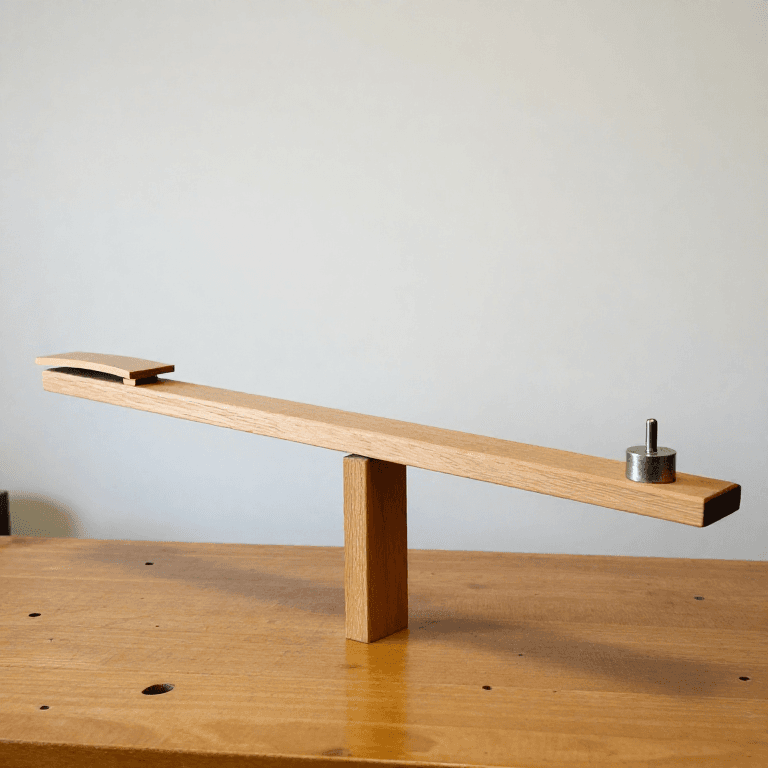
- On the model, simulate weight-shift by moving the ballast sideways and observing the response.
- Now double the model’s size — or reason it through — and ask how far the ballast must move to produce the same effect.
- Compare the mass being moved with the mass of the whole machine in each case.
Weight-shift control works only while the pilot is a large fraction of the total mass, and its authority falls away as the machine grows. A person can shift perhaps half a metre; on a small glider that is a big change in balance, on a large one it is nothing. Worse, it is slow — the pilot must physically swing before anything happens, and a gust does not wait.
So the machine had to be given control surfaces of its own: things that redirect the AIR rather than move the mass. That is the entire subject of the next stage, and it is why the aileron and wing-warping blueprints exist.
Hang gliders still use weight shift, and they are precisely as large as that method allows. It is not a discarded idea, it is a technique with a size limit — which is a much more useful way to think about superseded engineering.Efni fyrir þetta skref:
Mótunarleir sem kjölfesta1 pakkiNauðsynleg verkfæri:
Stafræn vogStafrænn skífmælir 6 tommurGráðubogiSnjallsími með hægmyndatökuTær öryggisglerauguCopy his lift table, and note what he could not know
Copy his lift table, and note what he could not know
Lilienthal’s published tables were the best data in the world and they contained an error that nearly ended the Wrights.
- Using the whirling arm from the previous blueprint, measure lift coefficients for your cambered section across the angle range.
- Tabulate them the way Lilienthal did: coefficient against angle of attack.
- Note the conditions of your measurement — the size of the surface, the speed, and whether the air was already moving.
Write those conditions down, because a coefficient without its conditions is not a measurement, it is a rumour. Lilienthal’s figures were taken on a whirling arm, in air his own apparatus had already disturbed, on surfaces of one particular size. Used outside those conditions they were wrong — and they were used outside those conditions by everyone, because they were the only numbers available.
The Wrights built their 1900 and 1901 gliders using these tables, found the lift far short of prediction, and faced a choice: assume they had built badly, or assume the world’s best data was wrong. Choosing the second is the subject of the next blueprint, and it is the most important decision in the history of aviation.Efni fyrir þetta skref:
Rúðustrikaður pappír1 padNauðsynleg verkfæri:
 GormavogGráðubogiStafrænn skífmælir 6 tommurStafræn vogTær öryggisgleraugu
Efni
8- 2 plöturStaðgengill
- 1 búntStaðgengill
- 1 flaskaStaðgengill
- 1 pakkiStaðgengill
- Staðgengill
- 1 settStaðgengill
- 1 settStaðgengill
- 1 padStaðgengill
Nauðsynleg verkfæri
10- Staðgengill
- Staðgengill
- Staðgengill
- Beltislípivél3% þóknunMagento Legacy Storeships internationallyStaðgengill
- Staðgengill
- Staðgengill
- Staðgengill
- Staðgengill
- Staðgengill
- Staðgengill
Tengd Blueprint
Þessi blueprint deila þekkingu — tækni, efni eða meginreglur

CC0 opinbert ríki
Þessi teikning er gefin út undir CC0. Þér er frjálst að afrita, breyta, dreifa og nota þetta verk í hvaða tilgangi sem er, án þess að biðja um leyfi.
Studdu smiðinn með því að kaupa vörur í gegnum teikningu hans þar sem hann fær þóknun smiða sem seljendur ákvarða, eða búðu til nýja endurskoðun á þessari teikningu og tengdu hana sem tengingu í þinni eigin teikningu til að deila tekjum.