Samvinna
LIST
FEGURÐ OG VELLÍÐAN
HANDVERK
MENNING OG SAGA
SKEMMTUN
UMHVERFI
MATUR OG DRYKKUR
ÖFUGVERKFRÆÐI
VÍSINDI
ÍÞRÓTTIR
TÆKNI
KLÆÐANLEG TÆKNI
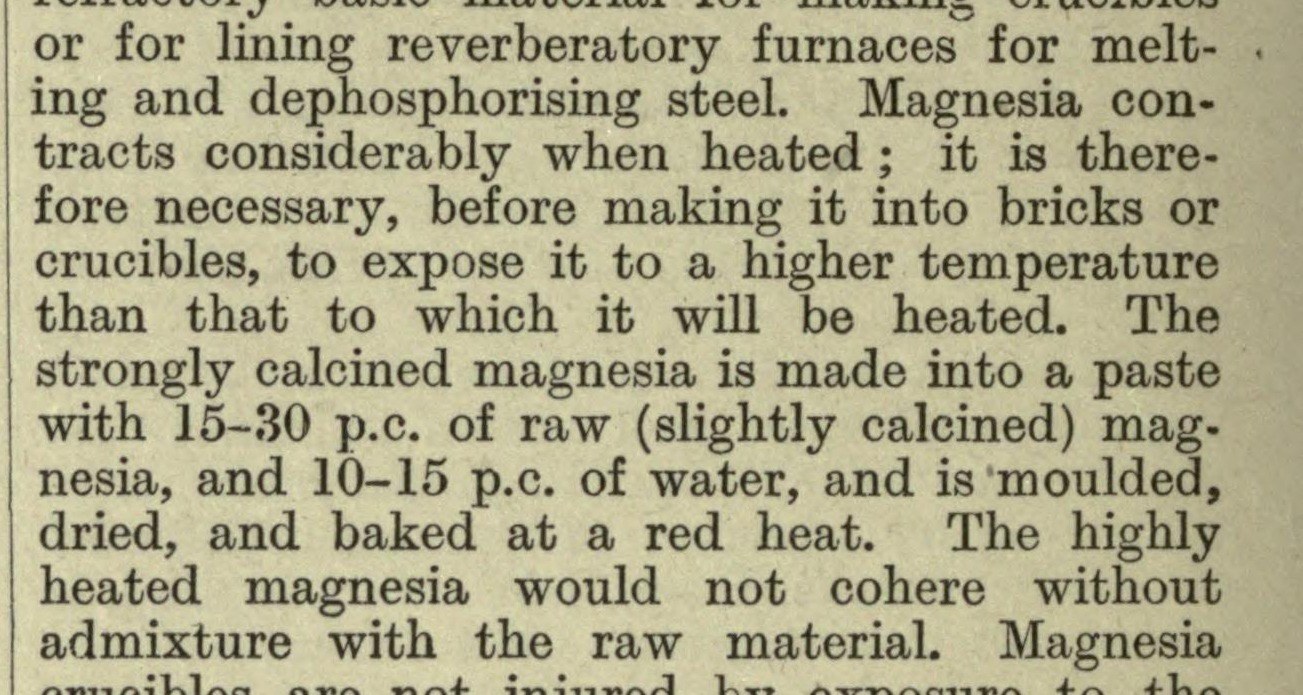


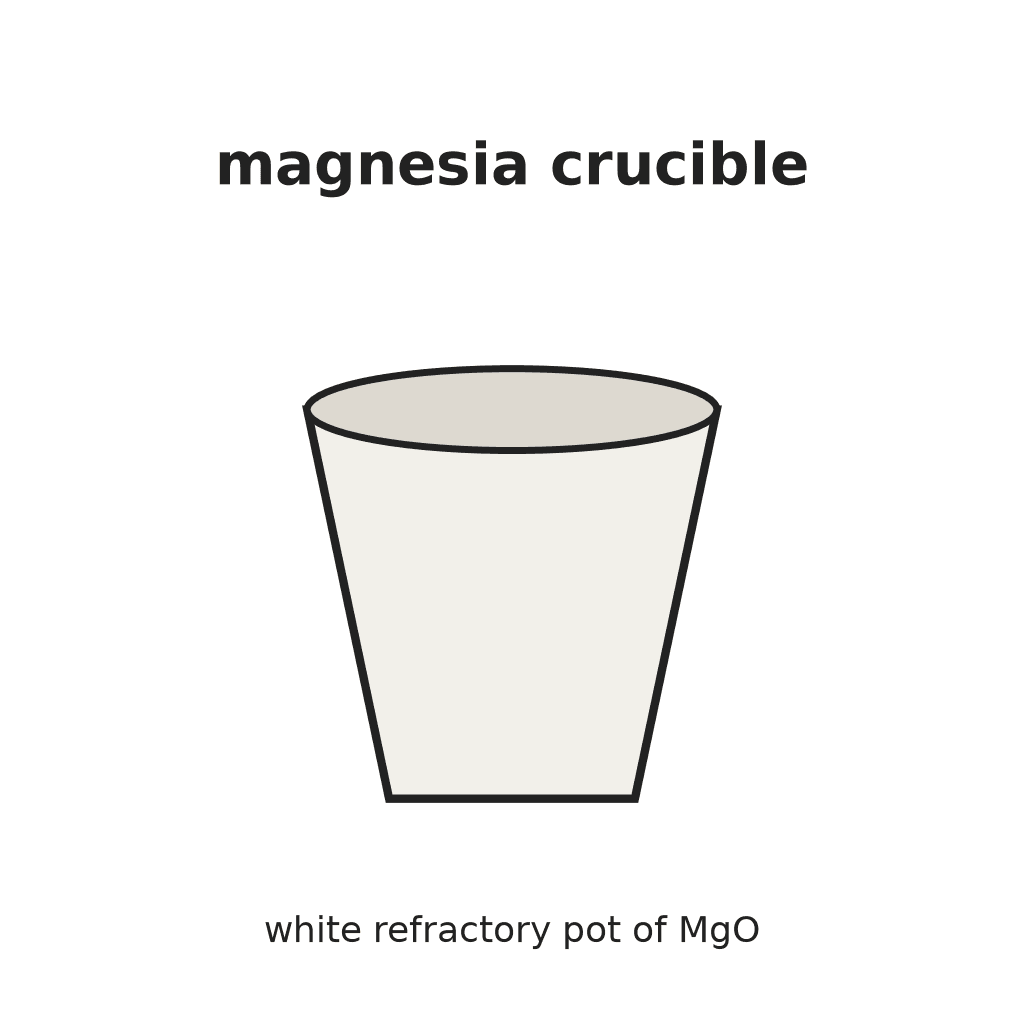
Magnesia Crucible: Strongly Calcined Magnesia Bound with Raw Magnesia and Baked at a Red Heat (Thorpe 1912)
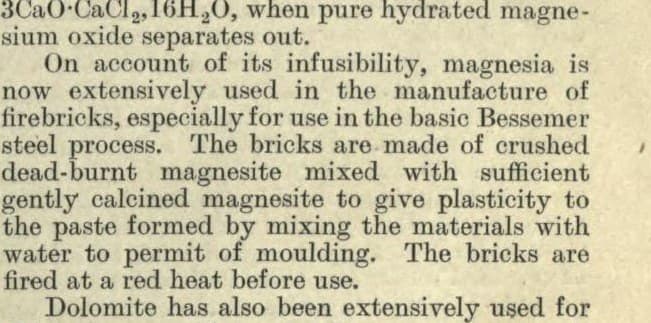
A magnesia crucible is a pot of magnesia, a basic refractory. Thorpe's Dictionary of Applied Chemistry (1912) gives the recipe introduced by Caron: magnesia shrinks a great deal when heated, so it is first calcined hotter than it will ever be used, then bound with 15-30 per cent of raw, slightly calcined magnesia and 10-15 per cent of water, moulded, dried and baked at a red heat.
He gives no calcining temperature, mould or size; those are unknown here.
Source: Thorpe, Dictionary of Applied Chemistry vol. II (1912), CRUCIBLES, p. 170. Picture: that passage.
Miðlungs
Two to three days
Leiðbeiningar
1
1
Read Thorpe
Read Thorpe
"The highly heated magnesia would not cohere without admixture with the raw material."
2
2
Calcine most of the magnesia hard
Calcine most of the magnesia hard
Magnesia contracts considerably when heated, so before making it into a crucible expose it to a higher temperature than the crucible will meet in use. The temperature itself is not given. Keep back a part of the magnesia only slightly calcined.
Efni fyrir þetta skref:
 Magnesíumoxíð1 as required
Nauðsynleg verkfæri:
 Brennsluofn
 Hitaþolnir hanskar
3
3
Make the paste
Make the paste
Grind the strongly calcined magnesia and mix it with 15-30 per cent of the raw (slightly calcined) magnesia and 10-15 per cent of water into a paste. The raw part is what makes it hold together.
Efni fyrir þetta skref:
 Vatn1 10-15 per cent
Nauðsynleg verkfæri:
 Mortél og stautur
 Nákvæm stafræn vog
 Rykgríma
4
4
Mould the crucible
Mould the crucible
Mould the paste into crucibles. Thorpe does not describe the mould or give sizes (unknown).
Nauðsynleg verkfæri:
 Óþekktur efniviður
 Óþekkt mál
5
5
Dry and bake
Dry and bake
Dry the crucibles, then bake them at a red heat. Thorpe notes that magnesia crucibles are not harmed by standing in the air.
Nauðsynleg verkfæri:
BrennsluofnHitaþolnir hanskar6
6
History and honest limits
History and honest limits
Thorpe credits Caron with introducing magnesia for crucibles and for lining reverberatory furnaces in which steel was melted and dephosphorised. He also lists magnesia-bauxite crucibles (Gaudin) and calcined magnesite with a boron compound (Rawson and Littlefield, 1900).
The calcining temperature, the mould, the size and the drying are not given; the tools are ours.
Nauðsynleg verkfæri
7- Staðgengill
- Staðgengill
- Staðgengill
- Staðgengill
- Staðgengill
- Staðgengill
- Staðgengill
Þessi teikning býr til
Tengd Blueprint
Þessi blueprint deila þekkingu — tækni, efni eða meginreglur
CC0 opinbert ríki
Þessi teikning er gefin út undir CC0. Þér er frjálst að afrita, breyta, dreifa og nota þetta verk í hvaða tilgangi sem er, án þess að biðja um leyfi.
Studdu smiðinn með því að kaupa vörur í gegnum teikningu hans þar sem hann fær þóknun smiða sem seljendur ákvarða, eða búðu til nýja endurskoðun á þessari teikningu og tengdu hana sem tengingu í þinni eigin teikningu til að deila tekjum.