Samvinna
LIST
FEGURÐ OG VELLÍÐAN
HANDVERK
MENNING OG SAGA
SKEMMTUN
UMHVERFI
MATUR OG DRYKKUR
ÖFUGVERKFRÆÐI
VÍSINDI
ÍÞRÓTTIR
TÆKNI
KLÆÐANLEG TÆKNI
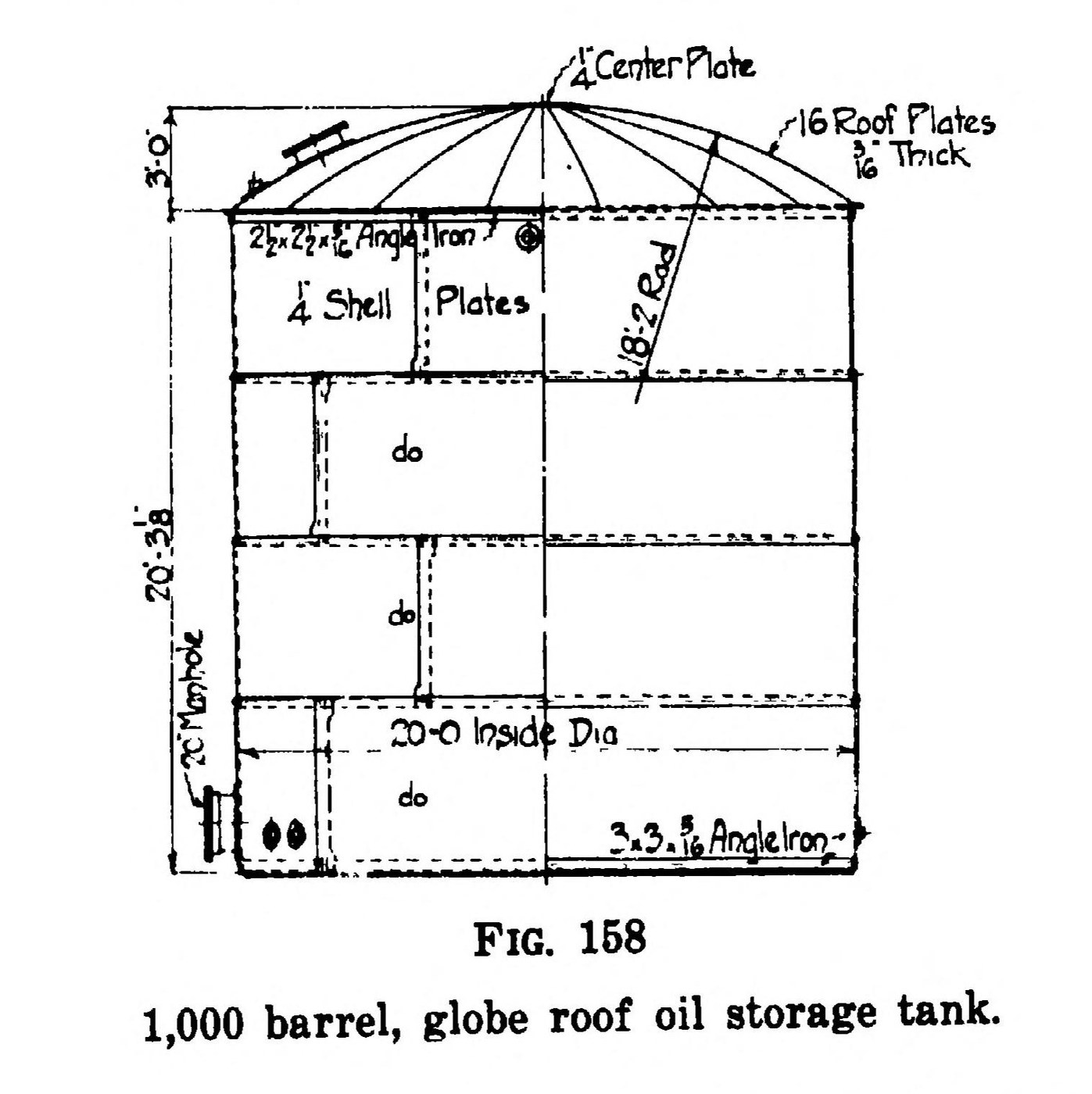

Oil Storage Tank: a Riveted Steel Tank with Globe Roof (Bell, 1923)
An above-ground oil tank of riveted 'tank steel': a flat bottom, rings of plate lapped and riveted, angle irons at top and bottom, and a self-supporting globe roof. Every seam is caulked oil-tight and the tank is water-tested before painting.
Variable: capacity. Bell's Fig. 158 is 1,000 barrels: 20 ft inside diameter, about 20 ft 3 in high, four rings of 1/4 in plate, sixteen 3/16 in roof plates rising 3 ft. Standard tanks run from 500 to 80,000 barrels (120 ft x 40 ft).
Source: H. S. Bell, American Petroleum Refining (1923), pp. 286-306. Picture: Fig. 158 of the book.
Sérfræðingur
Unknown
Leiðbeiningar
1
1
Choose the size and plates
Choose the size and plates
Pick the capacity from the standard sizes (1,000 barrels: 20 ft diameter, 20 ft high). Take plate thickness from Bell's chart for the head and diameter, with a factor of safety of at least 2 1/2 for refinery tanks. Use at least 1/4 in for the shell; bottom 1/4 in on larger tanks, 3/16 in on smaller. Rings are 6 ft (72 in plates); about 7 ft is the limit.
Nauðsynleg verkfæri:
 Óþekkt mál
2
2
Prepare the ground
Prepare the ground
Level the ground in a circle 10 ft wider than the tank and remove all vegetable growth. Avoid a mix of cut and fill. In old yards filled with cinders, dig them out at least 8 in deep and replace with fine gravel, loam or sand. On poor soil, use piles.
Efni fyrir þetta skref:
 Möl1 as needed
Nauðsynleg verkfæri:
Óþekkt mál3
3
Punch and scarf the plates
Punch and scarf the plates
Punch the rivet holes. For 1/4 in plate with 5/8 in rivets, a single lap seam has holes 2 1/4 in apart and 1 1/8 in from the edge; keep the clear space between holes no more than 6 or 7 times the plate thickness, or the caulked edge springs. Scarf the corner of the middle plate where three plates meet: cold up to 1/4 in, hot above, drawn to an edge no thicker than 1/16 in.
Nauðsynleg verkfæri:
 Gatapressa
 Sleggja
4
4
Build the bottom on horses
Build the bottom on horses
Lay, rivet and caulk the bottom on trestles or horses about 30 in high. Rivet the bottom angle iron (Fig. 158: 3 x 3 x 5/16 in) with a 1/4 in bent-plate shoe behind each angle splice; caulk the shell leg past the shoe at least 12 in, or better bevel and caulk the angle all round. Assemble and drive the first ring while the bottom is still up. Test the bottom under 6 to 8 in of water. Coat its underside with ship-bottom or heavy asphalt paint.
Efni fyrir þetta skref:
 Plata úr mjúku stáli1 bottom, first ring
 Vinkiljárn úr mjúku stáli1 bottom angle
 Stálhnoð1 stykki
 Óþekktur efniviður1 asphalt paint
Nauðsynleg verkfæri:
 Hnoðhamar
 Gatvíkkari
 Vatn
 Breiður málningarpensill
5
5
Lower it and raise the shell
Lower it and raise the shell
Raise the tank on jacks round the edge, clear out the horses and debris, and lower the bottom to grade. Rivet and caulk the remaining rings from scaffolds: floating scaffolds where water is at hand (water is pumped in as each ring is caulked tight, testing as you go), or brackets bolted through punched holes, later plugged with hot rivets. Where three plates meet, bolt them, heat cherry red with an oil-burning torch and lay the joint up with sledges before riveting. Fit the top angle (2 1/2 x 2 1/2 x 5/16 in) and a flanged steel manhole in the bottom ring.
Efni fyrir þetta skref:
Plata úr mjúku stáli1 ringsVinkiljárn úr mjúku stáli1 top angleStálhnoð1 stykkiNauðsynleg verkfæri:
 SkrúftjakkurHnoðhamarGatvíkkari
 BlysSleggjaVatn
6
6
Fit the globe roof
Fit the globe roof
For tanks up to 54 ft across, rivet on a self-supporting globe roof of segmental 3/16 in plates (Fig. 158: sixteen plates, 1/4 in centre plate, 3 ft rise); cold riveting is fine here. Make it gas-tight, with one vent at the apex covered by brass or monel wire cloth of at least 50 mesh.
Efni fyrir þetta skref:
Plata úr mjúku stáli1 roofStálhnoð1 stykkiNauðsynleg verkfæri:
Hnoðhamar7
7
Test and paint
Test and paint
Fill the tank with water to test it before painting; it shows the important leaks, though not always tightness for light oils. Wire-brush off mill scale and rust. Give shell and roof three coats: one of red lead ground in boiled linseed oil, then two of good grey graphite paint.
Efni fyrir þetta skref:
 Menja1 first coat
 Soðin línolía1 stykkiÓþekktur efniviður2 grey graphite paint
Nauðsynleg verkfæri:
Vatn VírburstasettBreiður málningarpensill
Efni
7- 1 as neededStaðgengill
- 1 roofStaðgengill
- 1 top angleStaðgengill
- 1 stykkiStaðgengill
- 2 grey graphite paintStaðgengill
- 1 first coatStaðgengill
- 1 stykkiStaðgengill
Efni úr tengdum teikningum
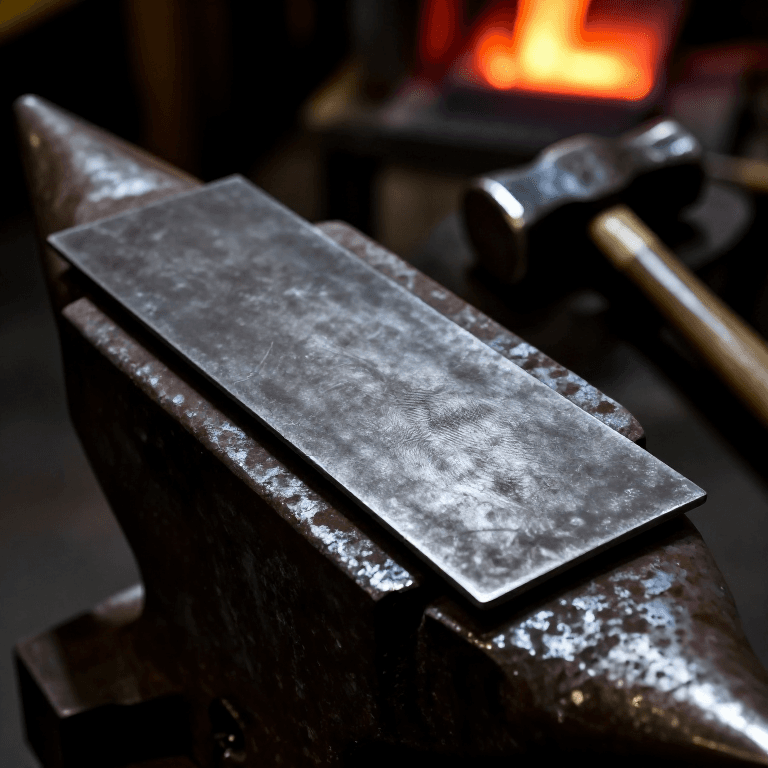
10% eignun
Mild Steel Plate and Sheet Hammered from a Billet
eftir Forge
Nútíma
41
0
0
0
5
0
10% eignun
Hot-Rolled Steel Angles and Channels
eftir Forge
Málmsmíði
27
0
0
0
2
0
10% eignun
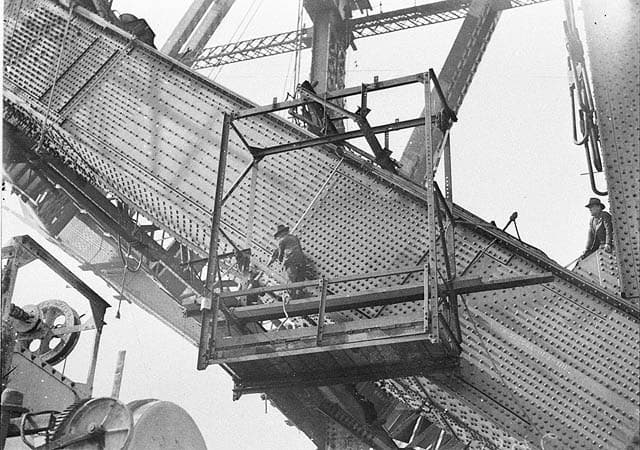
Steel Rivets Forged in a Nail Header
eftir Forge
Járnsmiður
26
0
0
0
1
0

Hættulegt
10% eignun
Making Red Lead (Minium) — The Pigment That Named the Art of Miniature Painting
eftir Charlie
LIST
117
0
0
0
2
0
Þessi teikning býr til
CC0 opinbert ríki
Þessi teikning er gefin út undir CC0. Þér er frjálst að afrita, breyta, dreifa og nota þetta verk í hvaða tilgangi sem er, án þess að biðja um leyfi.
Studdu smiðinn með því að kaupa vörur í gegnum teikningu hans þar sem hann fær þóknun smiða sem seljendur ákvarða, eða búðu til nýja endurskoðun á þessari teikningu og tengdu hana sem tengingu í þinni eigin teikningu til að deila tekjum.