

Paper Clip
A paper clip is a single piece of spring wire that holds sheets together by storing elastic energy in its own bends. Nothing is fastened, nothing is punctured, and the whole device works because the wire is trying to return to a shape the paper will not let it reach.
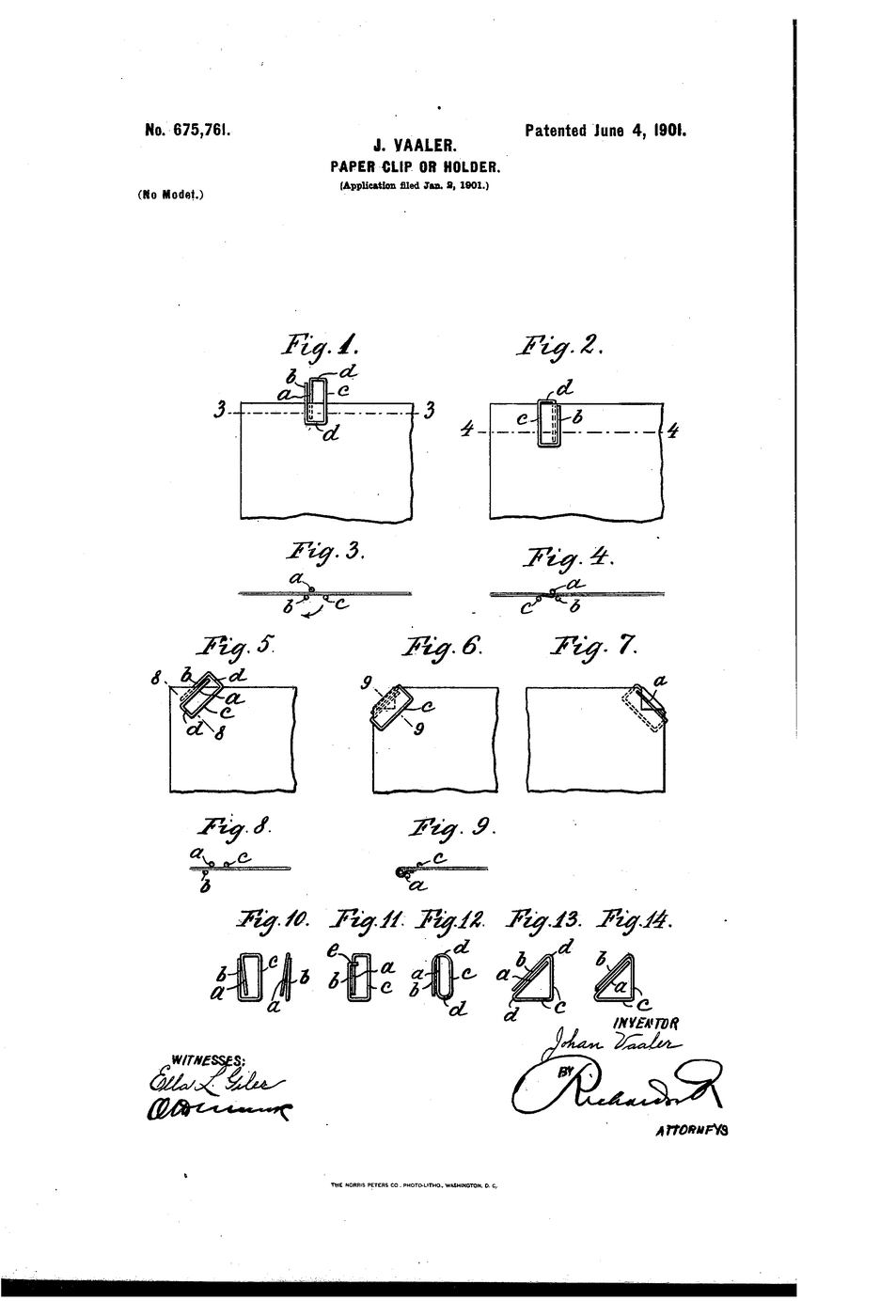
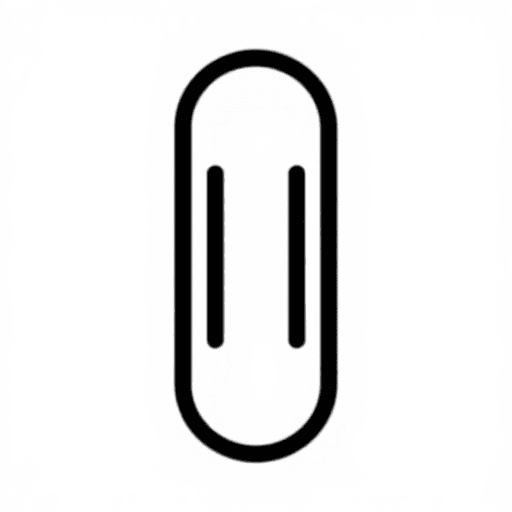
Vaaler's patented clip is a hoop with two tongues. You slide the sheets between the tongues and rotate the body about half a turn; the spring tension of the wire grips them. It is a real, granted, working design — and it is not the clip in your desk drawer.
US Patent 675,761, "Paper clip or holder", filed 2 January 1901 and granted 4 June 1901 to Johan Vaaler (1866-1910) of Norway. The clip everyone actually uses is the Gem, a double-oval already in production in Britain when Vaaler filed. Vaaler's design lacks the two full loops that make the Gem work, was never manufactured, and its inventor is nonetheless celebrated as the father of the paper clip — one of the best-documented mis-attributions in the history of design.
Leiðbeiningar
Read US 675,761 and note what is claimed
Read US 675,761 and note what is claimed
Vaaler claims wire "bent to a rectangular, triangular, or otherwise shaped hoop" with end parts acting as gripping tongues. Count the closed loops in his drawing — there are none.
Count the loops on a shop-bought clip
Count the loops on a shop-bought clip
Take an ordinary paper clip and trace the wire with a fingertip from end to end. It makes two full oval turns, one inside the other. This is the Gem geometry.
Cut two equal lengths of wire
Cut two equal lengths of wire
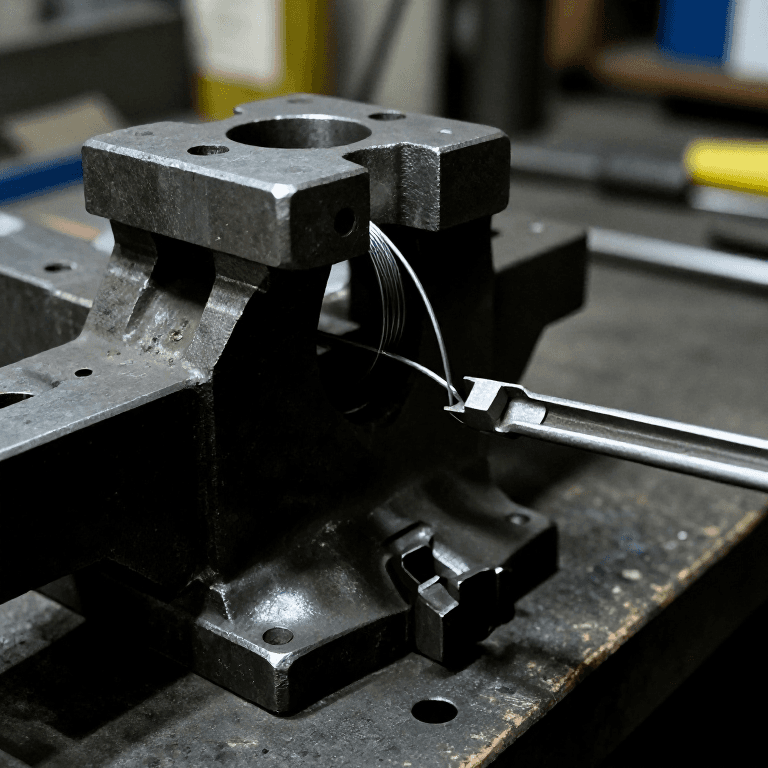
Cut 2 × 100 mm of galvanised steel wire. Equal lengths matter — the comparison later is only fair if both clips use the same amount of material.
Efni fyrir þetta skref:
 Sinkhúðaður stálvír1 metri
Nauðsynleg verkfæri:
 Flatkjaftatöng
Bend Vaaler's hoop from the first length
Bend Vaaler's hoop from the first length
Form a rectangular hoop about 30 × 12 mm, leaving both ends as straight inward-facing tongues that overlap the opening. Do not close the ends into loops.
Bend a Gem clip from the second length
Bend a Gem clip from the second length
Form an outer oval about 32 × 10 mm, then bend the wire back inside it to form a second, shorter oval. Both ends finish inside the outer loop.
Fit Vaaler's clip as the patent directs
Fit Vaaler's clip as the patent directs
Slide 5 sheets between the tongues, then rotate the body about 180°. The patent requires this twist — the clip does not simply slide on.
Fit the Gem clip by sliding it on
Fit the Gem clip by sliding it on
Push the same 5 sheets straight into the Gem. No rotation, no manipulation. Note how much less handling this takes.
Measure pull-off force for the Gem
Measure pull-off force for the Gem
Hook a spring scale to the clip and pull steadily along the sheets until it slips. Record the force in newtons.
Nauðsynleg verkfæri:
 Kraftmælir (gormvog)
Measure pull-off force for Vaaler's clip
Measure pull-off force for Vaaler's clip
Repeat identically on the hoop clip. Record the force. Same wire, same length, same paper.
Compare the two numbers
Compare the two numbers
The Gem holds harder. The two full loops give a longer sprung span and a wider contact line, so more of the wire's elastic energy ends up pressing on paper.
Test both on 20 sheets
Test both on 20 sheets
Increase the stack and refit both. Vaaler's tongues splay outward and lose grip; the Gem's outer loop opens elastically and keeps clamping.
Check both for paper damage
Check both for paper damage
Remove each clip and inspect the top sheet. The rotation Vaaler's design needs scores and creases the paper; the Gem leaves a light indent.
Fatigue both clips ten times
Fatigue both clips ten times
Fit and remove each clip ten times, then re-measure pull-off force. Note which one loses grip faster as its bends take a permanent set.
Write down which design you would sell
Write down which design you would sell
Record your own verdict from the four measurements before reading on. The historical answer and your bench answer should agree.
History & Context — the clip that was never made
History & Context — the clip that was never made
The patent. US 675,761, "Paper clip or holder", filed 2 January 1901 and granted 4 June 1901 to Johan Vaaler (15 March 1866 - 14 March 1910), a Norwegian who worked at an invention office in Kristiania. He had already secured a German patent, applied for on 12 November 1900 and granted 6 June 1901. Both grants are genuine. Norway had no patent law covering this at the time, which is why he filed abroad.
His clip is not the Gem, and the difference is the thing your measurements found. The Gem-type clip — the double-oval everyone uses — was already being manufactured by the Gem Manufacturing Company in Britain before Vaaler filed, though it had not yet reached Norway, so he very likely did not know it existed. His design lacks the two full loops. That is not a cosmetic difference: the loops are what let the clip be pushed straight onto a stack, what give it a long enough sprung length to accommodate varying thickness, and what stop it from scoring the paper. Vaaler's has to be twisted into place. He probably obtained his patents at all because patent authorities of the period were liberal and rewarded any marginal modification of an existing idea.
How the myth started, precisely. This is unusually well documented. In the 1920s an engineer from the Norwegian patent agency travelled to Germany to register Norwegian patents there, came across Vaaler's German patent, and failed to notice that it was not the common Gem clip. He wrote up Vaaler as the inventor of the paper clip in the agency's report on its first fifty years. From there the claim moved into Norwegian encyclopedias after the Second World War, and writers on Norwegian technological history took it up because it made a thin national story substantial. One misreading, in one report, by one person who was not looking carefully.
Why it stuck so hard. During the German occupation Norwegians wore paper clips in their lapels as a silent sign of resistance, after flag pins and pins bearing the cipher of the exiled King Haakon VII were forbidden. The clip became a national symbol of holding together, and a symbol that useful does not get fact-checked. In 1989 a giant paper clip was erected at Sandvika in Vaaler's memory — and the monument depicts a Gem-type clip, not the one Vaaler patented. The memorial to the wrong attribution is itself in the wrong shape.
Why this belongs in a blueprint at all. Vaaler did invent something, did patent it legitimately, and did not claim to have invented the Gem; the error was made about him, decades later, by people not reading the drawing. The honest version is more interesting than the myth: a working design that lost on the merits, and a national story built on a clerical misreading. If you did step 14 before reading this, you re-ran the 1901 commercial decision yourself, with a spring scale, and reached the same conclusion the market did.
Efni
1- 1 metriStaðgengill
Nauðsynleg verkfæri
2- Staðgengill
- Staðgengill
Efni úr tengdum teikningum

Þessi teikning býr til
CC0 opinbert ríki
Þessi teikning er gefin út undir CC0. Þér er frjálst að afrita, breyta, dreifa og nota þetta verk í hvaða tilgangi sem er, án þess að biðja um leyfi.
Studdu smiðinn með því að kaupa vörur í gegnum teikningu hans þar sem hann fær þóknun smiða sem seljendur ákvarða, eða búðu til nýja endurskoðun á þessari teikningu og tengdu hana sem tengingu í þinni eigin teikningu til að deila tekjum.