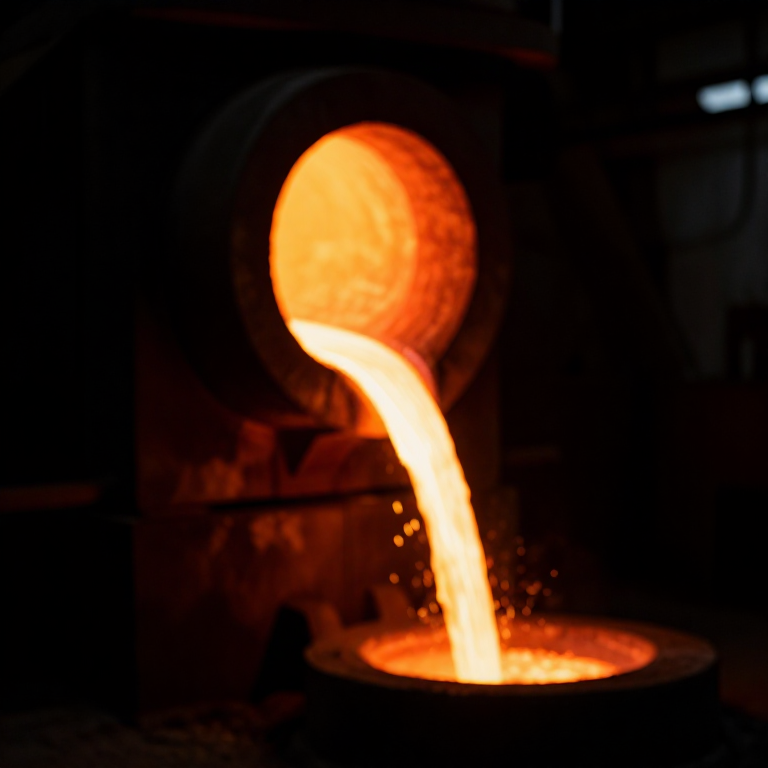


Smelting Pig Iron in a Coke Blast Furnace — Molten Iron at Industrial Scale
The bloomery gave the ancient world iron, but only in small spongy lumps, one slow batch at a time. The blast furnace changed everything: a tall shaft kept continuously charged and blown produces a steady river of molten iron. Where a bloomery never melts its metal, a blast furnace runs hot enough to liquefy iron entirely, letting it pool at the hearth and be tapped out by the tonne.
The key is heat and chemistry working together. A powerful air blast burns coke to carbon monoxide, which strips the oxygen from iron ore; meanwhile the descending iron soaks up carbon until it melts. Limestone added as flux carries off the stony impurities as a floating slag. What runs out of the tap hole is pig iron — iron saturated with about four percent carbon: hard, brittle, and perfect for casting or for refining into wrought iron and steel.
When coke replaced charcoal as the blast-furnace fuel in the early 1700s, iron could finally be made in unlimited quantity without consuming whole forests. Cheap pig iron became the raw material of the Industrial Revolution — the metal behind rails, bridges, engines, and machines.
Leiðbeiningar
Understand pig iron
Understand pig iron
Build the shaft furnace
Build the shaft furnace
Efni fyrir þetta skref:
 Eldfastur steinn80 stykki
Nauðsynleg verkfæri:
 Handskófla
Crush the ore and flux
Crush the ore and flux
Efni fyrir þetta skref:
 Þurrkað mýrarrauðajárn30 kg
 Kalksteinsflís8 kg
Nauðsynleg verkfæri:
 Hamar
HamarSet up the air blast
Set up the air blast
Nauðsynleg verkfæri:
 Smiðjubelgur
Light the coke bed
Light the coke bed
Efni fyrir þetta skref:
 Málmvinnslukox40 kg
Charge in layers
Charge in layers
Efni fyrir þetta skref:
Málmvinnslukox40 kgReduce the ore
Reduce the ore
Melt and carburize
Melt and carburize
Form and tap the slag
Form and tap the slag
Nauðsynleg verkfæri:
 Tappastöng
Tap the molten iron
Tap the molten iron
Nauðsynleg verkfæri:
TappastöngCast the pigs
Cast the pigs
Efni fyrir þetta skref:
 Mótasandur50 kg
Cool, break, and identify
Cool, break, and identify
Nauðsynleg verkfæri:
HamarEfni
5- 80 stykkiStaðgengill
- Staðgengill
- 8 kgStaðgengill
- 40 kgStaðgengill
- 50 kgStaðgengill
Efni úr tengdum teikningum

Tengd Blueprint
Þessi blueprint deila þekkingu — tækni, efni eða meginreglur


CC0 opinbert ríki
Þessi teikning er gefin út undir CC0. Þér er frjálst að afrita, breyta, dreifa og nota þetta verk í hvaða tilgangi sem er, án þess að biðja um leyfi.
Studdu smiðinn með því að kaupa vörur í gegnum teikningu hans þar sem hann fær þóknun smiða sem seljendur ákvarða, eða búðu til nýja endurskoðun á þessari teikningu og tengdu hana sem tengingu í þinni eigin teikningu til að deila tekjum.