

Logic Gates from Relays
Leiðbeiningar
Start from the telegraph relay
Start from the telegraph relay
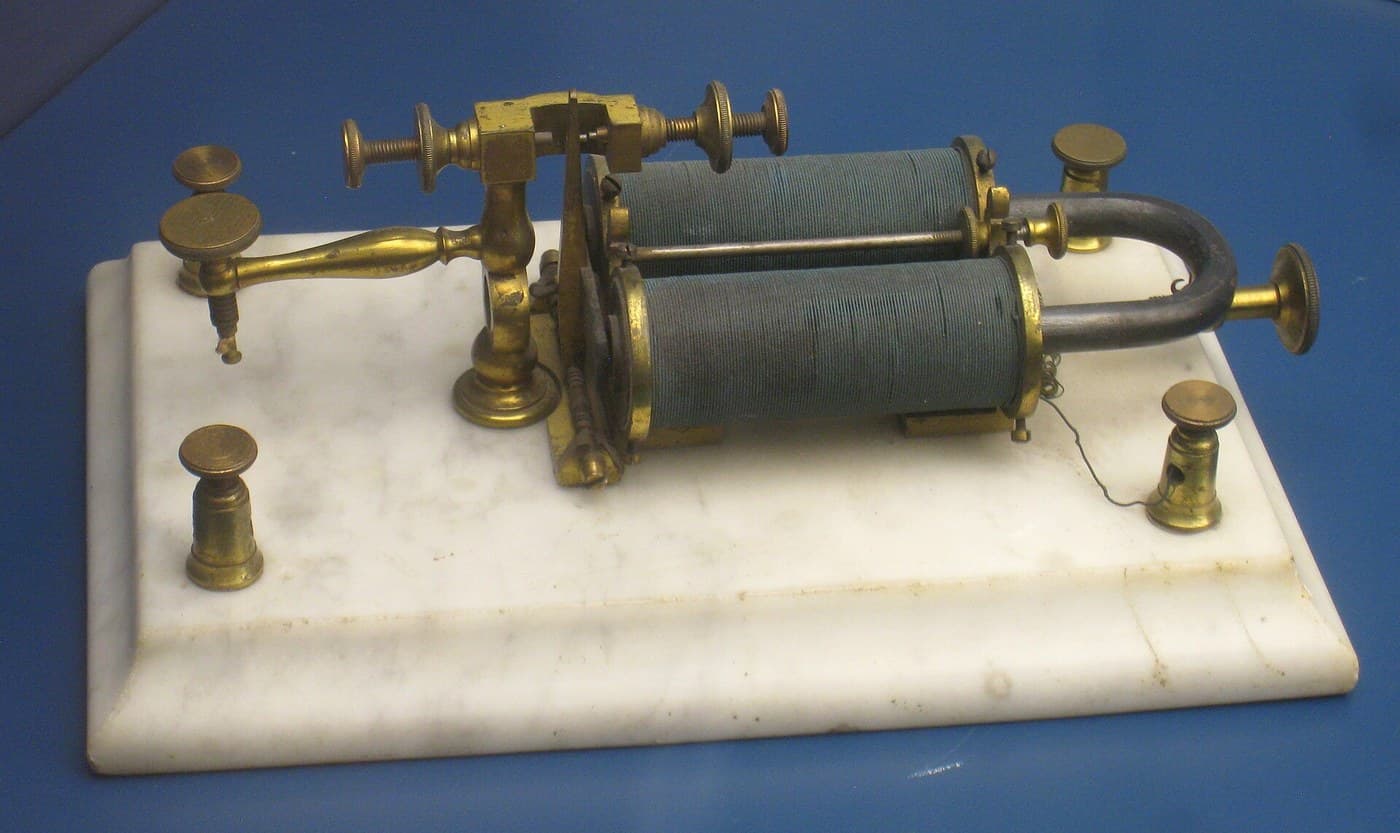
Build or re-read the relay first. It was invented to solve a completely different problem — a telegraph signal too weak to travel further, restored by using it to operate a local switch on a fresh battery.
Note the property that matters here and mattered not at all to its inventors: the thing that operates the switch is the same KIND of thing the switch controls. A lever needs a hand; a relay needs only another relay. That closure under composition is what makes logic possible, and it was sitting unused in telegraph offices for eighty years.
Wire AND, OR and NOT from contacts
Wire AND, OR and NOT from contacts
Three circuits, and every digital device ever built is made of them.
- AND: wire two relay contacts in SERIES between supply and lamp. The lamp lights only if both coils are energised.
- OR: wire two contacts in PARALLEL. The lamp lights if either coil is energised.
- NOT: use a normally-CLOSED contact. The lamp lights when the coil is NOT energised.
- Build all three and fill in a truth table for each by trying every input combination.
Series is AND, parallel is OR, normally-closed is NOT. That is Shannon's entire correspondence, and it is worth pausing on how unreasonable it is that a topology of wires should match an algebra of propositions.
Now the payoff: because it IS algebra, you can simplify circuits symbolically. De Morgan's laws say NOT(A AND B) equals NOT A OR NOT B — which means the same function can be built two different ways, and you pick whichever needs fewer contacts. Engineers had been optimising relay circuits by intuition; after 1937 they optimised them by algebra.Efni fyrir þetta skref:
 Liðari4 stykki
 Sett af LED-vísiljósum1 sett
 Viðnámasett1 sett
 Gataborð / frumgerðaborð1 stykki
 Tengivír1 reel
Nauðsynleg verkfæri:
 Lóðstöð
 Stafrænn margmælir í rannsóknastofugæðum
 Stillanlegur aflgjafi fyrir vinnubekk
 Tær öryggisgleraugu
Build the same logic as blocks
Build the same logic as blocks
Blockly vinnusvæði
Loading Blockly workspace...
Nauðsynleg verkfæri:
 Borðtölva
Simulate, simplify, and count the contacts
Simulate, simplify, and count the contacts
Nauðsynleg verkfæri:
BorðtölvaMeasure the switching time, and find the ceiling
Measure the switching time, and find the ceiling
Relay logic works perfectly and is slow. Measure exactly how slow, because that number ends the era.
- Drive a relay coil with a square wave and put the oscilloscope on both the drive and the contact output.
- Measure the delay from coil energising to contacts closing, and again for release.
- Watch the contact closure closely at high sweep speed.
- Chain three relays so each drives the next, and measure the total delay.
A relay takes something like 5 to 20 milliseconds to switch, and the contacts BOUNCE for a millisecond or two after closing. Chain them and the delays add, so a computation passing through fifty gates takes most of a second.
The bounce is its own problem: a single logical transition arrives as a burst of several, and any counter downstream counts them all. Debouncing exists because a mechanical contact does not close once.
So the ceiling is mechanical, not logical. The algebra is fine and the relay is honest; it simply has mass, and mass takes time to move. The escape is a switch with no moving parts at all — the vacuum tube, which switches in microseconds, and then the transistor, which does it without the heat. That is the rest of this batch.Efni fyrir þetta skref:
Liðari3 stykkiViðnámasett1 settNauðsynleg verkfæri:
 Sveiflusjá
 MerkjagjafiStafrænn margmælir í rannsóknastofugæðumStillanlegur aflgjafi fyrir vinnubekk
Efni
5- 7 stykkiStaðgengill
- 1 settStaðgengill
- frá$5.74
- 1 stykkiStaðgengill
- 1 reelStaðgengill
Tengd Blueprint
Þessi blueprint deila þekkingu — tækni, efni eða meginreglur

CC0 opinbert ríki
Þessi teikning er gefin út undir CC0. Þér er frjálst að afrita, breyta, dreifa og nota þetta verk í hvaða tilgangi sem er, án þess að biðja um leyfi.
Studdu smiðinn með því að kaupa vörur í gegnum teikningu hans þar sem hann fær þóknun smiða sem seljendur ákvarða, eða búðu til nýja endurskoðun á þessari teikningu og tengdu hana sem tengingu í þinni eigin teikningu til að deila tekjum.