
The Ring Spinning Frame — Continuous Yarn Production with Ring and Traveler
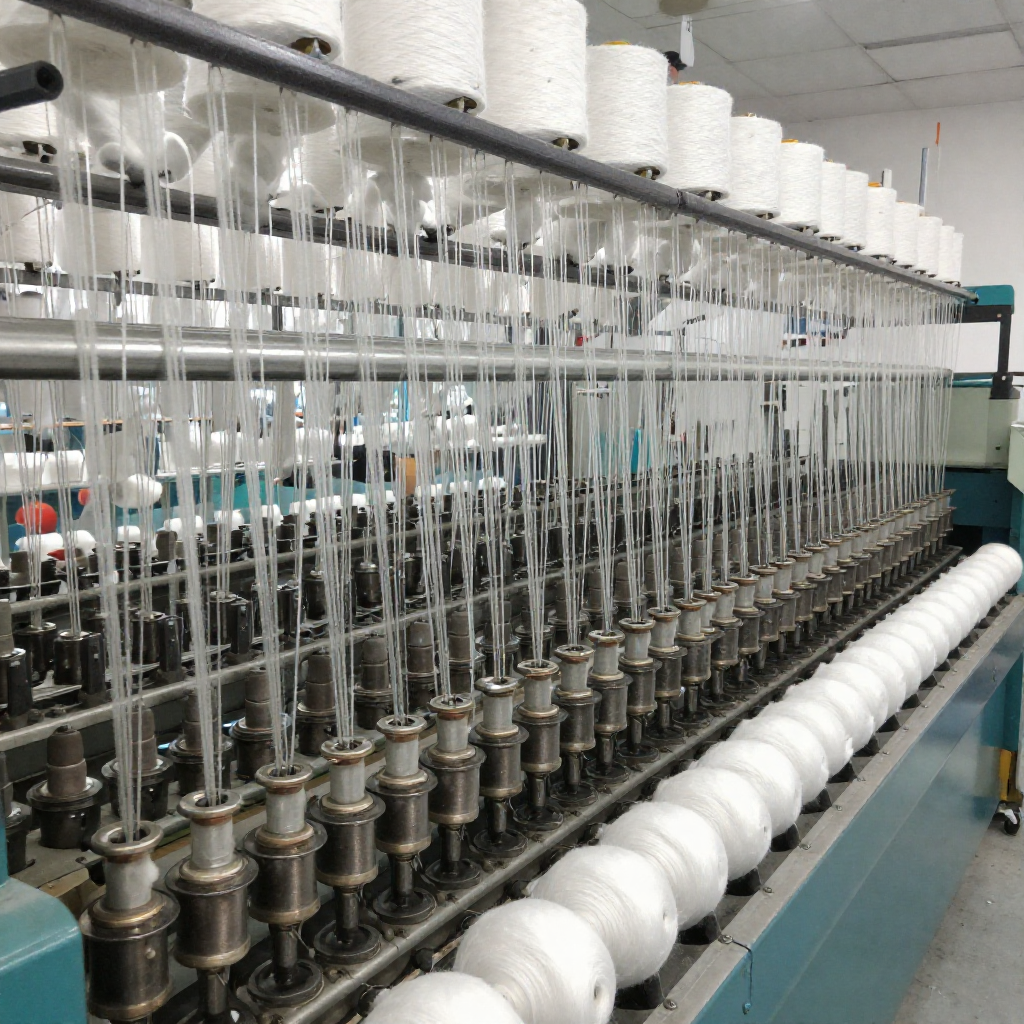
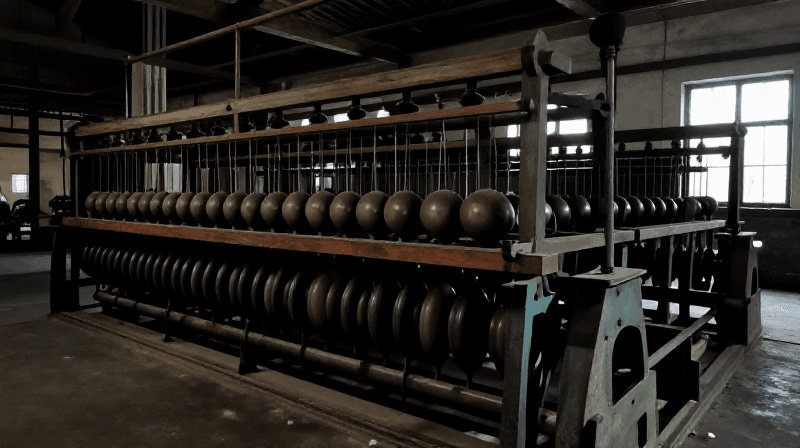
In 1828, American inventor John Thorp patented the ring spinning frame — a machine that spins yarn continuously without the intermittent stop-and-start motion of the spinning mule. The ring frame replaced the mule's movable carriage with a simple, elegant mechanism: a small C-shaped metal clip called a 'traveler' rides freely around a steel ring encircling each spindle. As the spindle turns at high speed, friction drags the traveler around the ring, simultaneously inserting twist and winding the yarn onto a bobbin.
The ring frame's genius is its simplicity. The mule required a complex carriage mechanism that drew outward to draft and spin, then pushed inward to wind — an intermittent process that demanded skilled operators and frequent maintenance. The ring frame drafts, twists, and winds all at once, continuously, with no moving carriage. This made it cheaper to build, easier to operate, and far more reliable. A ring frame could run at higher speeds with less-skilled labor.
Adoption was slow at first — the mule produced finer yarn, and Lancashire spinners resisted the change. But by the early 1900s, ring spinning dominated new installations worldwide, and today ring spinning produces over 80% of all staple yarn globally. The spinning mule was the virtuoso; the ring frame was the workhorse that outran it. Every cotton T-shirt, pair of jeans, and bed sheet you own was almost certainly spun on a descendant of Thorp's ring frame.
Leiðbeiningar
Prepare drawn cotton roving
Prepare drawn cotton roving
Begin with cotton roving that has passed through multiple drawing frames to produce an even, consistent sliver approximately 1 cm thick. The ring frame's roller drafting system reduces this further, but it cannot correct unevenness in the input — poor roving produces poor yarn. The roving is wound onto large bobbins mounted on a creel behind the machine.
Efni fyrir þetta skref:
 Bómullarlopi500 g
Thread roving through the drafting rollers
Thread roving through the drafting rollers
Feed the roving between three pairs of weighted rollers — back, middle, and front — each pair turning faster than the one before it. The speed differences draft the roving to the desired fineness. A typical draft ratio is 15:1 to 40:1 depending on the target yarn count. The roller spacing must exceed the longest cotton fiber length (typically 25–35 mm for upland cotton) to prevent fiber breakage.
Nauðsynleg verkfæri:
 Hringspunavél
Guide the drafted strand to the spindle
Guide the drafted strand to the spindle
The drafted fiber ribbon exits the front rollers and passes downward through a small wire guide (the pigtail or lappet) positioned directly above the spindle. The guide directs the yarn onto the spinning assembly below. The distance between the front roller nip and the guide is kept short to minimize the 'spinning triangle' — the vulnerable zone where untwisted fibers can break.
Understand the ring and traveler mechanism
Understand the ring and traveler mechanism
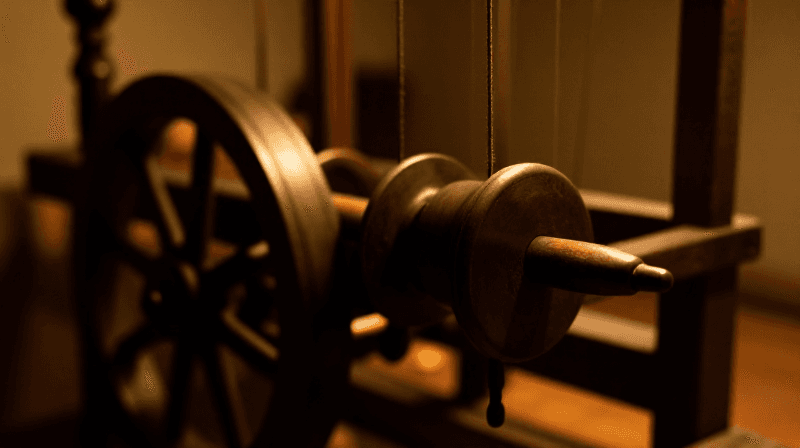
A steel ring (approximately 40–50 mm diameter) encircles each spindle, mounted on a ring rail. A tiny C-shaped metal clip — the traveler — sits loosely on the ring. The yarn passes from the lappet guide, through the traveler, and onto the bobbin mounted on the spindle. When the spindle turns, friction between the yarn and the traveler drags the traveler around the ring. This orbital motion inserts twist while the slight speed difference between spindle and traveler winds yarn onto the bobbin.
Start the machine at operating speed
Start the machine at operating speed
Engage the drive. All spindles begin rotating simultaneously — a modern ring frame has 400 to 1,200 spindles on a single machine, all driven from a common shaft. Spindle speeds on early ring frames reached 5,000–8,000 RPM; modern versions exceed 25,000 RPM. Each traveler begins orbiting its ring, inserting twist into the yarn flowing continuously from the drafting rollers above.
Observe continuous spinning in action
Observe continuous spinning in action
Unlike the mule's intermittent draw-and-wind cycle, the ring frame operates continuously: rollers draft, the traveler inserts twist, and the bobbin winds — all at the same time, without stopping. This is the ring frame's fundamental advantage. There is no carriage to push out and pull back, no pause between spinning and winding. Output per spindle per hour is significantly higher than a mule of equivalent count.
Watch the ring rail build the bobbin
Watch the ring rail build the bobbin
The ring rail — the horizontal bar holding all the rings — moves slowly up and down during operation. This distributes the yarn in even layers along the bobbin length, building a cone-shaped package called a cop. The ring rail's vertical stroke shortens slightly with each layer, creating the tapered cop shape that allows clean unwinding in subsequent processes.
Monitor twist insertion
Monitor twist insertion
The twist level in ring-spun yarn is determined by the ratio of spindle speed to delivery speed (how fast the front rollers feed drafted fiber). More twist per unit length produces stronger, harder yarn; less twist produces softer, loftier yarn. The ring frame produces a true-twist yarn with fibers spiraling uniformly around the core — a characteristic that gives ring-spun yarn its superior strength compared to later open-end (rotor) spinning.
Manage thread breakages
Manage thread breakages
When a thread breaks, the corresponding spindle continues spinning an empty bobbin. The operator (called a 'ring spinner' or 'piecer') must find the broken end on the bobbin, draw it back up through the traveler and lappet guide, overlap it with the emerging drafted fiber, and rejoin them. On a 500-spindle frame spinning medium-count yarn, breakages occur several times per minute across the full machine.
Understand traveler selection
Understand traveler selection
The traveler's weight and shape critically affect yarn quality. A heavier traveler increases winding tension and produces a tighter bobbin but generates more friction heat; a lighter traveler reduces tension but may slip or flutter at high speeds. Travelers are consumable — they wear out from constant friction against the ring and are replaced every few days. Different yarn counts require different traveler weights, selected from manufacturer charts.
Doff the full bobbins
Doff the full bobbins
When the bobbins are full, the machine stops and all bobbins are removed simultaneously — this is 'doffing.' Empty bobbins are placed on the spindles, the yarn ends are re-threaded through the travelers and guides, and the machine restarts. On early frames, doffing was manual and took 10–15 minutes; automatic doffing mechanisms (developed in the 1950s–1960s) reduced this to under 2 minutes.
Wind the yarn from cops to cones
Wind the yarn from cops to cones
The small ring-frame bobbins (cops) hold only 50–150 grams of yarn each. In the winding department, yarn from multiple cops is wound onto larger cone-shaped packages (1–3 kg) on automatic winding machines. During winding, electronic sensors detect and remove yarn faults — thick places, thin places, and foreign matter — splicing clean yarn ends together. The wound cones are the final yarn package sent to weaving or knitting.
Compare ring-spun yarn to mule-spun yarn
Compare ring-spun yarn to mule-spun yarn
Ring-spun yarn has a compact, round cross-section with fibers tightly wound around the core in a helical pattern. Mule-spun yarn is softer and loftier because the mule's intermittent twisting creates a less uniform fiber arrangement. For most commercial applications — weaving, knitting, sewing thread — ring-spun yarn's consistent strength and evenness make it superior. The mule retained an advantage only for the very finest counts (above 100s) until it was finally retired in the mid-twentieth century.
Recognize the ring frame's lasting dominance
Recognize the ring frame's lasting dominance
The ring spinning frame is the most successful spinning machine ever built. It outlasted the jenny (obsolete by 1810), the water frame's flyer mechanism (absorbed into other designs), and the mule (last commercial units retired in the 1960s). Today, ring spinning accounts for roughly 80% of global staple yarn production. The remaining 20% uses open-end rotor spinning (faster but coarser) or air-jet spinning (faster still but limited to certain fibers). For yarn quality, the ring frame remains king — 200 years after Thorp's patent.
Efni
1- 500 gStaðgengill
Nauðsynleg verkfæri
1- Staðgengill
Efni úr tengdum teikningum
Arkwright's Water Frame — Roller-Drafted Warp Yarn by Water Power
eftir Tex
Textíll og leður
Crompton's Spinning Mule — The Machine That Made Fine Cotton Possible
eftir Tex
Textíll og leður
The Spinning Jenny — Multi-Spindle Yarn Production
eftir Tex
Textíll og leður
Þessi teikning býr til

Tengd Blueprint
Þessi blueprint deila þekkingu — tækni, efni eða meginreglur
CC0 opinbert ríki
Þessi teikning er gefin út undir CC0. Þér er frjálst að afrita, breyta, dreifa og nota þetta verk í hvaða tilgangi sem er, án þess að biðja um leyfi.
Studdu smiðinn með því að kaupa vörur í gegnum teikningu hans þar sem hann fær þóknun smiða sem seljendur ákvarða, eða búðu til nýja endurskoðun á þessari teikningu og tengdu hana sem tengingu í þinni eigin teikningu til að deila tekjum.