

Separable Fastener — The Zipper
Pull a zipper and nothing about it explains itself. Two rows of identical metal teeth go in, one continuous closed seam comes out, and the only moving part is a small slider with no catch, no latch and no spring.
The slider is a cam, not a clasp. Inside it is a Y-shaped channel with a wedge — the plough — dividing it. Pull one way and the two tape edges are guided together at an angle that forces each tooth down into the hollow of the tooth opposite, where it locks by geometry alone. Push the other way and the plough drives between the rows and levers them apart. The slider does no gripping; it simply steers.
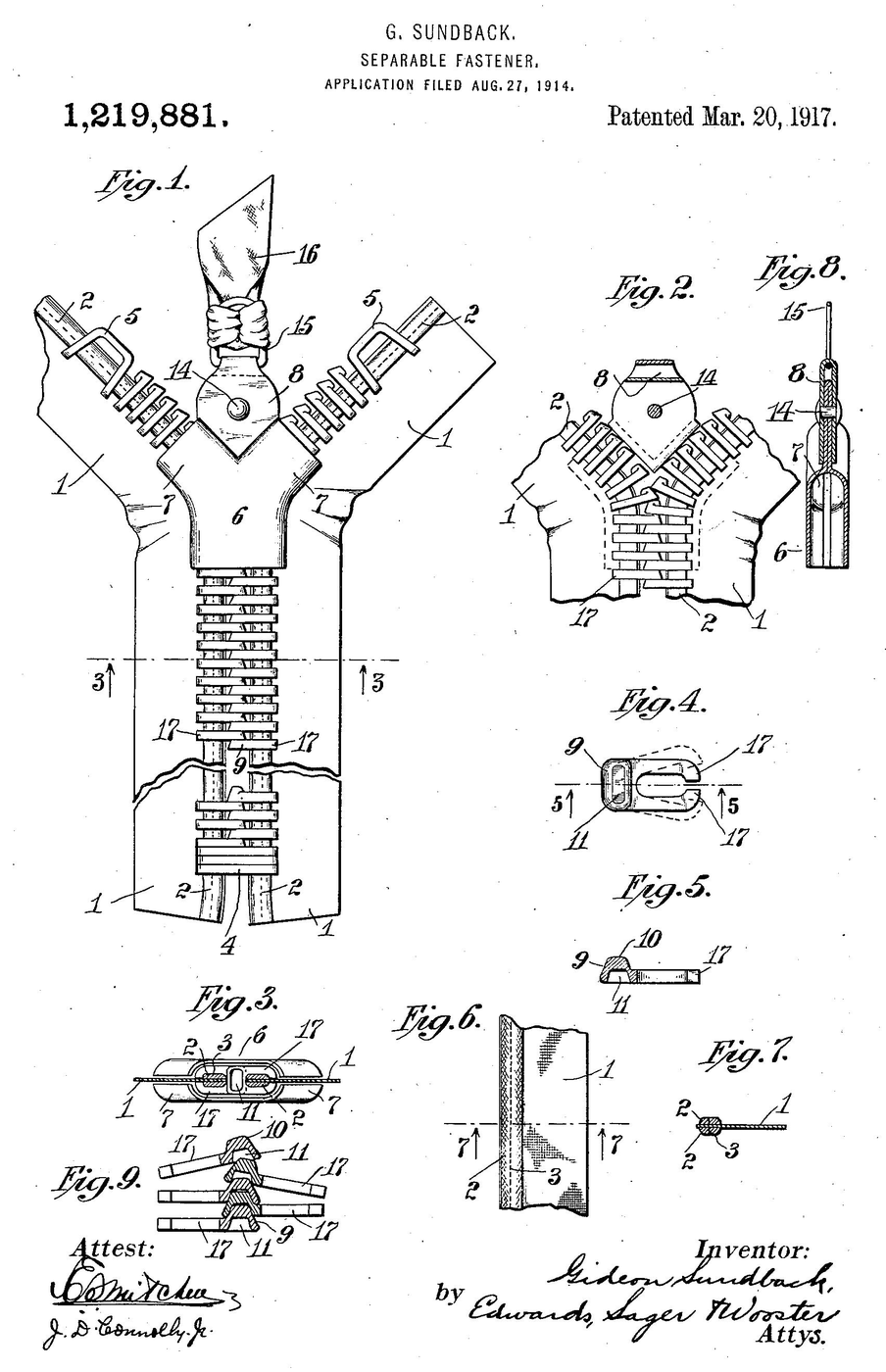
Gideon Sundback's US Patent 1,219,881, granted 20 March 1917, is where the version you own was fixed. The two decades of failed fasteners before it are the interesting part — because they failed for a reason you can build and feel.
Leiðbeiningar
Read the patent before you touch the sewing machine
Read the patent before you touch the sewing machine
Open US 1,219,881, filed 27 August 1914 and granted 20 March 1917. Sundback's own drawings show the tooth profile and the slider channel more clearly than any modern diagram.
Take a scrap zipper apart
Take a scrap zipper apart
Cut the stops off an old metal zipper and slide the pull right off the end. You now have the three separate parts the patent describes: two toothed stringers and one slider.
Nauðsynleg verkfæri:
 Rennilás
Look at a single tooth under magnification
Look at a single tooth under magnification
Every tooth has a nub on one face and a hollow on the other. That one asymmetry is the whole invention — the nub of each tooth sits in the hollow of the tooth from the opposite side.
Nauðsynleg verkfæri:
 Stækkunargler
Confirm the teeth are all identical
Confirm the teeth are all identical
Compare teeth from both stringers. They are the same part, not a hook-and-eye pair — which is exactly what Judson's earlier fastener got wrong.
Count the teeth per inch and measure the pitch
Count the teeth per inch and measure the pitch
Record the spacing. Sundback's key number was roughly ten teeth per inch — far denser than earlier fasteners, and density is what makes the closure continuous rather than a row of separate clasps.
Nauðsynleg verkfæri:
 Reglustika
Cut the slider open along its side
Cut the slider open along its side
Sacrifice one slider. File or cut through the outer wall so you can see down into the channel while it is still in one piece.
Nauðsynleg verkfæri:
 Málmþjöl
Find the plough inside
Find the plough inside
The wedge dividing the Y-channel is the plough. Trace how the two paths converge into one on the closing side and diverge into two on the opening side.
Work out that the slider never grips anything
Work out that the slider never grips anything
Nothing inside clamps. The slider only sets the ANGLE at which the two tape edges meet, and the teeth do the locking themselves. This is the point most explanations get wrong.
Model a tooth pair many times life size
Model a tooth pair many times life size
Cut two large nub-and-hollow teeth from stiff card or scrap sheet and interlock them by hand. Feel how they resist being pulled apart sideways but release freely when swung open.
Efni fyrir þetta skref:
 Kartonpappír2 plötur
Prove why the teeth must be on tape, not on cloth
Prove why the teeth must be on tape, not on cloth
Try flexing a stringer. The woven tape carries the tension along the row so the teeth stay in register — sew teeth to a stretchy fabric and they pull out of pitch and burst open.
Nauðsynleg verkfæri:
RennilásborðiFit both stops before you use it
Fit both stops before you use it
A zipper without a bottom stop simply runs off the end. The stops are not trim — they define the travel and hold the slider captive.
Sew a zipper into a test seam
Sew a zipper into a test seam
Baste first, then stitch close to the teeth with a zipper foot. Keep both tapes under equal tension — an unevenly sewn zipper drags forever after.
Efni fyrir þetta skref:
 Bómullarþráður10 metrar
Nauðsynleg verkfæri:
 Saumavél
Diagnose a zipper that opens behind the slider
Diagnose a zipper that opens behind the slider
This is the classic failure and it is almost never the teeth. A slider whose walls have spread stops forcing the teeth fully home — squeeze it gently back and it usually closes properly again.
Test what actually breaks it
Test what actually breaks it
Load a closed zipper sideways across the teeth and then lengthwise along the tape. It is enormously strong across the row and weak in peel — which is why zips fail at the ends first.
Compendium — twenty years of nearly working
Compendium — twenty years of nearly working
The patent and its date. Gideon Sundback filed on 27 August 1914 and was granted US 1,219,881, "Separable Fastener", on 20 March 1917, assigned to the Hookless Fastener Company. Sundback was Swedish-born, trained in Germany, and emigrated to the United States in 1905. The patent is titled for a fastener, not a zipper — the name "Zipper" was coined in 1923 by B. F. Goodrich for a rubber overshoe that used it, and it named the sound, not the mechanism.
Why the earlier attempts failed. Whitcomb Judson patented a "clasp locker" in 1893 and showed it at the Chicago World's Fair, where it drew attention and almost no orders. His design used alternating hooks and eyes — two different parts that had to align perfectly — and it sprang open under load, jammed, and could not be laundered. Sundback's insight was to abandon hooks entirely: make every element IDENTICAL, give it a nub on one face and a hollow on the other, and let it interlock with its opposite number. Identical parts also meant a machine could stamp and clamp them onto tape continuously, which is what made the thing manufacturable rather than merely clever.
The slider is a cam. The Y-shaped channel with its central plough does two jobs with no moving parts: closing, it converges the stringers so each tooth is pressed into the hollow of the one opposite; opening, the plough wedges between the rows and levers them apart. Nothing latches and nothing springs. Because the lock is purely geometric, a zipper's strength across the row is very high — a closed zip resists a surprising sideways load — while its resistance to being peeled apart from one end is low, which is why failures start at the stops.
How it actually spread. It was not fashion. Zips went into military gear in the First World War — flying suits and money belts — then into boots and tobacco pouches. Clothing resisted for two decades, partly because a fastener that could be opened quickly was thought improper. The turn came in 1937, when French couturiers took it up and Esquire called it the "Newest Tailoring Idea for Men", pointedly noting that it avoided "the possibility of unintentional and embarrassing disarray". A twenty-year gap between a working patent and general adoption is normal, not exceptional, and it is worth remembering when judging any new mechanism by how fast it catches on.
Efni
2- 2 plöturStaðgengill
- 10 metrarStaðgengill
Tengd Blueprint
Þessi blueprint deila þekkingu — tækni, efni eða meginreglur
CC0 opinbert ríki
Þessi teikning er gefin út undir CC0. Þér er frjálst að afrita, breyta, dreifa og nota þetta verk í hvaða tilgangi sem er, án þess að biðja um leyfi.
Studdu smiðinn með því að kaupa vörur í gegnum teikningu hans þar sem hann fær þóknun smiða sem seljendur ákvarða, eða búðu til nýja endurskoðun á þessari teikningu og tengdu hana sem tengingu í þinni eigin teikningu til að deila tekjum.